A new chapter in A-Class catamaran racing is about to unfold on New Zealand waters. From 8 to 16 November, the Milford Cruising Club in Auckland will host the PredictWind A-Class Catamaran World Championships 2025, bringing together more than 55 elite sailors from eight nations. The combination of hydrofoiling rockets and fast displacement cats promises a week of high-speed competition and sharp tactical battles in one of sailing's most technically progressive classes.
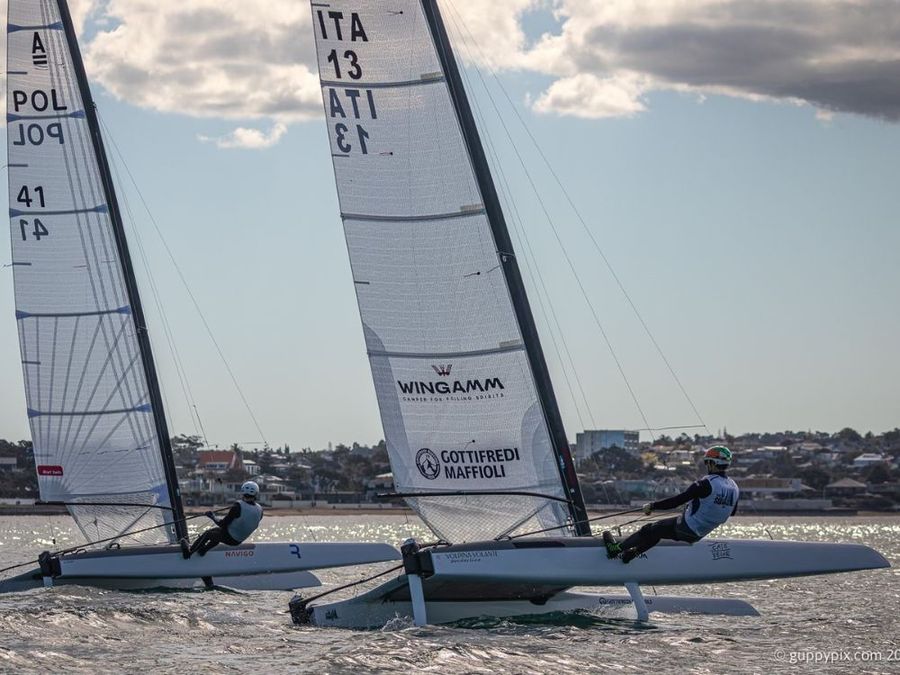
The A-Class traces its roots back to 1956, and in the decades since, the class has changed beyond recognition while staying true to a strict box rule. Each boat must fit within 5.49 metres in length, 2.3 metres in width, and weigh around 75 kilograms. Within those constraints, two very different types of boat now compete. When the A-Class Association introduced a dual-fleet format in 2018, it drew a clear line between the Classic fleet, which uses straight or constant-curve foils and races in displacement mode, and the Open fleet, where boats rise entirely clear of the water on hydrofoils. The format has allowed experienced sailors and traditionalists to stay competitive while the top end of the fleet pushes the boundaries of what a small cat can do.
The Open division provides the headline spectacle. Powered by just 13.94 square metres of sail, these boats can lift fully off the surface and punch past 35 knots. They demand absolute precision, exceptional fitness, and the ability to make split-second decisions, because errors in foiling mode can end a race almost immediately.
The Classic fleet is no slouch, either. Hitting speeds of 20 knots and beyond, these boats reward clean boat handling and sharp tactical thinking rather than aerobatic flair. When the breeze is light, their reduced drag becomes a genuine weapon, and when conditions build, their stability keeps them in the hunt. For a great many sailors, the Classic fleet strikes the ideal balance between outright speed and strategic depth. The two divisions together give the modern A-Class its distinctive character, pairing advanced foiling technology with a style of racing that remains firmly grounded in seamanship.
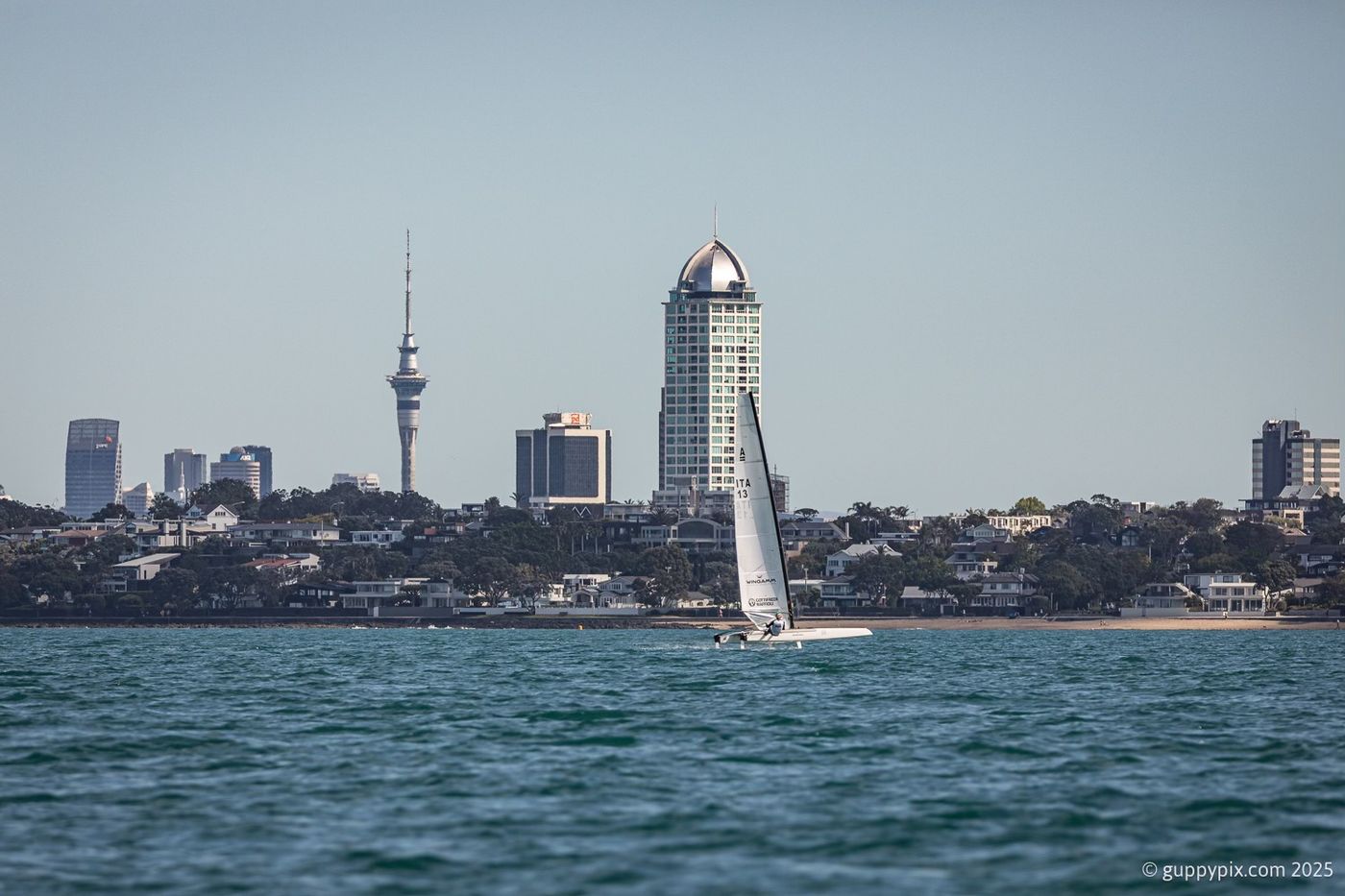
The Milford Cruising Club is a fitting home for a world championship. The century-old North Shore institution sits alongside Castor Bay, with golden sands, a generous lawn rigging area, and easy access to the Hauraki Gulf. Spectators can follow the fleet from Milford Beach or head to Rahopara Point, where the Open boats will be skimming across the gulf at serious speed. Inside the clubhouse, the race hub has already been humming with preparation, as volunteers, technicians, and local sailors get everything in order for the arriving global fleet. PredictWind is backing the event throughout the week, supplying precise weather forecasting, current data, and live race tracking for competitors and followers alike.
The quality of the 2025 field more than compensates for the absence of the record numbers seen at the 2024 Worlds in Italy, where 179 boats competed. Auckland has drawn world champions, Olympians, and America's Cup veterans. New Zealand's foiling charge is led by Dave Shaw (NZL 270), with Derek Scott, David Haylock, and Hamish Hall-Smith also in the Open fleet. In the Classics, Mike Drummond, John Kennett, and Pat Ashby carry the home nation's hopes and the advantage of knowing these waters intimately. From across the Tasman, Australia has again assembled a formidable contingent, headlined by multi-world champion Andrew Landenberger and Olympic medallist Darren Bundock.
In total, 55 boats will take to the water, 33 in the Classic fleet and 22 in the Open, representing Australia, New Zealand, Poland, the USA, Italy, the Netherlands, France, Spain, and Switzerland. A genuinely international gathering, assembled in the southern hemisphere for a week of focused racing.
The programme opens with a two-day Pre-Worlds series on 9 and 10 November, followed by a lay day before the main championship gets underway on 11 November and runs through to the 16th. Twelve races are scheduled across the week, with two discards applied and separate courses laid for each fleet. Wind limits have been set between 5 and 22 knots, a range that suits both Classic and Open sailing. Forecasters are pointing to moderate northeasterlies and manageable sea states, conditions that could play into the hands of the local sailors who know the Hauraki Gulf's moods as well as anyone.
The Milford Cruising Club team has put months of careful work into making this event worthy of its world championship status. When the starting horn goes on 11 November, Auckland will have every opportunity to remind the sailing world why it ranks among the great venues for the sport.