Halfway through Leg 2 of the 2026 Doyle Sails Round North Island Two Handed Yacht Race, the fleet is closing on the Taranaki coast and bracing for one of the most consequential tactical moments of the race: the rounding of Cape Egmont.
By Wednesday evening, the leading boats had tracked to just north of New Plymouth, entering the fourth day of racing in conditions that were notably gentler than anything crews had endured to that point. The opening stretch of the leg had been a bruising affair. Marc Michel, sailing the Dehler 30D Niksen, offered a frank account: "tough both with conditions in first 24–36 hours, wet and tough physically." With the wind easing, the contest has shifted to something altogether different.
"It's very much high stakes poker with weather and tactics now as we play snakes and ladders with the leading pack as we approach Taranaki."
Read more about Niksen and the Dehler 300D design below.
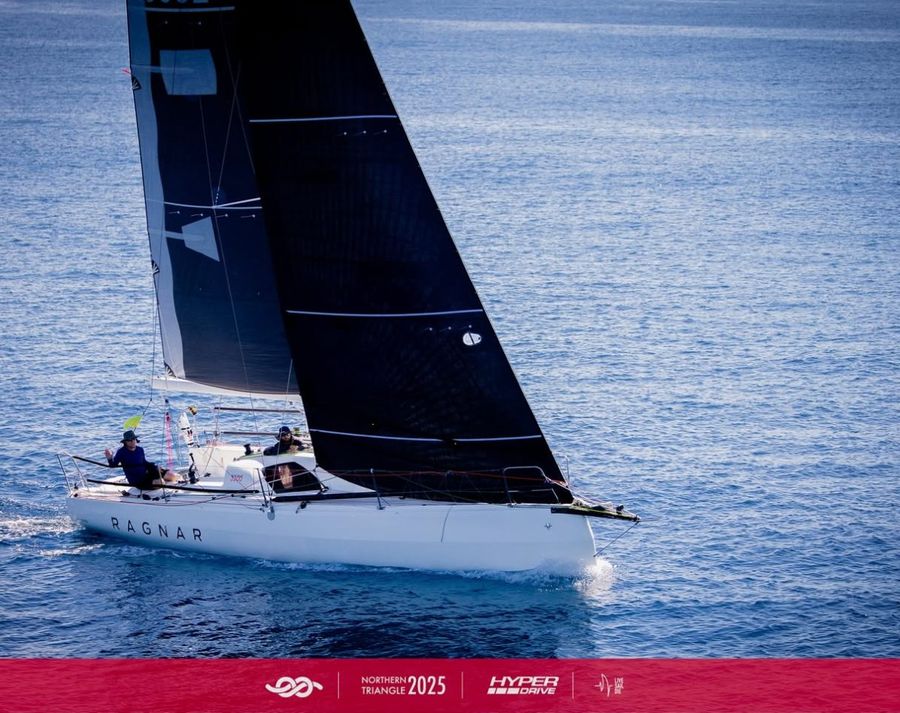
The fleet is spread broadly across the Tasman Sea. Furthest west, the Sunfast 3300 Ragnar, crewed by Brett Elliott and James Glidden, was sailing roughly 100 nautical miles northwest of New Plymouth in 8 to 9 knots of breeze. At the northern extreme, the Ross 8 C U Later, with Ben Sinton and Shaun Grigg aboard, sat approximately 180 nautical miles north northwest of the city. Closer to land, the Farr 1020 L'Avanti, sailed by John Power and Richard Power, was positioned about 13 nautical miles west of Manukau Harbour in stronger coastal breeze.
At the head of the fleet on line honours, the Elliott 50 Explore Racing, skippered by William Goodfellow and Jesse Turner, held a lead of a little over three hours on elapsed time, sitting approximately 53 nautical miles north of New Plymouth. The Thompson 1150 Motorboat III, under Damon Jolliffe and Josh Tucker, occupied second, while the Elliott 1350 Focus, skippered by Craig Fraser and Rob Croft, held third on the water.
Cape Egmont will demand careful thinking from every crew. Boats staying tight to the coast face variable winds ranging from 3 to 11 knots and swells of around 1.3 metres. Those willing to push further offshore find steadier breeze of 8 to 10 knots, though the swell builds slightly to around 1.5 metres. All crews must also navigate around the oil rigs positioned off the Taranaki coast.
On handicap, Division 3 boats currently dominate the overall PHRF standings, with the Elliott 1050 Kick, helmed by Brendan Sands and Ben Roff, holding the lead. Ragnar sits second and Niksen third, with just two minutes separating those two on estimated corrected time.
Within Division 1, Motorboat III leads on PHRF ahead of the Stomp 38 Perfect Storm, sailed by Ken and Lori Ormandy, and the Cookson 47 High 5, crewed by Bernie Hyde and Thomas Hyde. Division 2 is fronted by the Dehler 41 Äkonga, skippered by Nick Roberts and Max Livingstone, while Focus and the Pogo 36 Pipi, helmed by Steve Newcombe and Craig Parker, remain locked in a close fight for the positions behind. In Division 4, the Elliott 10.66 Carpe Diem, helmed by Rowan Smith and Lydia Boyd, leads the way, with C U Later second and L'Avanti third.
Cook Strait still lies ahead, and the decisions made around Taranaki carry real weight. The leaderboard could look very different by the time the fleet reaches Queen Charlotte Sound.