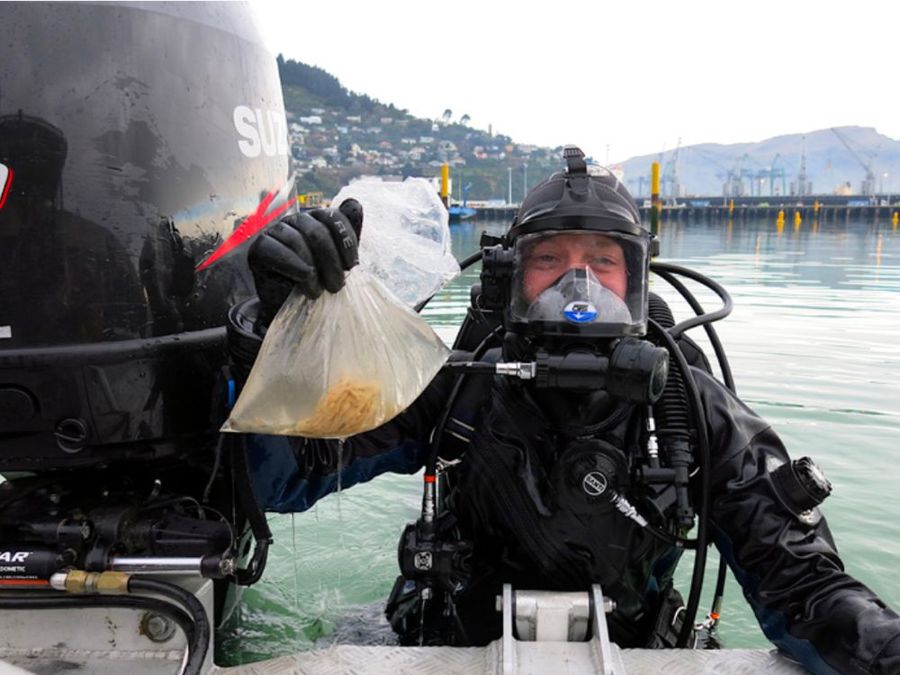
New Zealand's coastline has long acted as a gateway for marine species arriving on vessel hulls, in ballast water, and through the constant movement of traffic across the country's ports and harbours. For anyone not closely acquainted with the work involved in managing this risk, the sheer scale of the challenge can be difficult to grasp. The marine environment is vast and enormously varied, and many of the organisms of greatest concern are small, cryptic, or easily confused with species that naturally belong here. Rather than relying on a single line of defence, New Zealand has built an interlocking biosecurity system in which public awareness, policy, science, specialist expertise, and innovation each support and depend upon the others.
Two programmes form the core of this system. The National Marine High-Risk Site Surveillance programme, widely known as the NMHRSS, conducts structured early-detection surveys at locations considered most likely to receive unwanted marine arrivals. The Marine Invasives Taxonomic Service, or MITS, supplies the scientific rigour needed to confirm what those surveys uncover. The relationship between them is no accident. It is the defining characteristic of how New Zealand's marine biosecurity functions at its most critical edge.

The NMHRSS programme operates across 12 high-risk ports and their associated marinas around the country, conducting survey work aimed at identifying non-indigenous and potentially invasive marine flora and fauna before they have any opportunity to establish. Special attention is directed at species already documented as causing significant harm in other parts of the world. Beyond this early-detection function, the programme monitors how populations of non-indigenous species already present in New Zealand are shifting and spreading, feeding that information into biosecurity planning at both national and regional levels.
Five species not yet recorded in New Zealand head the programme's priority watch list: the Northern Pacific sea star Asterias amurensis, European shore crab Carcinus maenas, marine aquarium weed Caulerpa taxifolia, Chinese mitten crab Eriocheir sinensis, and Asian clam Potamocorbula amurensis. Each is considered capable of causing serious harm to New Zealand's environment, economy, or societal values should it ever gain a foothold here. Four species already present in scattered locations around the country are also subject to ongoing monitoring: the Asian bag mussel Arcuatula senhousia, Australian droplet tunicate Eudistoma elongatum, Mediterranean fanworm Sabella spallanzanii, and clubbed tunicate Styela clava.
Since the programme began in 2002, it has completed 42 seasonal survey rounds across both winter and summer conditions. The results speak to the value of sustained, systematic effort: 24 species new to New Zealand have been detected, along with 268 range extensions of non-indigenous species already established here. Every confirmed detection has been reported promptly, with full taxonomic verification, to national and regional authorities, enabling incursion management responses across more than two decades of continuous operation.
Alongside these detections, the NMHRSS programme has produced something of equal worth: a skilled, experienced team of marine biosecurity specialists within Earth Sciences New Zealand, formerly known as NIWA. This group represents a standing national capability, available to support a wide range of marine biosecurity activities for both MPI and regional bodies. The participation of Māori partners, stakeholders, and national and regional authorities in survey work has further strengthened capability across the broader biosecurity network, distributing knowledge and deepening the relationships that prove important when a genuine incursion calls for a rapid, coordinated response.
Where the NMHRSS programme provides the eyes on the water, MITS provides the certainty behind what those eyes find. Taxonomic identification is rarely simple in the field. Specimens collected through active surveillance, as well as those arriving through general surveillance channels such as reports to MPI's exotic pest and disease hotline and online notification system, frequently turn up damaged, incomplete, or at life stages where confident visual identification cannot be relied upon. MITS receives these specimens and resolves the uncertainty, drawing on specialist expertise across a wide range of marine taxonomic groups and combining that expertise with molecular methods wherever required.
Every confirmed identification is entered into a dedicated database, building a body of institutional knowledge that future investigators can draw upon. In a country whose economy, culture, and biodiversity are as closely tied to the sea as New Zealand's, that record carries real weight. MITS is not an optional addition sitting at the margins of the biosecurity system. It is one of the system's foundational pillars.
The interdependence of these two programmes is absolute: neither functions properly without the other. Because NMHRSS surveys target organisms that appear unusual, unfamiliar, or out of place, the specimens forwarded for identification are precisely those most likely to be new to New Zealand or previously unrecorded here. Integrated taxonomic approaches, combining the judgement of expert taxonomists with molecular tools, are what allow those difficult specimens to be resolved with results that are reliable and defensible. Without that resolution, surveillance observations remain inconclusive. With it, they become evidence capable of supporting proportionate, timely biosecurity decision-making.
The pressures on this system are not easing. Vessel traffic continues to grow, shifting ocean conditions are enabling species to extend into ranges previously beyond their reach, and the demands placed on identification and diagnostic services will only intensify. Meeting those demands will require faster turnaround times, closer integration of traditional taxonomy with molecular methods, and reference services that decision-makers can trust when the consequences of error are serious. Continued investment in both the NMHRSS programme and MITS is how New Zealand keeps that capability sharp and ensures it can respond with confidence to whatever the future brings to its shores.
Dr Serena Keeler Marine Biologist, Marine Biodiversity Earth Sciences New Zealand
Dr Chris Woods Marine Ecologist, Marine Ecosystems & Biosecurity Earth Sciences New Zealand
Abraham Growcott Principal Adviser Aquatic Surveillance Diagnostic, Readiness and Surveillance Directorate Biosecurity New Zealand, Tiakitanga Pūtaiao Aotearoa Ministry for Primary Industries/Manatū Ahu Matua abraham.growcott@mpi.govt.nz