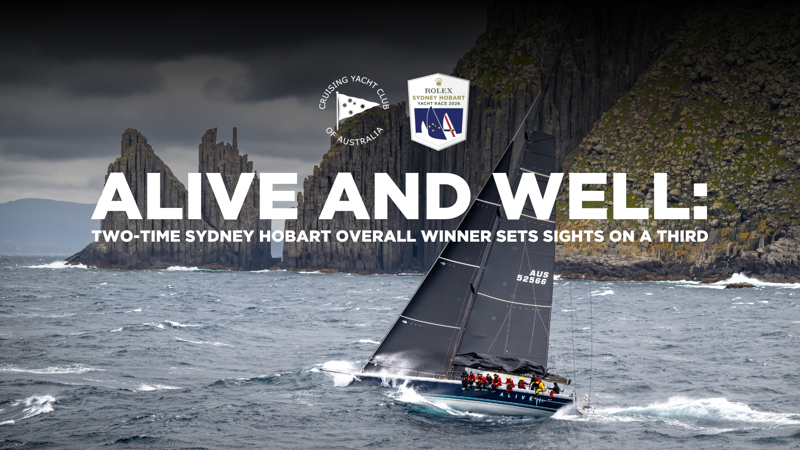

The fleet gathering for the 2025 Rolex Sydney to Hobart Yacht Race assembled under more stringent conditions than in recent editions, beginning with a Safety Briefing that made attendance compulsory for the first time. Sam Hayes, Commodore of the Cruising Yacht Club of Australia, opened the session this afternoon AEST to representatives drawn from the 129 boats entered in the 80th running of the race.
The mandatory attendance requirement was not a routine administrative update. It followed directly from what unfolded in the previous edition: two sailors lost their lives, a separate man overboard incident tested fleet response and rescue coordination, and the review that followed concluded that a shared baseline of understanding across the entire fleet had to be established before racing began. Weather interpretation, communications protocols, and safety procedures all needed to be covered with everyone present.
That backdrop shaped the briefing throughout. Last year's events were rarely named outright, but they informed how procedures were explained, how limits were set, and where emphasis was placed. The consistent underlying message was straightforward: reduce errors that do not need to happen, avoid compounding a difficult situation, and focus on sound execution over unchecked ambition.
The Bureau of Meteorology segment was built around interpretation rather than raw figures, which the briefing identified as a persistent source of offshore misjudgement.
Every wind speed figure published for the race is a ten-minute mean value, not a peak and not a ceiling. Gusts regularly exceed those figures, and squalls can push beyond them again. Crews were told plainly that reading a forecast number as a limit on what conditions will reach is among the most common errors made by offshore sailors.
Wave forecasts carry the same qualification. Published values represent significant wave height, which is the average of the highest third of waves recorded over a given period. Individual waves within that same window may reach roughly twice that figure. A two to three metre offshore forecast does not describe the largest wave on the course. It describes the statistical average of the upper portion of the wave spectrum.
For the opening stages of the race, a slow-moving high pressure system centred over Tasmania will dominate conditions. At the start, the fleet sits on the high's eastern flank, placing the course in a firm southerly flow. Winds in the low to mid twenties are expected once boats clear Sydney Heads, accompanied by a well-developed southerly swell running at around ten seconds period.

As the system moves east, conditions are forecast to ease through the 27th and 28th. Wind strength drops as boats approach the high's centre, with flow rotating gradually toward the east. For many in the fleet, that transition will influence routing through Bass Strait at least as much as outright boat speed.
The final approach to the Derwent presents a different set of challenges. South of Tasmania, residual southerly swell, a westerly component arriving from Southern Ocean latitudes, and locally generated wind waves are expected to converge near the Derwent approaches. Even in otherwise settled conditions, that combination can produce an awkward and unpredictable final run for finishing boats.
Toward the end of the forecast window, forecasters flagged the possibility of a low pressure system developing near Tasmania around the close of December. Model agreement on that scenario remains limited, but it carries the prospect of stronger winds and heavy rain. While many boats will have finished well before that point, delivery planning was clearly part of the discussion.
Offshore forecast access was addressed in practical terms. Coastal Water Forecasts now update four times daily and extend to 60 nautical miles offshore. Beyond that boundary, high seas products and ocean wind warnings are the appropriate tools. Text-based pages remain available for low-bandwidth connections, and HF radio and satellite broadcasts continue to carry warning information. The expectation was implicit rather than stated, but unmistakable: staying informed at sea is part of the crew's responsibility.
The start was treated as a distinct operational matter. Sydney Harbour will be subject to a controlled exclusion zone from midday, remaining active until the fleet has cleared the heads, supported by a substantial enforcement presence. A six-knot no-wash buffer surrounds the zone, and passive craft are excluded from the area. There will be no general recall. Individual recalls apply, with identification handled after the start rather than at the line. With an outgoing tide at high water adding another variable, the race committee identified fleet compression and closing speeds as factors requiring considered judgement from skippers rather than aggression.
Search and rescue guidance was presented without ambiguity. Every EPIRB or PLB activation is treated as a genuine distress event until confirmed otherwise, and assets will deploy regardless of what crews may intend or assume.
Specific technical guidance accompanied that message. Where conditions allow, EPIRBs should be deployed in the water and tethered to a life raft. PLBs should be worn high on the body with antennas upright. Crews were cautioned against multiple simultaneous activations unless physical separation makes them genuinely necessary, as overlapping signals can reduce homing accuracy.

Night operations received direct attention. Helicopter winching from yachts is not conducted after dark. Fixed-wing aircraft may assist with coordination, but crews must be capable of stabilising a situation until daylight allows direct rescue intervention.
Several regulatory changes take effect for the 2025 race. At least half the crew, including the person in charge, must have completed a qualifying race or passage aboard the specific yacht entered. Safety and Sea Survival certification is now required for sixty percent of crew members. AIS man overboard devices are mandatory in addition to personal locator beacons, and double-handed entries must carry two three-clip tethers.

IRC compliance inspections have been extended and may now occur before the race or up to twelve hours after finishing, with the Technical Committee empowered to initiate protests arising from those checks.
Satellite communications now sit at the centre of race management. Position reports via satellite SMS are mandatory twice daily within defined windows. Green Cape declarations must be made by satellite voice call using compliant fixed antenna systems. Crews using Starlink were specifically cautioned to confirm that testing is routed via satellite rather than cellular fallback, a distinction with real consequences once offshore.
The closing message was unadorned. The race will be physically demanding. Some crews will find it harder than anticipated. Some boats will not finish. The briefing made plain that the Sydney to Hobart is now managed openly as a complex offshore operation, and every entrant is expected to understand that and to operate within it.