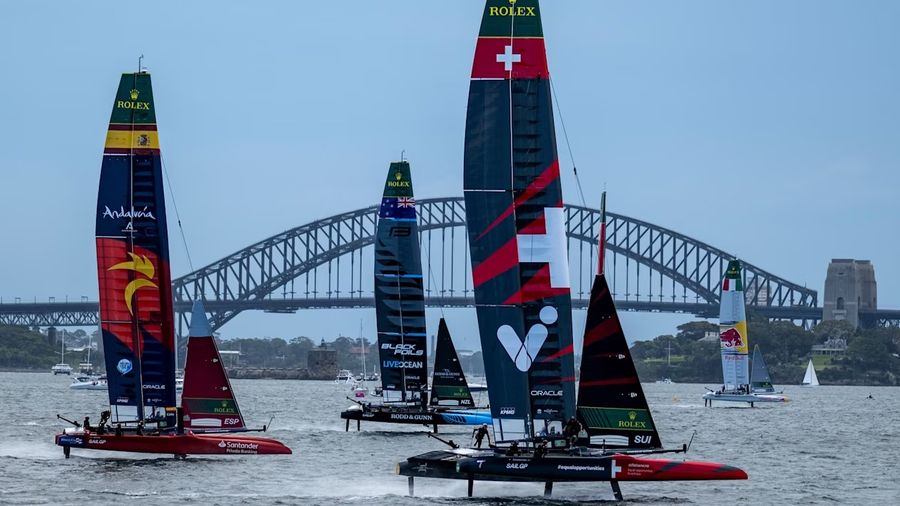
Sydney Harbour has a reputation for delivering one of two summer conditions. A reliable northeasterly sea breeze builds through the afternoon heat, or a southerly change sweeps in and rewrites the racecourse within minutes. At the KPMG Sydney Sail Grand Prix this weekend, neither scenario is likely to play out.
Heavy rain earlier in the week has given way to strong high pressure building across the Tasman Sea. The result is a moderate easterly flow settling over the Harbour, a direction that sits well outside the usual summer script and one that SailGP chief meteorologist Chris Bedford says will test the fleet in ways that are easy to underestimate.
“The course area isn’t really designed for an easterly. It’s better suited to a northeasterly or a southerly, so it will be interesting to see how the racecourse is configured, particularly on Saturday.”
Saturday's breeze is forecast to sit between 22 and 31 km/h. That represents solid, workable pressure rather than anything extreme, but the direction is where the real difficulty lies. An easterly puts land to the south in the upwind sector of the course, and that geography tends to produce disturbed air, patchy pressure, and shifts that arrive without much warning. On a foiling fleet travelling at speed, a small positional error can translate into a significant loss within seconds.
Bedford also pointed out that the unusual wind angle could strip away any advantage that comes from local familiarity.
“It’s possible that Saturday could catch teams out. Local knowledge may not be much of an advantage because this is a relatively uncommon wind direction for Sydney Harbour.”
With ocean swell unable to penetrate the Harbour at this angle, the water surface should stay flat throughout. That removes one variable while sharpening the focus on everything else. Positioning, the cleanliness of each manoeuvre, and the ability to read pressure lines ahead of rivals will be what separates the results. Survival sailing is not the challenge here. Precision is.
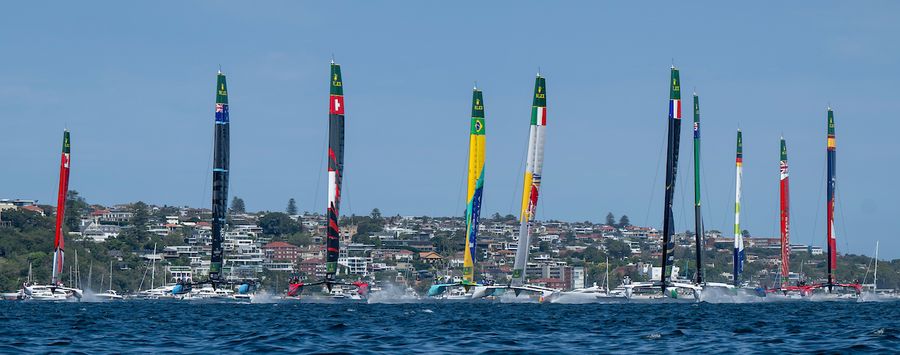
Should the course route around Shark Island, tidal flow becomes another factor for navigators to weigh. Committing to one side and holding that conviction tends to pay better than hesitating at a decision point. In conditions where shifts are subtle and unpredictable, a bold call made early is usually worth more than a cautious one made too late.
Sunday's forecast points toward a gradual swing back to the northeast. Whether that develops into the classic thermal sea breeze the Harbour is known for remains uncertain, and wind strength is similarly unclear, with conditions potentially matching Saturday or running slightly lighter. The direction alone should feel more comfortable to most of the fleet.
The weekend sets up as a mental exercise as much as a physical one. The teams that stay disciplined, maintain sharp awareness across both days, and identify the right moments to commit are the ones most likely to gain. For anyone watching from the shore or aboard a spectator vessel, that kind of racing tends to produce the most compelling spectacle.