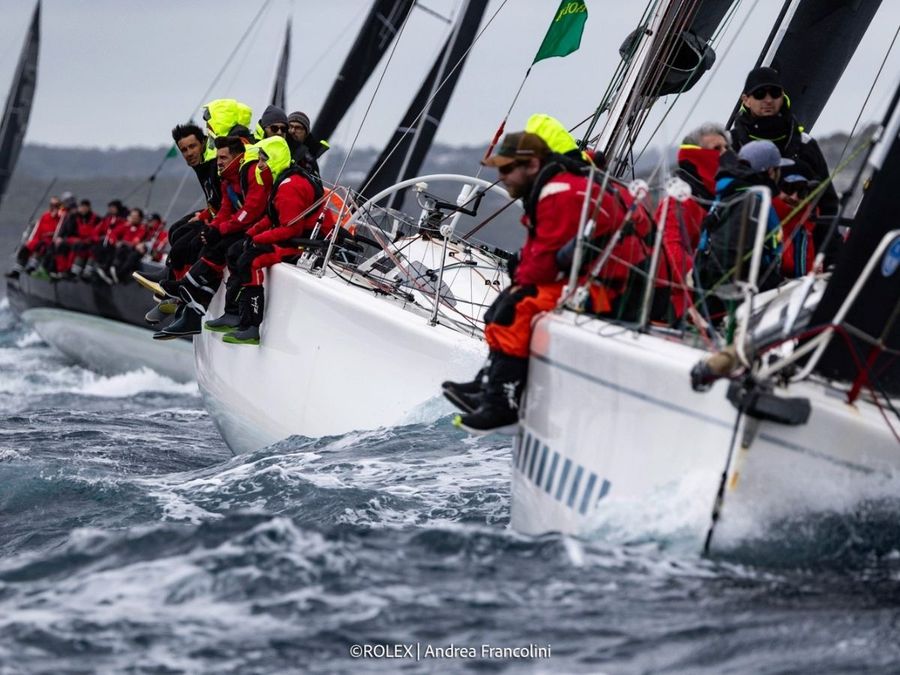
The 80th Rolex Sydney Hobart Yacht Race got under way in stiff winds and confined water, with conditions demanding respect from the moment the gun fired.
Inside Sydney Harbour, the breeze sat in the high teens and nudged 20 knots near the western channel pile. Sail selection across the fleet told its own story: smaller headsails dominated, and some crews had already tucked in a reef before the start. Nobody was racing for the crowd.
For the super maxis, depth restrictions imposed hard limits almost from the outset. Deep keels compressed the navigable water and raised the stakes around any mistake. The first turning mark arrived quickly, the second followed almost immediately, and within minutes the entire fleet was being funnelled hard toward the Heads.
Tide was a friend early on, allowing boats to gather pace faster than conditions alone might have permitted, and reaching sails were deployed almost as soon as racing began. Four start lines released the fleet without major incident, though congestion built rapidly beyond the leading group. Through the turning marks especially, lanes closed and traffic thickened.
The transition at the Heads hit sharply.
Wind dropped briefly in the shelter of the land, then the sea state rose fast. A short, disorganised swell brought lighter boats up short and kept heavier ones working hard just to stay balanced. Crews who cleared the exit cleanly were able to settle into a rhythm relatively quickly. Others spent longer fighting disturbed air and reflected chop before finding clear water.
From that point, the fleet began pulling apart.
LawConnect was first clear of the harbour, having timed the start well and controlled the run to the Heads ahead of Master Lock Comanche. It was the third consecutive year LawConnect had led the fleet out, a distinction earned through positioning and restraint rather than raw speed alone.
Lucky introduced a different early dynamic, starting further west and sailing a freer angle as the fleet spread seaward. Palm Beach XI took a measured approach, sailing upright and conservatively as the chaos of the start settled.
Behind the leaders, the race broke apart quickly into a series of smaller contests.
URM Group led Celestial V70 around the second turning mark with SHK Scallywag close in company, and throughout the broader fleet similar pairings were taking shape. Boats were racing whatever was nearby rather than worrying about what lay ahead.
New Zealand's influence ran quietly through this opening phase. Lucky and Callisto both carried something of a Kiwi identity into the race. Lucky, though American-owned, draws heavily on New Zealand crew and carries a strong Kiwi offshore heritage, including Brad Butterworth among her sailors. Her early pace and positioning pointed to a tightly run campaign, even if line honours was never a realistic ambition. Callisto, sailing under the New Zealand flag with Dean Barker aboard, carried a comparable experience base. A podium finish was always unlikely for Callisto barring something extraordinary later in the race, but through the first hour she showed clean sailing and sound decision-making, qualities that tend to hold their value as a Hobart progresses.
The Vixen Racing team rounded out the New Zealand presence in the fleet. None of these entries threaten the front of the race outright, but several are well positioned to remain relevant as the handicap picture develops over the days ahead.
Once the fleet was southbound, focus shifted to what was happening beneath the surface.
The East Coast Current was forecast to run strongly through sections of the course, and it entered the tactical equation almost immediately. Boats began committing to either offshore or inshore lanes earlier than might otherwise be typical, knowing that indecision could leave them boxed in with no good exit later. Patchy breeze near the Heads made those decisions harder, and several boats lost momentum early by finding themselves in poor lanes with no clean air to work with.
Through the middle and back of the fleet, the short sea was already grinding. Conditions demanded constant attention to trim and concentration just to keep boats moving at a respectable rate.
As the fleet reached Bondi, racing gave way briefly to something quieter.
Fifteen boats from the Cruising Yacht Club of Australia prepared to drop petals overboard in memory of the victims of the Bondi tragedy on December 14. Love & War was among them, carrying Grace Shipway on her first Hobart race. The tribute was carried out simply, without fuss, as the fleet kept moving south.
Within the first hour, the race had already moved fully into offshore conditions. The sea state was building, stronger breeze lay ahead, and both fatigue and breakage had become immediate considerations. At the front, control was the dominant theme. Everywhere else, clean air and sound judgement were the currencies that mattered most as the fleet settled into the long run south.