Wind is quietly working its way back into superyacht design conversations, and not just among traditionalists who never gave up on sails in the first place.
At The Superyacht Forum 2025, a panel titled Driven by Wind: Authentic innovation for a sustainable superyacht future tackled a question that sits awkwardly in an industry where 85% of the market is motor yachts. Can wind genuinely contribute to a more sustainable future for boats this size, without asking owners to give up comfort, convenience, or the freedom to cruise wherever they fancy?
The panel included Hermen de Jong, Innovation Manager at Royal Huisman, naval architect Wick Hillege of Dykstra Naval Architects, and Wim Verhoeff, Sales Director at Oceanco. Martin Redmayne, Chairman and Editor in Chief of the Superyacht Group, moderated, with the audience also taking part in the discussion.
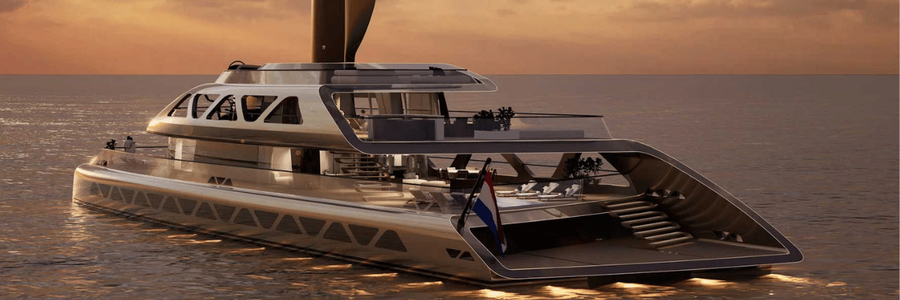
Royal Huisman's AERA concept, unveiled at last year's Monaco Yacht Show, featured heavily. It pairs a Rondal wing sail with a fuel cell powered retractable propulsion system on a multihull platform, blurring the line between sailing yacht and motor yacht so thoroughly that, in one sense, how it's categorised doesn't matter.
AERA follows a run of exotic, high-technology sailing yacht launches in recent years, among them Oceanco's DynaRig-equipped 107m Black Pearl, the similarly rigged Perini Navi 88m Maltese Falcon, and the rotating-masted 144m Nobiskrug sailing yacht A. Its purpose is different, though: AERA's primary objective is fuel reduction rather than outright independence from other fuel sources, putting it closer in spirit to commercial shipping's wind-assist push. A featured example was the VPLP-designed 120m RoRo ship Canopée, which transports Ariane rocket components from Europe to Guyana. Its four Oceanwings sails are said to save around 30% of the fuel that would otherwise be burned under diesel power alone.
The panel agreed that harnessing wind as one part of a portfolio of energy sources aboard offers the greatest opportunity for wider application.
Sail under rig, then hydro-generate to restore hotel load batteries for the next anchorage. Or design a rig primarily for propulsion assistance, saving fuel and freeing up the tankage and weight it would otherwise require for alternative gear such as fuel cells and batteries. Wind could also extend the range of electrically propelled vessels, potentially bridging the gap between fossil fuels and the emergence of viable new alternative fuel technologies.
One of the more unexpected ideas raised was the use of large kites, not just for propulsion assistance but with much wider application on virtually any motor yacht. Flown at heights of up to 1000m, kites of the scale a superyacht might carry can generate between 400 and 1000kW, in the range of a normal hotel load. The key requirements are enough space, weight capacity and strength in the bow section to handle and stow the kite. There are complications too: if used at anchor or in a harbour, the airspace would need to be closed, with consideration given to other vessels and infrastructure.
Wind generators got a more mixed reception. Common enough on smaller leisure yachts, they have little equivalent in the superyacht world. The panel raised concerns about the potential noise of larger wind generators, particularly in superyacht harbours where several installations might operate in a relatively small area, along with the amount of installation space required and how such generators might be stowed when not in use. The conversation didn't reach a firm conclusion, pointing to an area still open for innovators to tackle.
Ultimately, the panel kept circling back to the same sticking point: the customer. The industry can innovate all manner of solutions to harness the wind, but if the customer doesn't accept the idea of being on a vessel with a sailing rig, a kite or large wind generators, it will be hard to drive change through.
Some more traditionally minded owners will continue to tolerate the restrictions and costs that conventional sailing yachts and their crews impose. That doesn't mean these yachts can't benefit from the latest sustainable technology, as Vitters' forthcoming 68.9m fossil-free Project Zero demonstrates. But for a yacht of this kind to work effectively, the owner may need to accept that its design will dictate the cruising itinerary to some extent, not only because of wind direction and strength, but because hydro-generation only works effectively when underway, meaning a week or more at anchor may not be ideal. One suggestion raised was that, much as chase boats now accompany yachts, service tugs could move in to provide efficiently generated power and propulsive force for motherships when required.
For the majority of owners who don't want additional cost, complexity or a boat that heels underway, the panel floated other ideas. Younger members of superyacht-owning families are thought likely to put more pressure on older generations to support sailing and wind-generated energy. Combined with technologies such as DynaRig, where a yacht can move near-silently out to sea within minutes and the sails automatically feather once a modest level of heel is reached, key points of resistance might be overcome.
Motor yacht owners considering wind assistance will still be concerned about discomfort, complexity, extra crew skills, and the impact on build costs and deck space. Wing sails retrofitted atop elegant motor yacht superstructures may also simply look wrong to some eyes. One suggestion for keeping motor yacht owners happy while still capturing the benefits of wind was stowable rigs, deployed by crew during repositioning voyages between destinations, then hidden away when cruising with guests in local waters.
Education, as much as engineering, was seen as essential. The panel felt the industry needs to tell a better story about why owners should embrace rig systems that are affordable and easier to operate, with some feeling that large sailing yacht rigs have chased performance beyond what's needed for owners who simply want to cruise the world. A solid wing sail, by contrast, brings far less complexity, because there's no sail shape to control.
How fast the industry can innovate and educate, in equal measure, looks set to decide the pace at which wind-powered and wind-assisted superyachts move from concept to common practice.
The Superyacht Forum returns to RAI Amsterdam on 16-17 November 2026.