
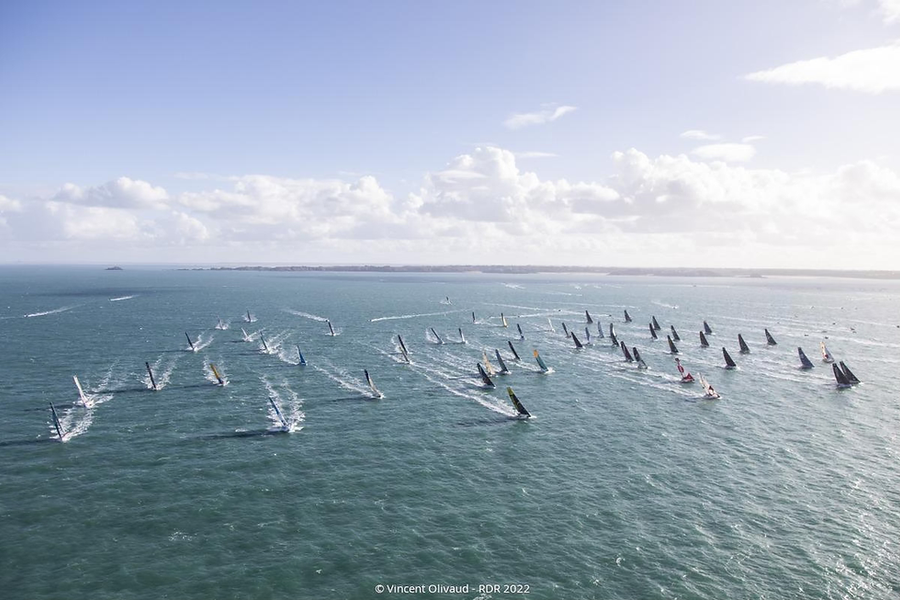
Race direction for the Route du Rhum has settled on a downwind start under blue skies this weekend, a rare treat after editions scarred by low-pressure drama. What follows across the Atlantic is shaping up rather differently.
High-pressure systems have swapped places with the lows this year, scrambling the usual November weather map entirely. The result is a fast, sunny departure and roughly 36 hours of pleasant sailing, but the absence of established trade winds means the fleet will be forced north of the Azores on a route riddled with uncertainty.
Winds of 8 to 11 knots from the north-east should make for a proper spectacle at the start. Fabrice Amedeo, racing FDJ United-Ocean Calling, summed up the mood: "We're not setting off with knots in our stomachs. Starting downwind is actually really nice. There's going to be beautiful light, good conditions. There's no stress." You'd need to go back to 2010 for the last downwind Route du Rhum start.
Not every class will have it easy rounding Cap Fréhel, 16 miles from the line. The Ultims, unlikely to be foiling in these conditions, face two gybes to get round. Sébastien Josse, technical director of Team Banque Populaire, called it "quite hard... it'll be a good half hour with two gybes and probably a sail change, with boats hitting 30 knots in the gusts. There'll be contact with other competitors, so plenty of concentration needed in a tight space."
Race direction has been watching the crossing points closely, particularly where Ocean Fifty and ORMA Vintage Multi boats gybing repeatedly might cross paths with IMOCAs taking a single tack to Fréhel from further south on the line.

Further west, conditions turn genuinely messy. A strong high sits over northern Ireland, another over Washington, while a depression near Greenland churns up the trade wind belt as far as the Tropic of Cancer. Jean-Yves Bernot, who routes SVR Lazartigue with Franck Cammas, didn't mince words: "It's a bit of a mess, frankly."
The early going should be quick regardless, with winds building to 20 knots and gusts to 25-30 knots by Monday, according to Cyrille Duchesne of Météo Consult. Ultims should be clearing the Azores by Tuesday evening, with speed records possibly falling across several classes. Skippers have packed extra layers for what promises to be a cold, dry slog rather than the usual trade-wind comfort.
"We're never going to drop into the warmth of the trades," warned Ambrogio Beccaria of Allagrande Mapei. "There's a small gift of weather at the start, but after that, no gifts. If you don't manage your track well, you can end up somewhere with far too much wind and sea."
From Wednesday, a depression forming near the Azores will complicate things further for the back half of the fleet. There's no clean route south this time. Nearly the entire fleet will be pushed north, more reminiscent of a transatlantic race to the United States than a traditional run to Guadeloupe.

Yann Eliès, who routes Upwind by Mer Concept and prepared the weather briefing for the Class40 fleet, put it plainly: "Even the most southerly routes pass north of the direct line, and at this stage none of those routes is a winner. The trade winds are down at Cape Verde, and to reach them you'd have to row there."
Yann Château, weather expert for race direction, didn't sugarcoat the gap between routing models and reality. Only 15 percent of ensemble model runs have the leaders arriving inside seven days. "The finish is going to be very uncertain, with big calls needed on how to approach the Antilles arc," he said.
Among the IMOCA fleet, Francesca Clapcich of 11th Hour Racing said the unusual weather pattern leaves little choice. "If there isn't really a trade wind heading south, there's no other option. We'll have to manage these low-pressure zones, the weather systems coming through. Every time we move west, we're forced to cross them. They arrive very quickly, you can't really surf them, so it's a different way of racing."
Arnaud Boissières, sailing April Marine, admitted he had been dreading the early stages more than what lies ahead. "I was really apprehensive about this start phase up to Cap Fréhel and then on to Ouessant. There's no trade wind, so at least we're sure of one thing: it's a northern route, it's beanies and oilskins, but we're trained for that. We're ready for it."
Tom Laperche, racing the Ultim SVR Lazartigue, said the picture beyond the Azores remains wide open. "It's quick until the north-west of the Azores, but after that it's more uncertain. There's almost no trade wind because there are more or less tropical depressions sitting well to the south. There can be strong wind for a short time and then nothing, so we'll need to stay opportunistic right to the end."