When John Brooke drew up the Sunburst in 1964, a national class was almost certainly the last thing on his mind. Yet the design proved far more enduring than even its creator might have anticipated. By the late 1990s, an estimated 5,000 Sunbursts had been built, with the class woven firmly into the fabric of New Zealand sailing and adopted for the inter secondary schools yachting championships. Thirty years on from that milestone, the Sunburst remains a living class rather than a museum piece.
Much of that vitality comes from the ground up. A dedicated Sunburst Facebook group has evolved into a practical hub for owners, sailors, and builders, where contributors share advice on everything from repairing ageing plywood hulls to sourcing fittings and commissioning new boats. Discussions about maintenance, restorations, and fresh builds appear regularly, reflecting the hands-on culture that has always sat at the heart of the class and confirming that the Sunburst remains entirely viable as a home-built or owner-maintained dinghy.
Brooke himself came from a long tradition of purposeful design. A trained engineer who began drawing boats as early as 1926, he applied an engineer's discipline to every project, producing craft that were inexpensive to construct, structurally reliable, and genuinely enjoyable to sail. The thread running through his entire career was accessibility: boats that allowed young people, and older ones too, to participate meaningfully in yachting without cost or complexity standing in the way. The Sunburst is the clearest expression of that philosophy, a compact two-handed centreboard dinghy suited equally to teaching beginners and to serious club and national competition.
At 3.5 metres (11 ft) in length, the Sunburst has become one of New Zealand's most popular dinghy classes. Although designed for two crew, it can be handled by a single sailor in light to moderate conditions, under mainsail alone or with mainsail and jib set. The standard rig carries a mainsail, jib, and spinnaker, meaning the boat can compete in both spinnaker and non-spinnaker configurations. Construction in wood or fibreglass is permitted, with class rules setting a minimum hull weight of 77 kg to ensure parity across build types. National Regattas are held annually, underpinning the class's long-standing role in grassroots and family sailing.
Brooke's ambitions ranged well beyond the dinghy park. From 1971 to 1985 he served as a director of Salthouse Brothers shipyard, and among the most significant achievements of his naval architecture career was the design of Spirit of Adventure, a youth training ship, completed in 1971 to 1972. In a gesture entirely consistent with his outlook, he refused payment for that work. That commitment to youth sailing gives the Sunburst much of its enduring relevance.
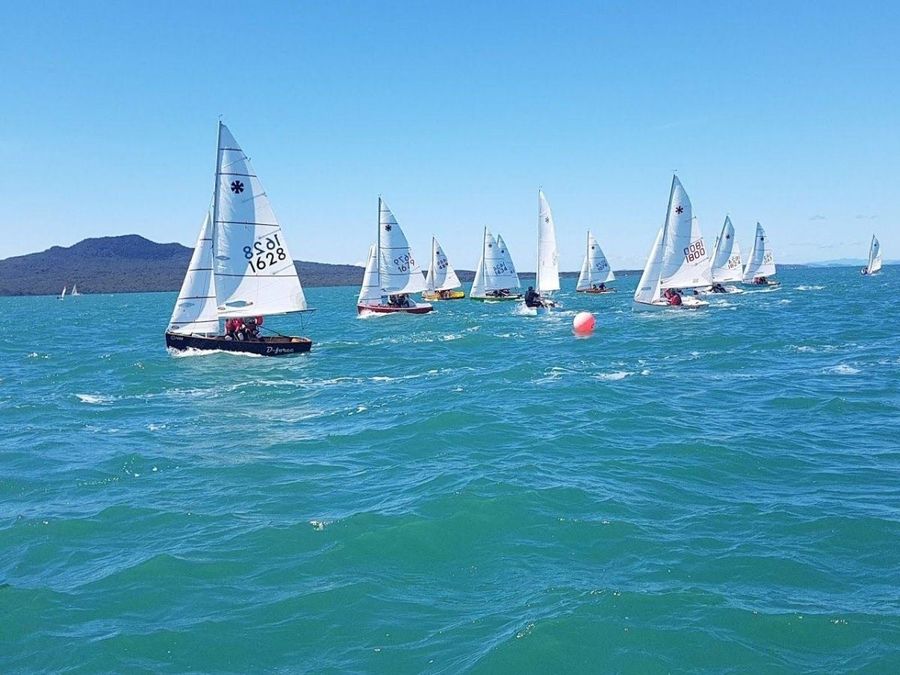
That legacy is back on the water this week with the 2026 New Zealand Sunburst National Championship, hosted by Wakatere Boating Club at Narrow Neck Beach. The regatta runs from Friday 16 January to Sunday 18 January, with 38 boats entered across three fleets: the Jack Brooke spinnaker championship fleet, the Taihoa non-spinnaker racing fleet, and a Cruising fleet. Competition opens with an Invitation Race on Friday, followed by two full days of championship racing across the weekend.
With entries spanning a wide range of build years all competing under tightly controlled class rules, the 2026 Nationals offer a practical demonstration of why Brooke's Sunburst design continues to hold its place in New Zealand sailing.