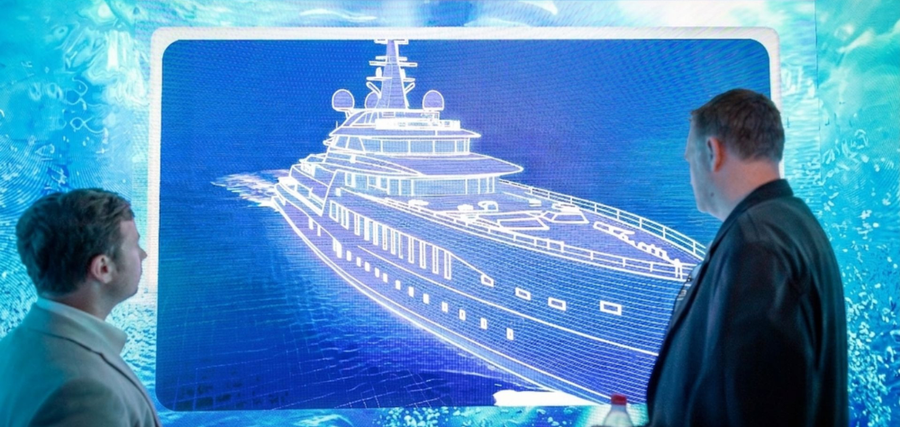
More than 120 superyachts are expected at Monaco Yacht Show this September. Inside the new Designer Gallery, though, some of the yachts exist only virtually.
There is no shortage of things to look at during Monaco Yacht Show.
Port Hercule fills with some of the world's largest private yachts, many of them open only to invited guests. More than 120 superyachts are expected in the Dockside Area this September, along with over 60 luxury tenders.
But there will also be yachts at Monaco that nobody can board. They haven't been built.
The show's new Designer Gallery will bring yacht designers and naval architects together from 23 to 26 September. Alongside it, technology specialist VBH will run an immersive experience using virtual yacht concepts.
For anyone interested in where yacht design is heading, it could be one of the more worthwhile stops at the show.
Step inside tomorrow’s superyachts
Reading yacht plans is a learned skill, and on a large custom yacht they can become complicated quickly.
A general arrangement will show where the saloon, cabins, stairways and machinery spaces sit. What is much harder is turning several decks of drawings into one mental picture.
You need to understand how spaces sit above and below each other, where the volume has gone and how people move between decks. Then there are the sightlines, proportions and connections between inside and outside spaces.
Naval architects and designers work with this information every day. Most owners don't.
Computer generated images make the design much easier to understand, and the yacht industry has become very good at them. Images released for new projects can look almost indistinguishable from photographs.
They still show the boat from viewpoints somebody else has chosen.
The MYS Immersive Experience takes that a stage further. Visitors will be able to move through virtual yacht concepts and experience their scale and proportions for themselves.
VBH is also working with sound, lighting and other sensory elements as part of the presentation.
There is a practical use for all this.
An owner considering a custom yacht is making decisions about spaces that may not physically exist for several years. Being able to experience a digital version gives them another way to judge those decisions. Perhaps a saloon feels smaller than expected. Maybe two spaces do not connect as naturally as they appeared on paper. A sightline that looked good in a rendering might be less convincing from another position.
Those are useful things to know before construction.
Familiar names in the Designer Gallery
The exhibitors announced so far cover quite different areas of yacht design.
Pininfarina is probably the best known outside the marine industry. The Italian design house works across automotive, transportation, architecture and industrial design, as well as yachts.
Hoek Design celebrates 40 years in business during 2026. André Hoek founded the Dutch studio in 1986, and it has become particularly well known for its sailing yachts. Its work includes the Truly Classic range and J Class designs.
Dixon Yacht Design has also been operating for more than four decades, with a long record in sailing yacht design. Where as, Hydro Tec combines naval architecture, exterior design and engineering. Explorer yachts form a significant part of its portfolio.
Van Oossanen Naval Architects comes at yacht design from the hydrodynamic end. The company specialises in naval architecture and marine engineering and developed the patented Fast Displacement Hull Form. Barracuda Yacht Design and Cor D. Rover Design are also confirmed for Monaco. Further exhibitors are due to be announced.
It is quite a range of disciplines to put in one place.
The person responsible for the exterior styling might get most of the attention, but there are naval architects and engineers working behind it. The yacht still has to perform properly once it leaves the marina.
A better look before the build starts
Using computers to design yachts is hardly new. What is more interesting here is giving the client greater access to the digital model. Plans remain essential. So do drawings, renderings and physical models. Immersive presentation adds another way of looking at the same boat.
For somebody accustomed to reading yacht plans, it may provide extra detail. For a first time client, being able to move around a virtual interior could make the design considerably easier to understand.
It also gives people a common point of reference. Instead of an owner, designer and builder each interpreting a drawing or rendering, they can look at the same space from the same position and discuss what works.
There is also the cost of changing things. Moving something on a digital model is one thing. Changing it after construction has started is another.
That does not mean every problem will suddenly be solved in a virtual environment. A digital model cannot reproduce how a yacht moves at sea, and it will never tell the whole story of living aboard.
It does not need to. If it helps an owner or designer identify a poor decision before the yard builds it, it has done something useful.
Step inside tomorrow’s superyachts at Monaco
The name may be new for 2026, but dedicated design spaces are already part of Monaco Yacht Show. The Yacht Design & Innovation Hub was introduced in 2021. Designers from the show's earlier Designer Gallery were later incorporated into that area.
For 2026, Monaco has brought the concept together again under the Designer Gallery name. Its position in the Dockside Area is particularly appropriate. Visitors can spend an hour looking through concepts and talking to designers, then walk outside and see what finished superyacht construction looks like at the highest level. There will be plenty to compare it with.
Monaco expects more than 560 exhibitors this year. Around 40 new yacht launches are also expected across the wider show.
The Designer Gallery offers the other end of that process, when the yacht is still a collection of decisions rather than a finished boat.
Could this reach everyday boating?
For most boat owners, custom superyacht design is another world.
The technology behind it need not be. Virtual product configuration is already familiar elsewhere. Car buyers routinely build a vehicle online, selecting wheels, upholstery, trim and equipment while watching the image change.
A boat is a more complicated proposition. There are cabins, heads, galleys, helm stations and cockpits to consider. Different layouts can change how the whole boat works, not simply how it looks. That arguably makes being able to explore your choices before ordering even more useful. A future production boat buyer could select a layout, upholstery, electronics and interior finishes, then walk through that particular configuration virtually.
Whether boatbuilders decide the cost is worthwhile is another question. Creating a convincing interactive model takes work, particularly when a range has numerous layouts and options.
At the premium end of the market, Monaco is giving the idea a serious outing.
When the show opens on 23 September, most visitors will understandably head for the docks. The Designer Gallery might be worth the detour. Some of the boats in there could turn up outside a few years later.
https://www.monacoyachtshow.com/en/designer-gallery-announcement-press-release