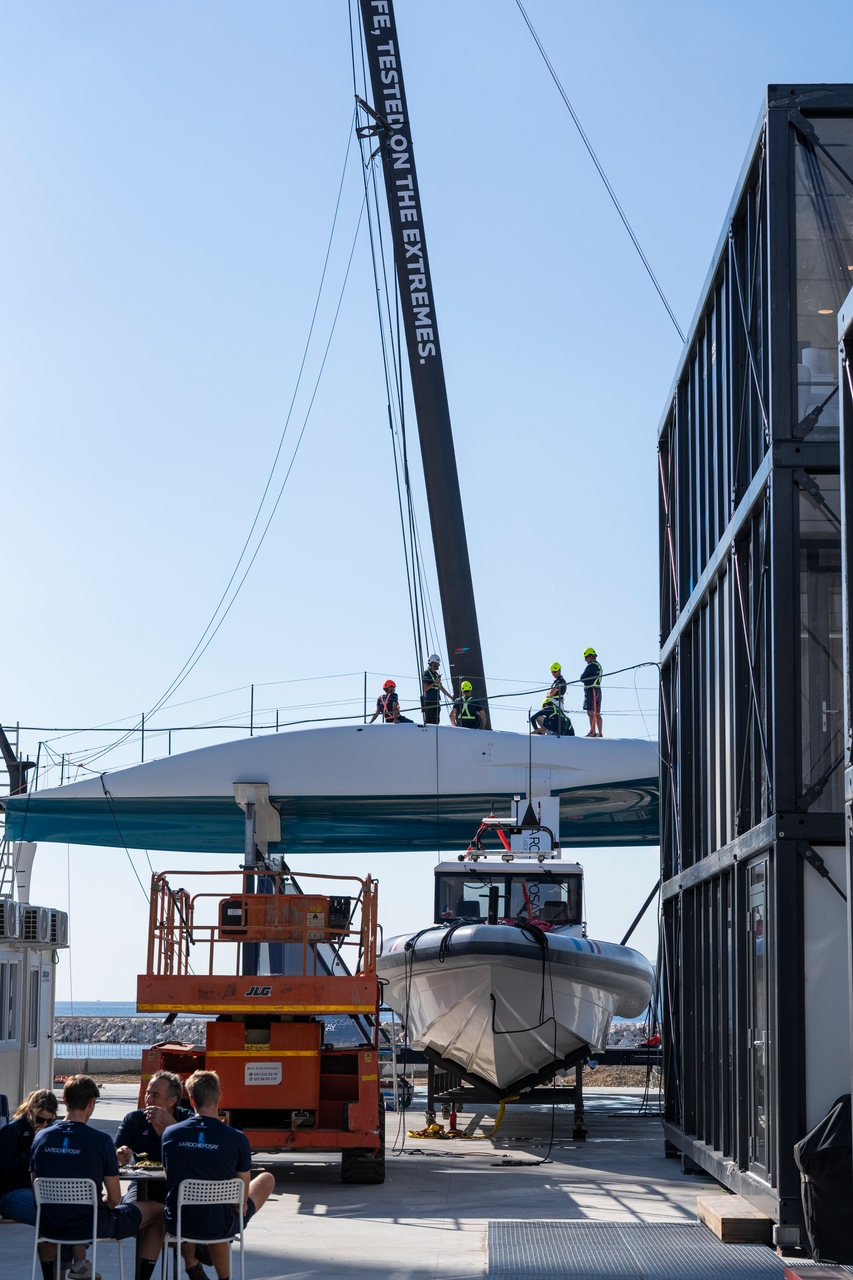
On the notification sheet, it was listed as a rig tune, nothing more. What unfolded on the dock at Bagnoli in Naples looked considerably more deliberate than that.
B1 rolled out of the shed around 12:15pm, under a clear sky with a light sea breeze filling in from the southwest through the early afternoon. The mast had been rolled out earlier, around midday, fitted with a load cell at each cap-shroud-to-mast fitting in place of the usual link. Nothing unusual there, except for what came next.
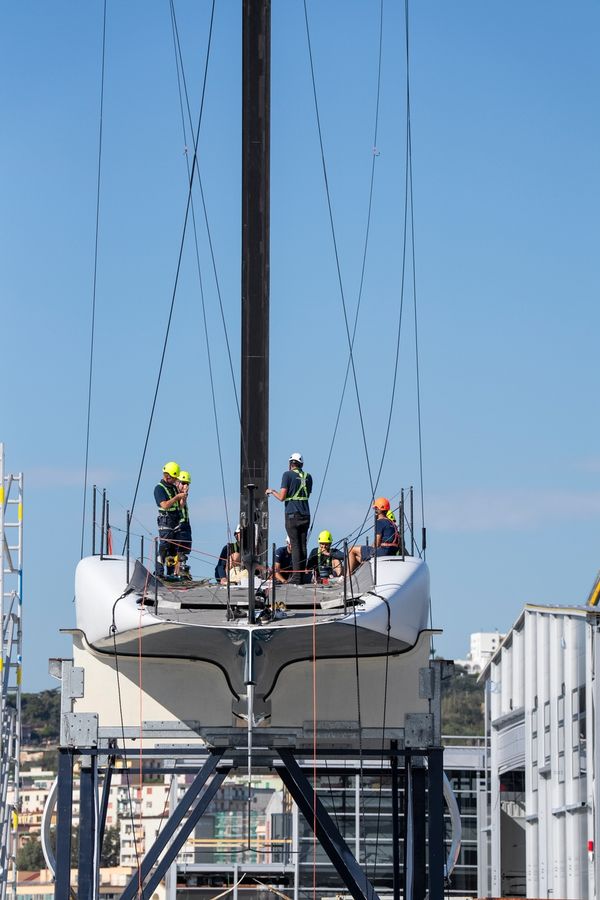
The lower shrouds were left slack through the entire session, while the mast sat with more rake than usual. That is the detail worth sitting on.
Normally the lowers help control the shape of the mast, particularly through the lower and middle sections. Leaving them soft strips away one layer of structural interference, making it far easier to isolate exactly how the mast responds to loading through the cap shrouds alone. It is not something a team does for a routine tune.
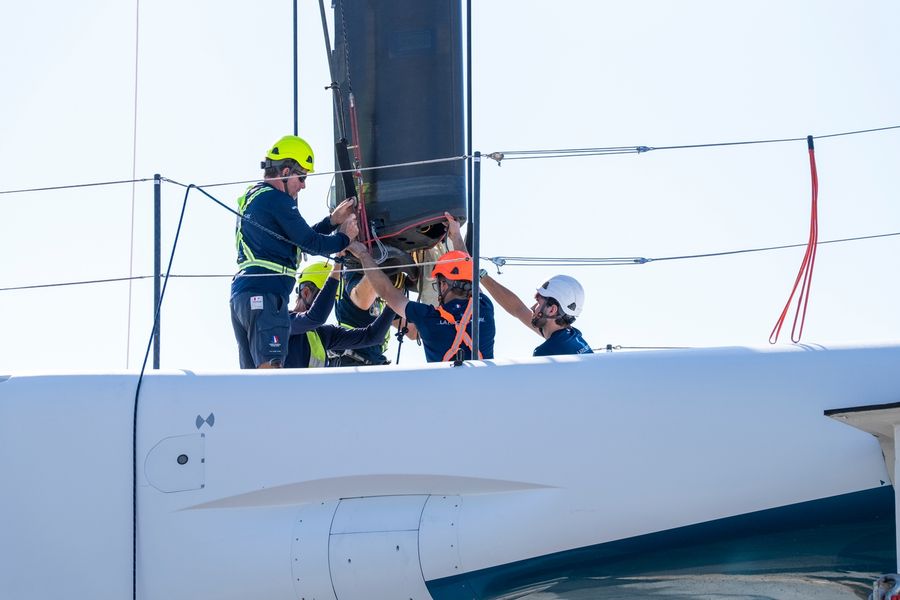
A shore crew member was hoisted up to the cap shroud fittings and stayed there for most of the session, reading numbers off a handheld display cabled to the load cells. At around 1pm, he held up both displays: 6,860 on the port cap shroud, 6,752 on starboard. The unit wasn't legible in the recon footage, but kilogram-force is the most plausible reading. If so, each cap shroud was carrying somewhere in the order of 66 to 67 kilonewtons of tension, a substantial load. The gap between port and starboard, about 1.6 percent of the average, is small enough to be unremarkable on its own.
What stands out more is that both shrouds were being measured independently and simultaneously, with Antoine Carraz, Antoine Rucard, the team member responsible for camera installation, and shore crew spending long periods crouched around laptops near the mast step. Quentin Delapierre joined the discussion on deck at one point.
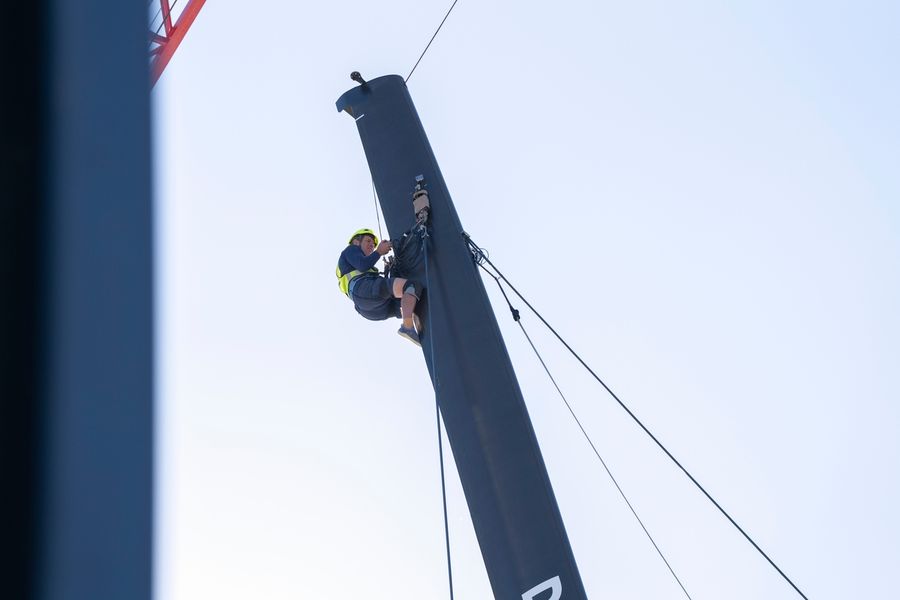
The camera specialist's presence is the detail that raises eyebrows. If this were simply about setting shroud tension, there would be little reason for someone from the camera team to be so heavily involved, on this day and the one before it. It points towards an optical measurement system, possibly tracking mast position, bend or movement against fixed reference points.
Put the pieces together and a picture starts to form. Known loads applied through the cap shrouds, reference load-cell readings recorded, and onboard sensor readings, potentially from fibre-optic lines that have been seen running along the shrouds since the team's commissioning period in Lorient, checked against them. Mast rake and bend measured physically, possibly with camera assistance given the white paint marks newly visible on the outer wings. Then the whole data set run against the structural model, with calibration coefficients adjusted accordingly.
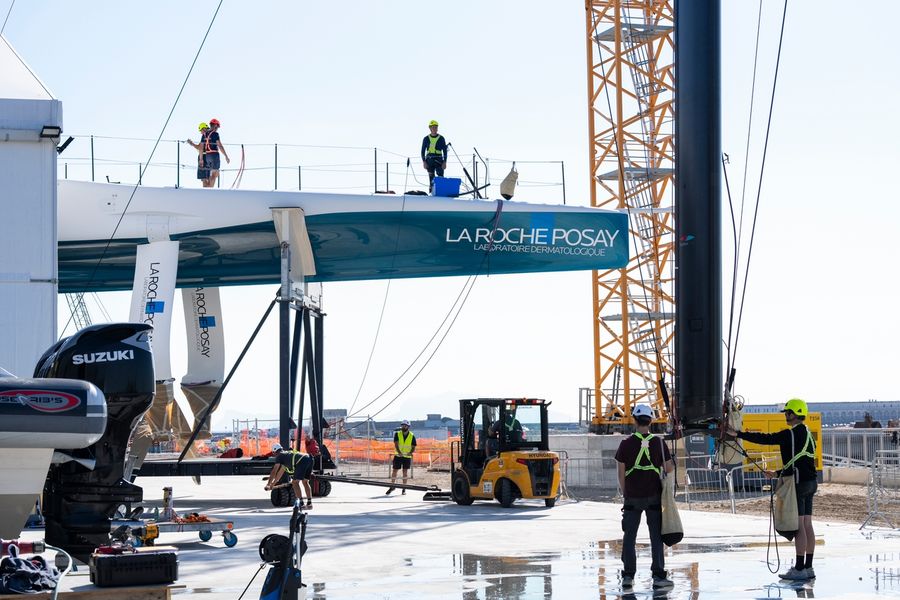
The previous day's session had already seen the lower shrouds removed and refitted, with rake measured repeatedly. Taken together, the two days look like a structured attempt to characterise the rig properly, not just retune it.
Why might this matter for the French campaign? Sail designers have reportedly been sailing as guests on the boat in recent days. If the assumed geometry of the mast doesn't match what the boat is actually doing on the water, a disappointing sail test could be wrongly blamed on the sail design when the rig configuration is the real issue. Getting the calibration right underpins everything downstream, from matching simulations to sailing data, through to repeatable dock-tune procedures and reliable comparisons between sail designs.
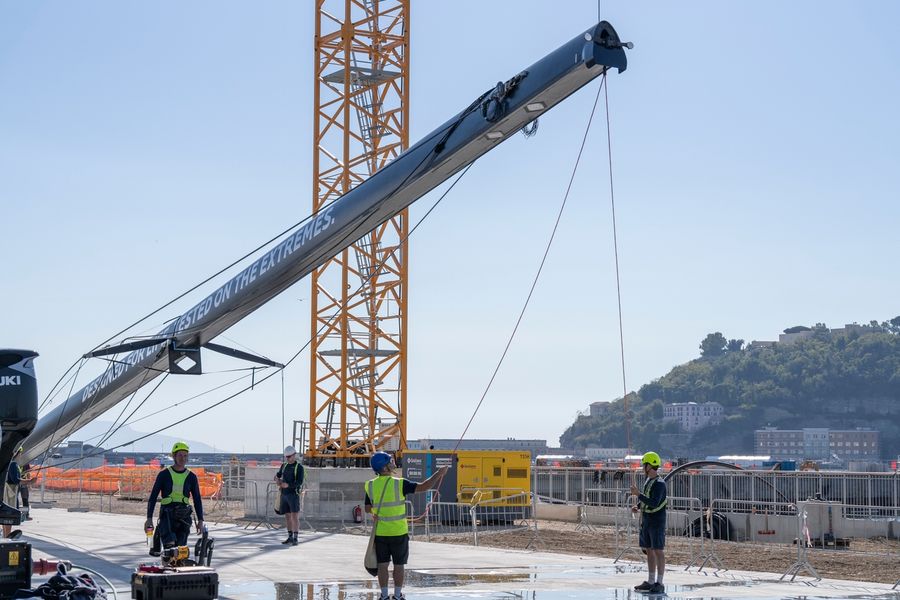
It is the sort of day that looks unremarkable on a notification sheet and turns out to be anything but.
Whether this was triggered by a specific discrepancy the team had picked up, or was simply the next step in a planned development programme, is not something the recon footage can answer. What does seem clear is that a day spent on load cells and laptops at the dock in Naples could end up mattering as much to the French campaign as any individual sail test.