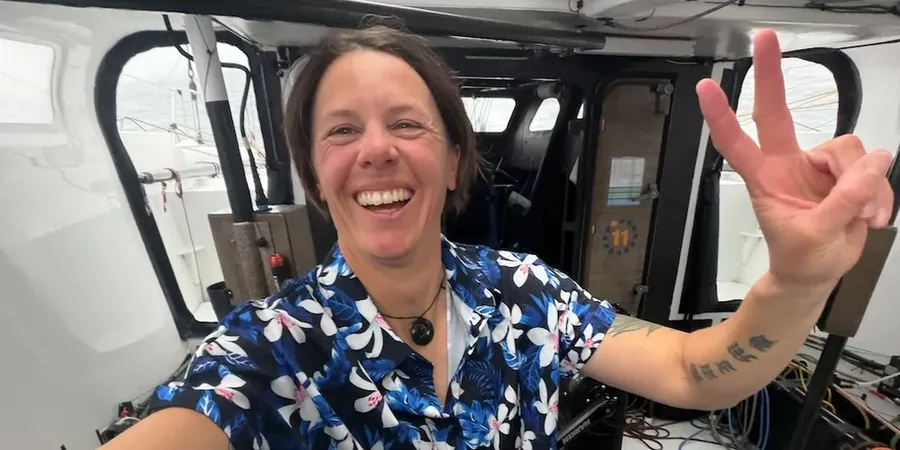
Somewhere above the Arctic Circle, in forty knots of wind and seas that offer neither rhythm nor mercy, Francesca Clapcich made a decision. She went below, changed out of her foul weather gear, and pulled on a Hawaiian shirt.
Bright blue, white and pink florals. An outfit built for somewhere significantly further from the pole. She wore it anyway, grinning straight at the camera, and sent the footage back to shore.
"I put on a summer top for the polar circle crossing," she said, as if that settled the matter. In many ways, it does.
The Vendée Arctique is not something a person stumbles into lightly. Four weeks alone, single-handed, in waters where the temperature hovers a few degrees either side of freezing and the wind never quite stops. Sails demand constant attention. The horizon delivers nothing in the way of variety or comfort. The fatigue accumulates in layers, grinding and relentless. It is the sort of racing that can hollow a person out completely, if they allow it.
Clapcich, sailing aboard 11th Hour Racing, has apparently resolved not to allow it. So has Arnaud Boissières. While their competitors process the experience each in their own way, these two have landed on humour as their preferred means of survival. Not a denial of the hardship, exactly, more a refusal to be entirely consumed by it.
The range of responses within the fleet tells its own story. Sam Goodchild is fixed on calculations around victory. Élodie Bonafous is counting the miles. Ambrogio Beccaria is cheering his own northward progress. Violette Dorange is giving off something that reads as straightforward joy. Nico d'Estais is sitting with the sheer scale of what he has committed to. Every one of them is navigating the crossing through their own private register, the internal language each sailor develops to make sense of weeks spent entirely alone at sea.
Clapcich and Boissières have chosen lightness. The beanie stayed below. The waterproofs stayed below. Out came the tropical florals, and the absurdity was entirely the point.
The IMOCA circuit tends to produce a recognisable type of sailor. The core qualities are shared across the fleet: deep seamanship, total commitment to the boat, and the capacity to keep sailing through whatever the Arctic or the Southern Ocean chooses to produce. What varies is everything built around that core. How a sailor digests the experience, what they choose to transmit back to land, where they locate the reserves to continue. That is where the individual surfaces from beneath the shared discipline.
A Hawaiian shirt at latitude 66 is a small act of rebellion. The water temperature is indifferent to it. The boat requires exactly the same precision from Clapcich in tropical florals as it does in technical fleece. But the gesture is genuine, a deliberate reach for brightness in conditions that push steadily in the other direction.
Out on those waters, where the mind and the spirit absorb punishment alongside the body, Clapcich and Boissières have made their position clear. They intend to keep things light.