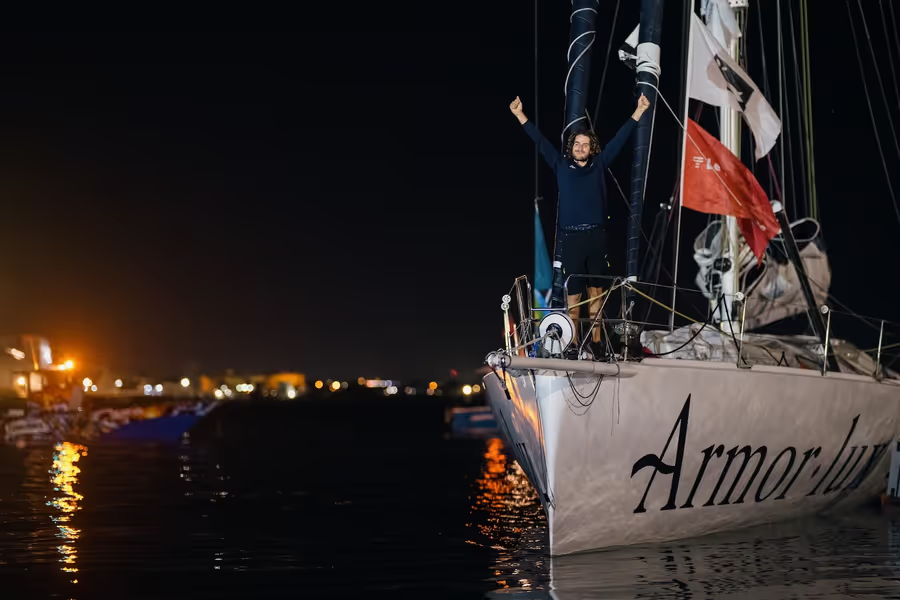
Every day since 2 November, at 4.45am, a phone call has opened a line straight into the Atlantic. On the other end, sailors mid-race in the Route du Rhum, Destination Guadeloupe, have shared their small victories, their bigger struggles, moments of fatigue and bursts of laughter. Sixteen days of conversation, sometimes patchy, often gripping, always human.
There are two types of people awake at that hour: those still asleep, and those who have clearly made poor choices about their sleep schedule. But what a privilege it is to ask a sailor, somewhere in the middle of an ocean, how their night went.
The connection didn't always cooperate. Between dropouts, repeated "hello?"s and sentences swallowed by satellites, some conversations had to be pieced together like a puzzle. With Tom Laperche on SVR-Lazartigue, the exchanges started at full throttle. The day after the start, the eventual winner was already describing his duel with Armel Le Cléac'h on Banque Populaire XI, a first night raced at startling speeds. "We were both cranking the handles hard. It's great to be able to race like that in an Ultim class, with speed gaps of around half a knot. It's so close, you really have to be flat out."
Others were still picturing Saint-Malo, the crowds, those final moments leaving loved ones behind. Then the sea took over.
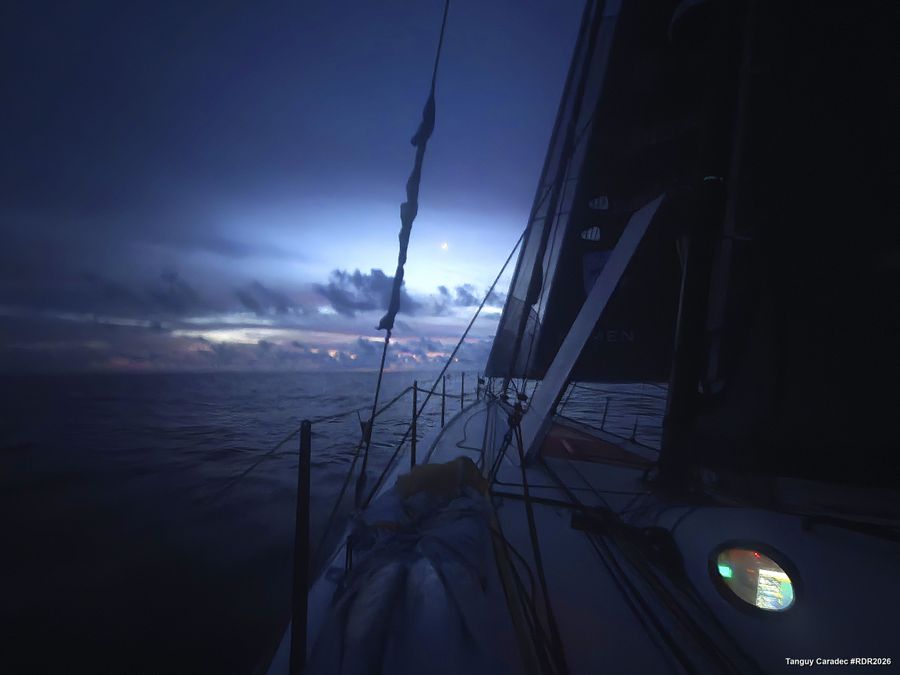
We'd been promised a transatlantic run toward the tropics. The Atlantic, it seems, had other plans, serving up depressions, squalls, short seas, endless transitions and trade winds gone missing. There was something for everyone, provided you enjoyed a bit of suffering.
Some handled it with good humour. In Class40, Pierre Leboucher on Institut Imagine thought he'd found salvation after days of heat and salt spray. "Looking at the radar, I thought, brilliant, a squall's coming, at least I'll get a shower. And it faded. We just got the light wind, not even the rain. What a con job."
In Ocean Fifty, the mood was grimmer. Anne-Claire Le Berre on UpWind by MerConcept, caught in a tropical depression, didn't dress it up. "It's basically a war zone out here. The waves are really short, so we're not going fast at all. We can't see the end of it."
Yet even in the toughest stretches, there was wonder too. Louis Burton on Armand Thiery described a night that was "almost fantastic", stormy squalls mixed with shooting stars.
Some mornings brought harder news: the capsizes of Matthieu Perraut on Elvest and Francis Joyon on Oceans, Ambrogio Beccaria's fall on Allagrande Mapei, the damage, the retirements. Behind the rankings and routing calls were people alone, facing real danger. The rescue of Benoît Sineau on Ekynox Réthorès by Jules Bonnier on Plastic Odyssey, after Sineau's distress beacon triggered, showed just how real solidarity among sailors can be.
After Perraut's capsize, Basile Bourgnon on Edenred admitted: "We text each other. Sometimes we ask, are we pushing it a bit too far here?" A question that deserves more than an answer, really.
On the other end of the emotional scale, Pamela Lee on #Empowher, who restarted from Horta after an electrical failure, spoke of the team effort behind her Class40's recovery. "It was an incredible team effort."
As Guadeloupe drew closer, the talk shifted to heat, flying fish, sargassum, elusive sleep, and that island's habit of reminding frontrunners that nothing is decided until it's decided. Robin Follin on Solano was blunt about his approach. "I'm more of a hunter. There's so little to lose that you may as well try to win. If there are attacks to make, they'll be made." Leboucher offered the counterpoint, disarmingly simple: "In your head it's easier being the hunter, but it's still better being in front."
There were gentler moments too. Nico d'Estais on Café Joyeux recalled his previous arrival near Guadeloupe, rounding the island's northern point and catching, suddenly, "the smell of the land, the smell of the forests, of the island." This year he returned to Pointe-à-Pitre almost eleven years to the day after his Mini Transat. "It's a nice anniversary, a nice way to close the loop."
Tomorrow, at 4.45am, the phone will stay quiet. But the voices from these two weeks will echo for a good while yet.