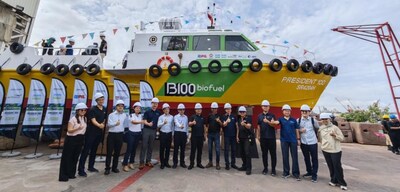
Singapore has positioned itself at the forefront of maritime decarbonisation with the introduction of President 100, the country's first harbour vessel to run entirely on B100 biodiesel. The 16-metre workboat has been purpose-built for real-world port testing, marking a meaningful move away from conventional fuels and toward low-emission alternatives that draw on existing compression-ignition technology.
Unlike concept vessels that rarely leave controlled conditions, President 100 is designed to operate under full working loads across a 1,000-hour continuous-use trial in one of the world's most demanding port environments. Powering the vessel are twin Weichai WP13C450-18BF engines paired with two CCFJ20J-W5BF generator sets, forming a propulsion and power system built specifically around the demands of running on pure biodiesel.
The project has brought together four distinct organisations. Chinese engine manufacturer Weichai, the China Classification Society's Singapore branch, local shipbuilder Pinnacle Marine, and the Marine Energy and Sustainable Development Centre (MESD) at Nanyang Technological University each play a defined role. Pinnacle Marine handled the construction of the vessel, while the MESD centre is tasked with collecting and analysing data across the trial period, covering engine performance, fuel efficiency, emissions output, and overall reliability. The findings will also shed light on practical considerations such as maintenance intervals and refuelling logistics under B100 operations.
B100 biodiesel is produced entirely from renewable feedstocks, including plant oils and used cooking oil. What makes it particularly attractive to port operators and short-range commercial operators is that it can be run in suitably modified compression-ignition engines without any blending with petroleum diesel, meaning meaningful carbon reductions can be pursued without the kind of sweeping infrastructure overhaul that other alternative fuels typically demand.
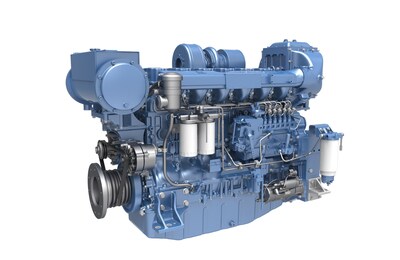
Although B100 carries somewhat less energy per litre than conventional diesel, its lifecycle greenhouse gas emissions and particulate output are substantially lower. Weichai has stated that its marine engines have been specifically tuned to sustain performance and dependability when operating on this fuel exclusively, addressing one of the more common concerns around running high-blend or neat biodiesel in commercial applications.
The scale and ambition of the trial reflect Singapore's broader strategic thinking. As a global maritime hub and one of the planet's busiest port centres, the city-state's decisions around fuel adoption carry considerable weight across the region. Infrastructure choices and policy settings in Singapore have a history of radiating outward to influence neighbouring ports and shipping markets throughout Asia.
A spokesperson for Weichai characterised the launch in significant terms, describing it as "a turning point" for maritime decarbonisation.
“WE SEE B100 AS A SCALABLE, IMMEDIATE SOLUTION FOR PORT AND COASTAL OPERATORS,” THEY SAID. “THIS PROJECT PROVIDES NOT JUST TECHNICAL VALIDATION, BUT A FRAMEWORK FOR STANDARDS, REFUELLING, AND EMISSIONS BENCHMARKS GLOBALLY.”
Data gathered from President 100 throughout the trial is intended to underpin Singapore's wider maritime sustainability objectives and to serve as a reference point for other operators considering biodiesel-powered vessels, both within Asia and further afield.
The broader context adds urgency to the work President 100 is doing. The International Maritime Organization's emissions reduction targets have intensified pressure on vessel owners to identify credible alternatives to liquefied natural gas and exhaust scrubber systems. For near-shore operations, auxiliary harbour vessels, pilot boats, and workboats, biodiesel presents a potentially cost-effective path that does not require entirely new vessel designs or bespoke fuelling infrastructure.
By commissioning a genuine operational testbed rather than a laboratory demonstration, Singapore is helping to close the gap between biodiesel's theoretical promise and its day-to-day practicality. A successful 1,000-hour trial could provide the evidence base needed to accelerate uptake across a much wider fleet of small commercial vessels, and potentially open the door to broader coastal shipping applications.
What President 100 represents, then, is more than a single vessel completing a single trial. The project is an attempt to build the data, confidence, and operational knowledge that could shift biodiesel from a promising option into a routine one.