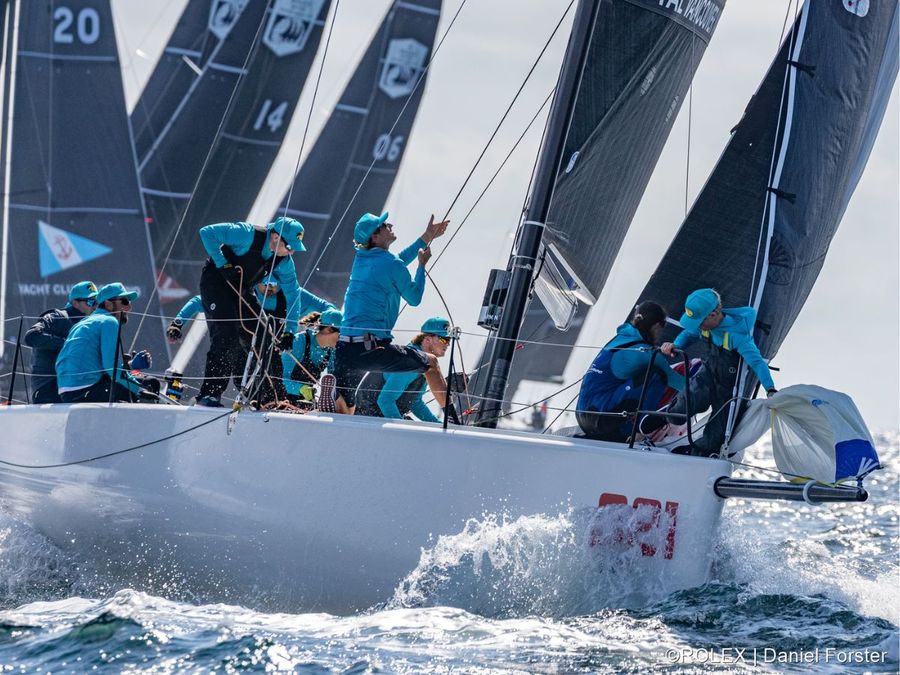
Four days of fierce Corinthian sailing on Narragansett Bay have set the stage for a final race that could tip any number of ways. San Diego Yacht Club carries the lead into the concluding day of the 2025 Rolex New York Yacht Club Invitational Cup in Newport, Rhode Island, but the margin is no longer comfortable. Royal Vancouver Yacht Club has surged into second and knows precisely what is required: seven boats must finish between them and San Diego for the Cup to change hands. Royal Hong Kong Yacht Club sits close enough to capitalise if either falters. The arithmetic is clear, the pressure is enormous, and Narragansett Bay will have the final say.
How that seven-boat equation came to exist runs through day four. San Diego had looked composed and methodical through much of the week, combining clean starts with measured risk management to build a cushion that seemed secure. Then the breeze and chop began to expose small cracks. They opened the day with a win, then absorbed a sixteenth and a ninth as competitors found their measure. Royal Vancouver delivered a 5, 1, 1 to vault into second overall and announce themselves as genuine title contenders.
{{TABLE_1}}
Their path to that position has not been straightforward. A rig collision on day one forced a boat change and left the Canadians carrying two redress scores from the earliest stages of the regatta. Rather than unravelling, they rebuilt. Manoeuvres tightened, the crew settled into a fast and low-risk upwind mode, and their lane-holding downwind became a quiet strength. The persistence behind that recovery was rooted in preparation done well away from Newport. Royal Vancouver invested in an IC37 at home to learn the platform, even without local one-design tuning partners to sail against. Solo training cannot replicate the dynamics of a full fleet, but it sharpened the core mechanics that matter most. Trim teams moved as a unit through the chop, layline judgement looked crisp, and mark approaches on day four were measured and tidy. A top four finish overall is now secured. The title still requires San Diego to falter in traffic, but it is no longer a distant prospect.
San Diego retains the yellow spinnaker as regatta leader for good reason. Their strike rate across eleven completed races represents the most complete body of work of the week, with very few double-digit scores weighing on their tally. Royal Hong Kong has been nearly as consistent, staying in single digits with a regularity that has kept them within nine points of the lead. Their strength lies in boat placement at congested points on the course, and their patience on laylines combined with a willingness to soak for lane control could prove decisive if the final race turns into a positional dogfight through the fleet.
The clubs rounding out the top five have earned their places through solid, if less spectacular, campaigns. Corinthian Yacht Club and Royal Cork Yacht Club have been reliable middle-to-upper-fleet finishers throughout. Royal Canadian, Royal Swedish, and Royal Thames are clustered tightly just behind, separated by only a handful of points. Eastern Yacht Club produced one of the most discussed moves of the regatta, a so-called Reverse Rabbit call that converted a broken start into a sixth-place finish, backing up a second in the previous race. Itchenor Sailing Club offered a different kind of highlight earlier in the series, a wire-to-wire win that reminded the fleet a clean lane and steady boathandling still carry real weight in an even one-design.
Royal Prince Alfred Yacht Club has pushed hard with a youthful crew but sits in the lower half of the fleet after a run of mid-fleet results. The IC37 is unforgiving in that respect. One poor start can compound across an entire leg when clear lanes are scarce, and recovering position in a class where every boat is evenly matched demands near-flawless execution. Among the American clubs, San Diego remains the clear benchmark while Eastern Yacht Club and New York Yacht Club have traded strong days with tougher ones, outcomes often hinging on how cleanly they handled the set pieces around the marks.
The race committee has set a 1 pm local start for the final race, targeting a fair breeze. Each of the leading clubs will approach it differently. San Diego's task is straightforward: a clean start, a middle-lane hold, a measured approach to the favoured side only when conviction is high, and the grinding consistency that converts small gains into a tidy points finish. Royal Vancouver cannot afford to simply shadow San Diego boat for boat. They need separation, not a parallel ladder-rung duel. Whether that means a bold pin-end start, a decisive move toward the right edge of the course, or an early cross from a lane seized before the fleet compresses, they must manufacture distance rather than merely follow. Royal Hong Kong will look for leverage without creating chaos, at their best when the fleet bunches and composed decision-making separates the patient from the reactive.
The starboard layline on the first beat will bear close watching. The IC37 punishes late ducks and optimistic roll tacks, and the traffic there is likely to decide several positions in a single moment. Downwind, the teams protecting pressure rather than chasing angle alone have tended to come out ahead when the breeze has streaked unevenly across the run. Gate choices will matter accordingly. The single, deciding race is scheduled for 1 pm Eastern, with live coverage on YouTube and Facebook beginning shortly before the start sequence. For Royal Vancouver, seven boats is the number that changes everything. For San Diego, one more composed, tidy race is all that stands between them and the Cup.