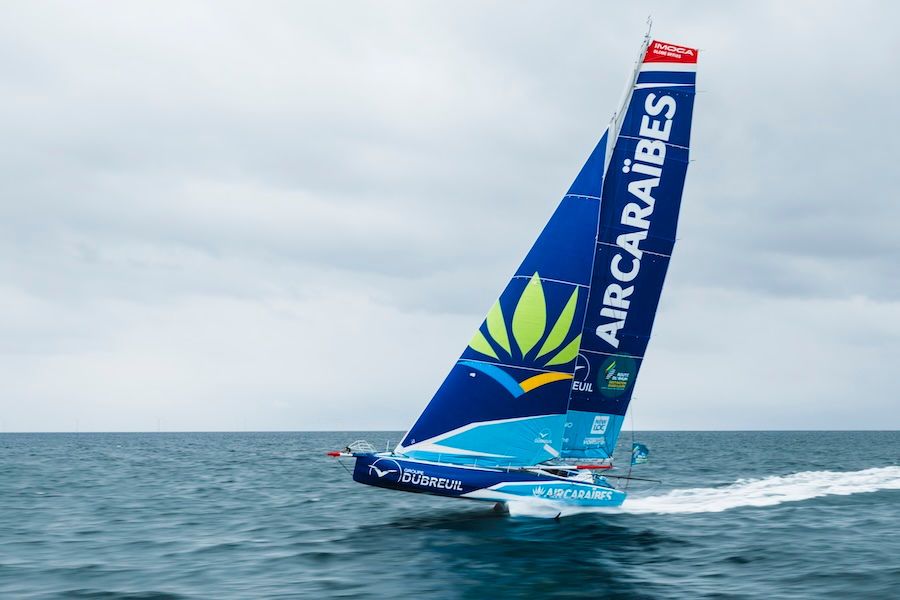

Race director Francis Le Goff says conditions for Sunday's Route du Rhum start could hardly look better, with the fleet set for a fast exit from the Channel and a real shot at race records across several classes.
The final preparations are falling into place in Saint-Malo, with the start set for 1.02pm on Sunday. The ULTIM trimarans left the basins yesterday, with the Ocean Fifty, IMOCA and Vintage classes due out on Saturday, followed by the Class40s on Sunday morning. Calmer weather after a run of depressions and the passage of storm Austen has made for a smoothly drilled operation.
"We're now benefiting from a settled high-pressure system over the Channel, which should hold for several days," Le Goff said. "For all the port operations, it's ideal." The ULTIMs and IMOCAs can wait off Dinard, the Ocean Fiftys at Bas Sablons, while the Class40s will go through the locks on Sunday morning.
Spectators will need to pick their vantage point carefully. Two viewing areas are being set up, one at Pointe du Grouin and the other at Cap Fréhel, mainly for passenger boats. With downwind conditions forecast, the multihulls will need to tack their way out to make progress, so spectator boats won't be able to follow the fleet north. Each will have to settle for either the start or the fleet's passage at Fréhel, which Le Goff says should still offer good viewing while keeping things safe on the water.
Le Goff is expecting around 12 knots at the start, with a calm sea and favourable downwind conditions, building to 18-20 knots overnight. That should let the fleet clear the Channel quickly without hugging the coast or sitting too long in shipping traffic. "It'll be a fairly comfortable start, but with enough pressure afterwards to get some good speeds going."
Out to 96 hours there is no warning sign on the horizon, he says, so skippers should be able to get straight into racing rather than spending their first days managing heavy weather.

Routing models are sending the fleet well to the north this year, largely bypassing the Bay of Biscay. "We shouldn't hear much about the Bay of Biscay this year," Le Goff said, though each class will have its own options as forecasts evolve.
Records could fall. "If things stay as they are, all the professional classes could be in the hunt for the race record in their category," he said, pointing to potentially huge mileage on the night of Monday into Tuesday. The trade winds further south remain less settled, though, so how competitors handle their approach to Guadeloupe is still uncertain.
For the ULTIMs, some routings suggest finishes as early as the following Saturday, around six days of racing. "Five days, I don't think that's realistic. But going under the current record, yes, clearly."
Calmer conditions also mean less of the usual last-minute pressure, Le Goff says, for sailors, shore teams and race organisers alike, and a better experience for the public following the start.
Still, 115 boats pushing hard across the Atlantic is no reason to relax. "This is still a mechanical sport, with boats under heavy load, risks of breakage and all the challenges of solo sailing," Le Goff said. "We'll have 115 competitors at sea, across very different classes. We need to stay alert to make sure everything goes well, from first to last."