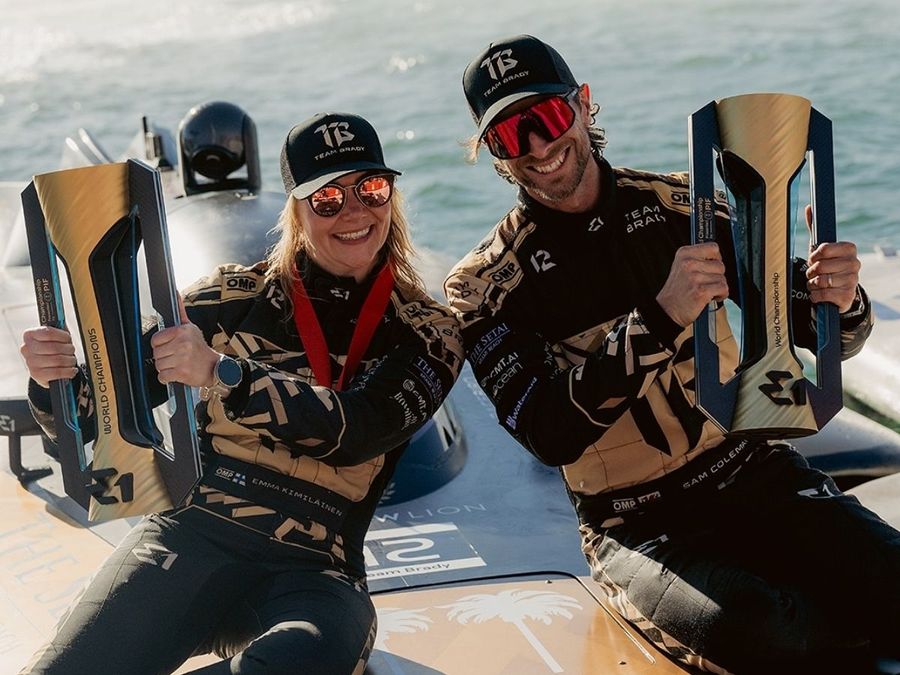
When Team Brady's Sam Coleman and Emma Kimiläinen climbed out of their RaceBirds after the Miami finale, the Season 1 E1 Series championship was theirs. Their victory closed a debut season that had travelled from the Red Sea to the Adriatic, taken in the Italian lakes, and wrapped up on the Florida waterfront, showing along the way that electric foiling raceboat competition could hold its own against any motorsport spectacle on the planet.
The E1 Series was conceived by Alejandro Agag and Rodi Basso, two figures whose fingerprints are already on Formula E and Extreme E. The premise was straightforward: gather a field of identical RaceBird craft, built by SeaBird Technologies and Victory Marine, equip each with twin hydrofoils and zero-emission propulsion, and put them in the hands of two-pilot teams, one male and one female, racing in alternate heats across some of the world's most recognisable waterfront venues. The format rewards quick thinking as much as raw speed, with pilots choosing between a long or short lap to find clean water and gain fractions of a second on their rivals.
The ownership roster gave the series an immediate global profile. Tom Brady, Rafael Nadal, Steve Aoki, Will Smith, Diddy Drogba, and Sergio Pérez were among those lending their names and networks to what was, at its core, an audacious sporting experiment.
The season opened in Jeddah, Saudi Arabia, in January 2025, and it was Aoki Racing Team, Steve Aoki's outfit, that set the early standard. Pilots Dani Clos and Mashael Alobaidan navigated a tense double-final format to claim victory, signalling from the outset that the RaceBird's performance potential was real and that no single team would have things their own way.
February brought the championship to Doha for the Visit Qatar E1 Doha GP, and Rafael Nadal's Team Rafa responded in style. Pilots Cris Lazarraga and Tom Chiappe combined to deliver the team's first win, pushing them to the top of the standings. "It was an incredible weekend for us," Lazarraga said afterwards. "We showed that we can fight with the best."
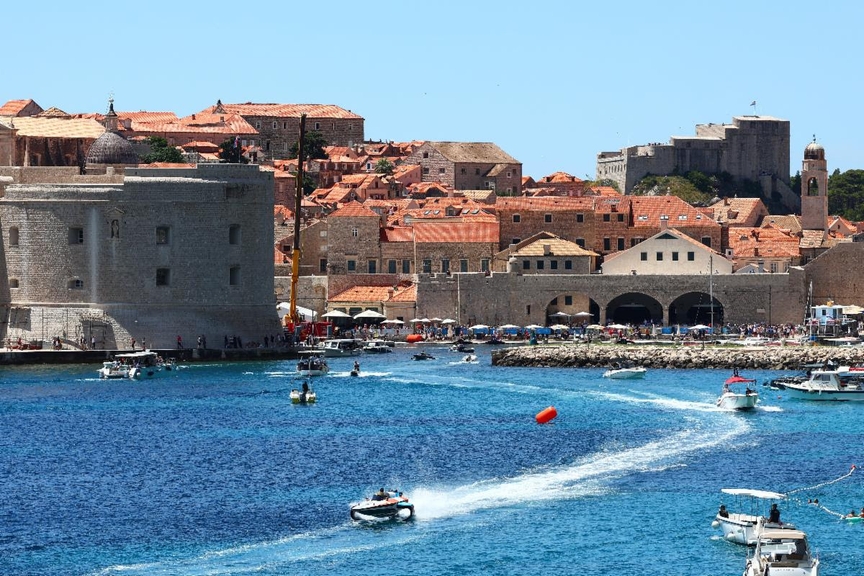
The Dubrovnik GP in June took the fleet to Croatia's Adriatic coast, and despite absorbing long-lap penalties, Aoki Racing found a way to win again. Clos's composed, Formula-1-honed racecraft proved decisive, and the result moved Aoki Racing back into the points lead. Consistency, the episode demonstrated, would matter as much as outright pace over the course of a full season.
The championship's turning point arrived late in June at Lago Maggiore in northern Italy. Team Brady, which had endured a mixed first half of the season, clicked into gear. Coleman and Kimiläinen dominated the round, finding a harmony with the RaceBird that had eluded them earlier in the year. "Every time we get on the water we learn something new," Coleman reflected. "By Italy, we knew how to make the RaceBird fly."
Miami, the grand finale, was always going to be dramatic. Four teams, Team Brady, Team Rafa, Team Blue Rising, and Aoki Racing, all held a mathematical chance of lifting the title. Qualifying sharpened the tension further when Nadal's Team Rafa trimmed Team Brady's advantage to just two points. Once racing began, however, Coleman and Kimiläinen were relentless. In Group B, Coleman crossed the line 38 seconds clear of his nearest rival, and Kimiläinen matched that authority in her heat. Will Smith's Westbrook Racing took an early Group A win to add some colour to proceedings, but the finals belonged to Team Brady. Despite a determined challenge from Team Rafa, Coleman and Kimiläinen produced near-flawless runs to claim both the Miami GP and the overall Season 1 championship.
"The calls, the strategies; everything went super-well today," Kimiläinen said moments after stepping ashore. "Sam, you crushed it. Absolutely crushed it."
Coleman was equally measured in his assessment. "We've learned from our mistakes earlier in the season," he said. "Every time we've gone on the water we've improved. So look out, Season 2."
Team Brady finished on 195 points. Team Rafa came second on 184, Team Blue Rising third on 169, and Aoki Racing fourth with 149. Westbrook Racing, with Sara Price and Lucas Ordóñez sharing the driving duties for actor Will Smith's team, completed the top five. Team Brazil by Claure Group and Team Drogba Global Africa finished level on points just outside the top five.
The breadth of talent across the grid was one of Season 1's defining qualities. Former Formula 1 testers and Olympic-level sailors competed side by side, among them Micah Wilkinson, a New Zealand Olympic medallist and accomplished Nacra sailor who raced for Team Drogba Global Africa. At the other end of the experience spectrum, Sara Misir caught the eye with consistent performances across multiple rounds.
Central to everything was the RaceBird itself. At seven metres in length and powered by a 150 kW battery system, it rises onto carbon foils and reaches speeds above 90 km/h while generating virtually no wake. Each venue tested teams in different ways. The flat, sheltered waters of the Persian Gulf demanded one type of energy management, while the chop and breeze of Mediterranean locations pushed battery cooling systems and foil trim setups in completely different directions. Technical parity across the fleet meant the finest margins separated competitors, and teamwork between pilots became as important as individual pace.
The series is also anchored to a broader environmental purpose. Partnerships with the Blue Impact Programme and the Sport for Nature Charter place clean-marine innovation at the heart of the E1 mission, with the ambition of encouraging coastal cities to embrace electric waterborne transport.
Season 1 was equally a competition built on the personalities of those involved. Brady brought the composed confidence of a champion. Nadal gave the championship emotional investment. Aoki added a different kind of energy entirely. For New Zealand followers, the crossover between the E1 Series and the foiling world felt natural, with echoes of SailGP's sharp tactics and split-second decision-making, played out on a more compact and intimate stage.
The season also demonstrated something many had doubted: that a full international electric-boat championship could be fast, genuinely competitive, and commercially sustainable. Attendance grew at each venue, and the series' broadcast reach extended through new streaming arrangements. "It's a new era for racing," said co-founder Rodi Basso. "We're showing that electric mobility can thrill spectators while protecting the waters we race on."
Season 2 is expected to bring additional teams, more venues, and an expanded Pilot Academy programme designed to bring fresh talent from new nations onto the grid. Updated RaceBirds are also in development, promising greater range and improved responsiveness.
The foils may have stilled and the batteries cooled since Miami, but the E1 Series has made its point. Electric foiling racing is not a curiosity or a sideshow. It is a fully formed sport, and after one extraordinary inaugural season, it is only getting started.