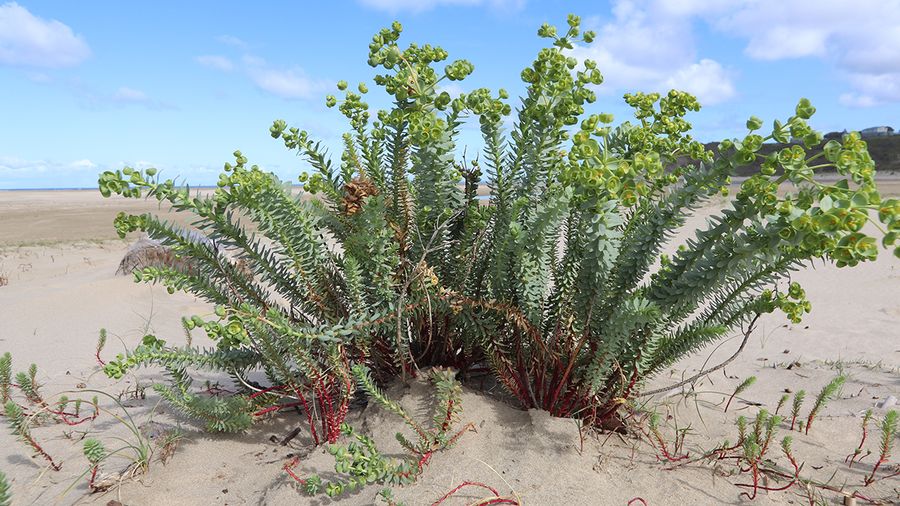
A new sea spurge infestation has been discovered at Kapowairua, Spirits Bay, bringing the total number of confirmed sites across Northland to seven.
The find was made by Ngāti Kuri's Te Haumihi team, which has been progressively surveying the coastline within their rohe to determine whether sea spurge (Euphorbia paralias) has established. Joanna Barr, Northland Regional Council's Biosecurity Manager for Pest Plants, credited the team's proactive approach with enabling early detection. "Having local teams supported to undertake proactive surveillance work has meant that this new site has been detected while it is still relatively small and in a relatively contained area," she said.
Te Haumihi Programme Manager Melanie Dalziel described what her team uncovered: more than 50 plants within a six square metre area, comprising one larger plant believed to be the original coloniser, 18 smaller mature plants that had already seeded, and 32 seedlings. While it was very disheartening to find these plants, Dalziel acknowledged both her team and the support of the Northland Regional Council in locating and safely removing the plants before further seeding could occur. Her team has since prioritised regular surveillance and monitoring of beaches along the eastern ridgeline of the Ngāti Kuri rohe.
The surveillance effort behind this discovery forms part of a broader management programme delivered in partnership with iwi and hapū, the Ministry for Primary Industries, the Department of Conservation, and the Northland Regional Council. Ms Barr noted that a number of iwi and hapū groups are now actively involved, controlling known sites and continuing to survey the coast, with locals and volunteers also contributing to reporting and monitoring efforts. "Over the past 12 months 175km of Northland's coastline has been surveyed, focused primarily on the west coast," she said.
Sea spurge is now recorded at seven locations across Northland: Poutō peninsula, the Waipoua River mouth, Mitimiti, Ahipara, Waipapakauri, Hukatere, and now Kapowairua, Spirits Bay. Plants at all of these sites have been controlled, with each location searched every four months to detect and remove new seedlings. That schedule reflects the plant's rapid development cycle: without intervention, seedlings can reach maturity and set seed in less than five months.
Native to Europe, sea spurge is thought to have reached New Zealand via ocean currents from Australia, where it has become a major weed along southern coastlines, causing significant environmental damage to beaches there. Ms Barr warned of similar consequences locally if the weed is allowed to spread. "It has the potential to overrun our native dune species and threaten the habitats of native birds," she said. A single adult plant can produce between 5000 and 20,000 buoyant, salt-tolerant seeds every year, each capable of travelling long distances on ocean currents. "This means there is an ongoing risk of seeds making their way over and establishing along our long stretch of coastline, with the west coast being the most at risk," Ms Barr said.
Sea spurge looks like a small shrub and typically grows to around 50 centimetres in height, though it can sometimes reach one metre. Its leaves are bluish green and tightly packed, and the stem often carries a red tinge at the base. The flowers are yellowish green, petal-less, and appear in clusters, while the leaves are stalkless, hairless, alternate, crowded, and overlapping along the stems. The plant produces a milky sap that is toxic to both people and animals and can cause temporary blindness. "Do not touch it as it has a milky sap, which is toxic to people and animals and may cause temporary blindness," Ms Barr said.

Anyone who suspects they have found sea spurge should report it immediately to the Ministry for Primary Industries Pests-and-Diseases hotline on 0800 80 99 66. Ms Barr urges people to photograph the plant clearly but leave it undisturbed. "Take some clear photos and please do not disturb the plants as the sap is toxic, and you could also spread the seeds via your clothing and equipment," she said, adding that plants can also regrow from root fragments.
Recording the location as precisely as possible is equally important. GPS coordinates are ideal, though dropping a pin in Google Maps or taking a screenshot of your location on the map are good alternatives. The iNaturalist app can also be used to mark potential sightings.
Sea spurge can be confused with several similar-looking species. Ms Barr noted that it resembles the rare native spurge, waiūatua / waiū-o-Kahukura (Euphorbia glauca), though the native plant has much larger leaves measuring 30–80mm in length. New Zealand linen flax (Linum monogynum) and sand daphne / toroheke (Pimelea villosa), both found in coastal environments, can also look similar.