The wind died on Monday afternoon. Sam Goodchild had led the Vendée Arctique for nearly nine days by that point, setting the pace, making the calls, carrying the burden of the race's benchmark position. Then the breeze simply deserted him, and everything that followed was already decided.
Ambrogio Beccaria crossed the finish line on Monday 16 June (NZST) at 2:38 pm. Goodchild arrived 1 hour 15 minutes and 3 seconds later. His elapsed time of 8 days 15 hours 20 minutes 53 seconds covered 3,219.86 nm at an average speed of 15.5 knots, a performance that was, by almost any measure, exceptional, and still not enough.
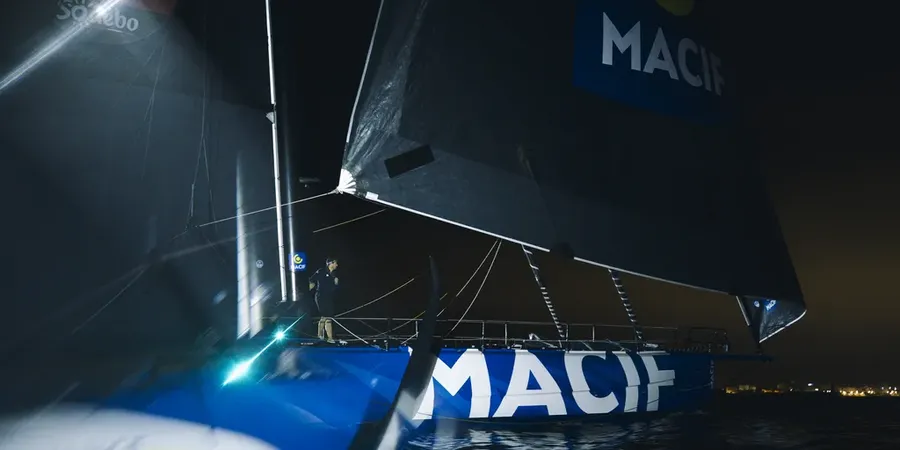
There was a particular kind of pressure attached to Goodchild's campaign from the outset. Racing aboard MACIF Santé Prévoyance, he arrived as the bookmaker's favourite, a very different position from his earlier campaigns under Vulnérable, where the freedom of the outsider had worked in his favour. He named that pressure directly, telling journalists he needed to "respond to the expectations it brings." He did not try to minimise it or deflect it. He stepped in and carried it.
That willingness defined how the race unfolded. Goodchild went to the front on the opening night and held it. When Corentin Horeau pressed him hard aboard MACSF, he didn't yield. When Horeau was eventually forced to retire, and when Élodie Bonafous began chasing him through Arctic waters in a sistership, Goodchild remained the one dictating the terms of the race. As the fleet cleared the polar circle and turned south for home, he chose the North Channel, threading between Ireland and England rather than taking the more conventional route. It was the kind of aggressive, instinctive call that had defined his years in the Figaro Beneteau class, and for a long time it appeared to be working perfectly.
Then the calm arrived. The windless zone had been visible on weather charts three days before it mattered, the sort of feature that seems manageable in forecast models and becomes something else entirely when you are sitting inside it, watching the sails go slack. Beccaria, coming from behind, found a way through it. He caught Goodchild on Monday afternoon, moved past him, and the race changed hands with no tactical response available to the man who had led it for nine days.
Goodchild's record in IMOCA competition is not that of a skipper struggling to find his level. Third in the Transat Jacques Vabre, victory in Return to Base in 2023, the Caps Race and The Ocean Race Europe the following year. He has established himself as a genuine front-runner in the class, and a second-place finish on the Vendée Arctique does nothing to undermine that standing. But losing in the final hours after nine days of near-flawless sailing carries its own particular sting. A defeat conceded earlier, or more cleanly, would be easier to file away.
Ocean racing returns to this lesson often enough that it should perhaps come as no surprise, and yet it always does. Sustained dominance offers no protection from a windless afternoon at the wrong moment. The weather holds the final vote, regardless of everything that came before. Goodchild will go back to sea carrying that knowledge, and those last, still hours will stay with him.