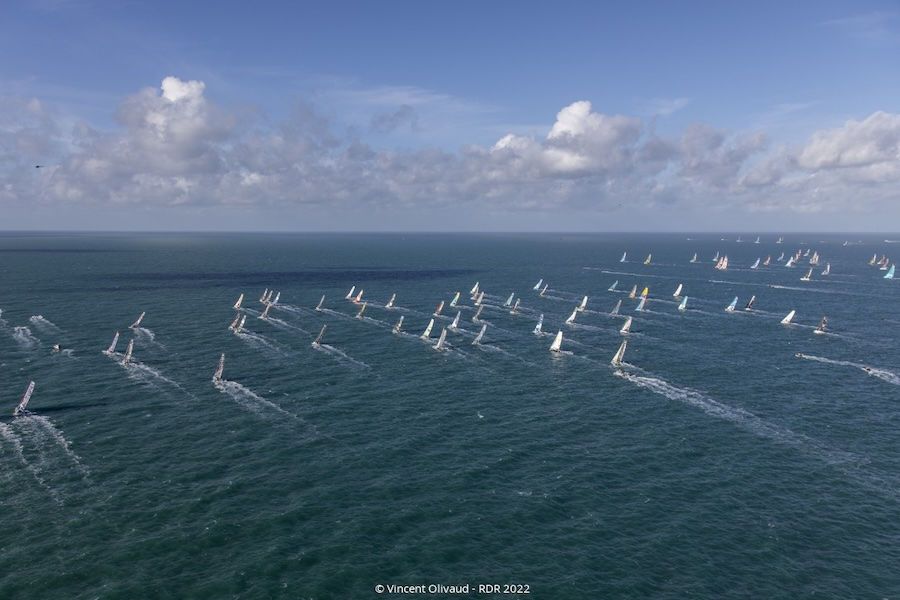
The 115-strong fleet for the Route du Rhum - Destination Guadeloupe won't all leave Saint-Malo at once. Sunday's 1.02pm start is the headline moment, but boats begin filing through the lock gates in staggered waves two days earlier.
ULTIM boats lead the way, passing through the locks from Friday evening. Saturday belongs to the Ocean Fifty, Vintage Multi, Vintage Mono and IMOCA fleets. Only the Class40s wait until Sunday morning to make their move.
"Since the Route du Rhum passed the 80-boat mark, there's always been a need to leave in several waves," says race director Francis Le Goff. "It's not possible to get all the boats through on one tide."
The ULTIMs, being the trickiest to squeeze through the lock given their size, get a full tide to themselves on Friday. Spectators can line the grandstands around the locks for the multi-day spectacle, which French broadcaster France Télévisions will carry live.
Once through the locks, boats head not straight out to sea but to anchorages near Saint-Malo. The ULTIMs and IMOCAs will sit off Dinard. The Ocean Fifty fleet gets a reprieve at Port des Bas Sablons, where local fishermen have cleared space for the Saturday-to-Sunday night. Organisers will enforce a security perimeter to keep onlookers at a safe distance.
Skippers stay aboard for the lock passage itself, a last chance to soak up the crowd's send-off. After that, technical crew generally remain with the boats at anchor while skippers head ashore for a night's sleep before the start.
On Sunday, only the Class40 skippers face an early lock crossing. Everyone else just needs to be on the start line by 1.02pm. "Sailors organise themselves however they want," Le Goff says. "It all depends whether they've got a big team, inflatables, whether they're moored close to shore, whether they know the area."
Skippers from Saint-Malo itself, who know these waters intimately, often anchor at Cancale to grab extra rest. Every skipper must be alone on board four minutes before the start gun.
Routing rules split by class. Monohulls, meaning the IMOCAs, Class40s and Vintage Monos, are banned from receiving shore-based routing advice. Multihulls across all three categories, ULTIM, Ocean Fifty and Vintage Multi, are allowed it.
Safety is the reasoning. "In a monohull, you can't capsize, unless the keel breaks," notes Corentin Horeau (MACSF). "But in an ULTIM or an Ocean Fifty, without a keel, there's always a risk of capsize."
Most multihull teams build dedicated routing cells, typically a meteorologist, a skipper, and a technical team member. Tom Laperche (SVR-Lazartigue) will lean on Jean-Yves Bernot, Franck Cammas and Gaston Morvan. Armel Le Cléac'h (Maxi Banque Populaire XI) will call on Marcel Van Triest, Nicolas Lunven and Sébastien Josse. That shore support will let the multihull skippers push flat out all the way to Guadeloupe.