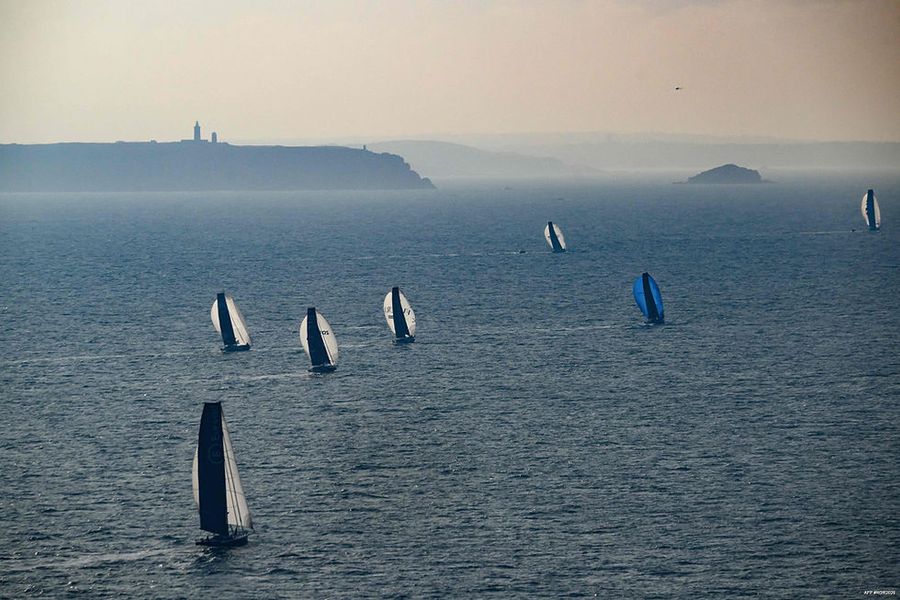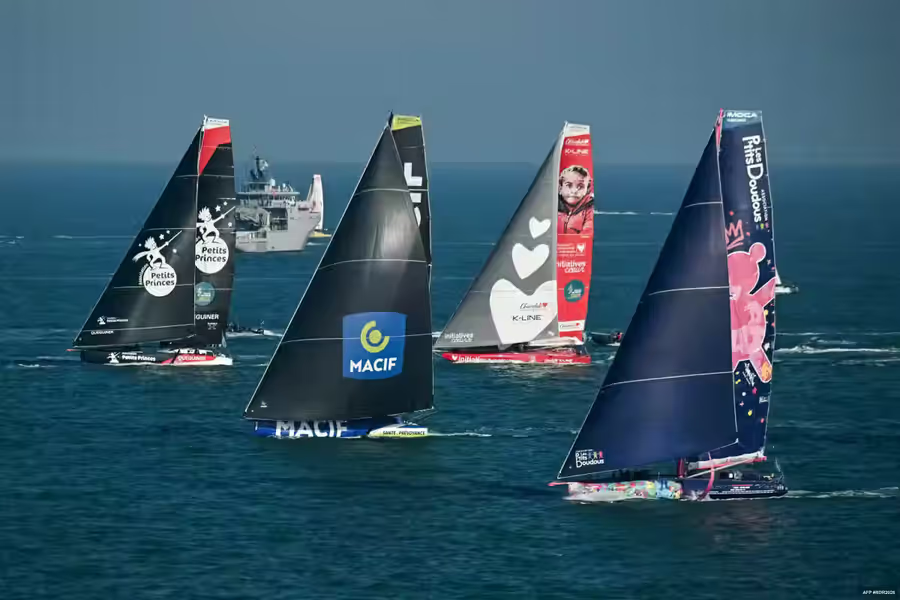
The transition from Saint-Malo's send-off to the open Atlantic took barely a day. The 115 skippers in the Route du Rhum, Destination Guadeloupe left the French port in near-perfect conditions, only to be swallowed almost immediately by the race's full intensity. Freshening wind, a harder sea, startling speeds: the first night offered little respite.
By Monday morning all six classes were deep into it, with a major strategic test already looming southwest of Ireland. In a race run at this pace, picking the right road matters as much as going fast.
There was the crowd, the waving, the last glimpses of loved ones on the pontoon. Then, within minutes, everything changed. "It's always strange to find yourself alone so quickly. But you've soon got plenty to deal with, so there's not much time to think," said Tom Laperche (SVR-Lazartigue) during Monday's morning check-in. Pierre Leboucher (Institut Imagine), racing the event for the first time in Class40, still carries the memory of those final shoreside moments. "The hardest part was leaving the pontoon, then saying goodbye to my boat captain. Those are special moments, when it really hits you what's happening. Luckily, once you're underway, you're fully in race mode."
Ambrogio Beccaria (Allagrande Mapei) played it right to the edge from the opening minutes. "I was aggressive, confident. I figured everyone would be a bit cautious early on and, given the conditions, I wanted to try to get out front. I was so close to the line I actually got worried I'd jumped the start." The Italian appeared to work with about as much safety margin as a driver running a well-ripened orange light.
The send-off was marred by a collision between the IMOCA Initiatives-Cœur of Violette Dorange and Romain Pilliard's trimaran Use It Again (Vintage Multi). Both skippers are unhurt. The impact damaged the monohull's starboard foil and a float on the multihull, and both boats diverted to Roscoff, Use It Again in the middle of the night and Initiatives-Cœur shortly after 4.30am on Monday.
Tom Laperche and Armel Le Cléac'h have been trading blows in the Ultim class since the first miles. "We really had to work the handles. We had to change sails several times, which wasn't necessarily planned. It was a pretty tough night. It's great to be able to race like that on these big machines, with speed differences of around half a knot. It's really tight, so you have to be fully switched on," said Laperche, who jibed around 155 miles southwest of the Fastnet Rock early Monday. The giants are expected to keep running near 35 knots on Monday, pushed by an east-southeast flow of 15 to 18 knots.
In Ocean Fifty, Matthieu Perraut (Elvest) spent much of the night sailing almost blind in short, confused seas. "The sea is short and the wind has really filled in. We've been covering big averages, it's full-on and you can't see a thing outside! We're sailing on feel, but everything's fine," he said. In IMOCA, Beccaria praised Sam Goodchild (MACIF Santé Prévoyance) for a sail change executed under pressure that he himself didn't dare attempt. "He did exactly what I wanted to do, but on my side, I didn't feel like trying the sail change. It was really impressive."
Class40 leader Pierre Leboucher battled brutal windshifts near the Isles of Scilly, where the islands' wind shadow reached well out to sea and wind dropped from 28 to 16 knots in moments. "It wasn't easy choosing sails, with the constant changes in wind direction and strength. I managed okay, especially since my boat isn't necessarily the most comfortable in these conditions," said the Nantes sailor, who is not inclined to ease off. "I managed to make good progress, even if it was sometimes marginal, with a few hairy moments! You've got to keep the pressure on, but above all not break anything."
In Rhum Mono, Kieran Le Borgne (Armor-Lux, Le Finistère Assurance) is still learning his boat at speed but clearly enjoying it. "It's intense for me, still learning the boat, but it's really well-balanced. The manoeuvres are going well, even though it's still a handful. I had a few nerves, but for now, I'm really enjoying it!" After a first stretch marked by heavy shipping traffic, he found more room to sail his own race, and a faster Channel exit than any he'd experienced before.
Among the Rhum Multi veterans, Francis Joyon, winner of the 2018 Ultim edition, leads ahead of Damien Seguin (Arkéa, Handicap International) and Éric Péron (French Touch Oceans Club). Seguin said Joyon's experience showed the moment conditions turned hard. "As soon as things got complicated, Francis got faster. He knows his machine perfectly. I tried quite a few things during the night to find the right settings, and now I'm managing to hold the pace better."
Laperche jibed first, just before 4am on Monday, roughly 155 miles southwest of the Fastnet lighthouse. "We manoeuvred pretty much where we wanted to. Now we'll see what the others do." For the Ultims, the next obstacle is already in sight: a narrow low-pressure corridor they're expected to reach this evening, bringing rain, a sudden wind collapse, then a fresh push from the north-northwest.
In their wake, the IMOCAs and Ocean Fifties are also preparing to jibe onto a west-southwest heading. Perraut is already thinking several moves ahead. "You need to work out what you're aiming for on the way out of the system and anticipate what happens next. We'll probably have to bet on one development over another, and maybe take a bit of a gamble."
Further east, the Class40s are eating up miles across the Celtic Sea in around 20 knots of wind. For Leboucher, the next decision will have lasting consequences. "The jibing point will set us up for the next three days. We'll need to play it right."
In Rhum Mono, some won't change course until Tuesday. Le Borgne is watching the weather systems develop with one concern in particular: "The routing is predicting a race against the clock so we don't arrive too late on the depression near the Azores." Seguin expects a similar course change. "We'll jibe again when the wind turns, and then it'll be full speed towards the north of the Portuguese archipelago, to see which system we land on there."
Less than 24 hours out of Saint-Malo, every eye is already on the Azores. Between here and there lie several hundred miles, and a forecast that hasn't yet shown its full hand. The speed is there. For the rest, the fleet will need a good nose for the weather.