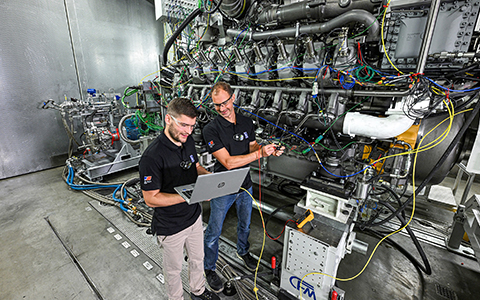
When it comes to decarbonising commercial shipping, propulsion technology has long struggled to keep pace with ambition. Rolls-Royce has now delivered a landmark result that may change that picture, successfully testing the world's first high-speed, single-fuel methanol engine purpose-built for marine use. The 2,000-kilowatt prototype was tested in Friedrichshafen, Germany, emerging from the meOHmare research project, a collaboration between Rolls-Royce Power Systems, Woodward L'Orange, and WTZ Roßlau with funding provided by the German Federal Ministry for Economic Affairs and Energy.
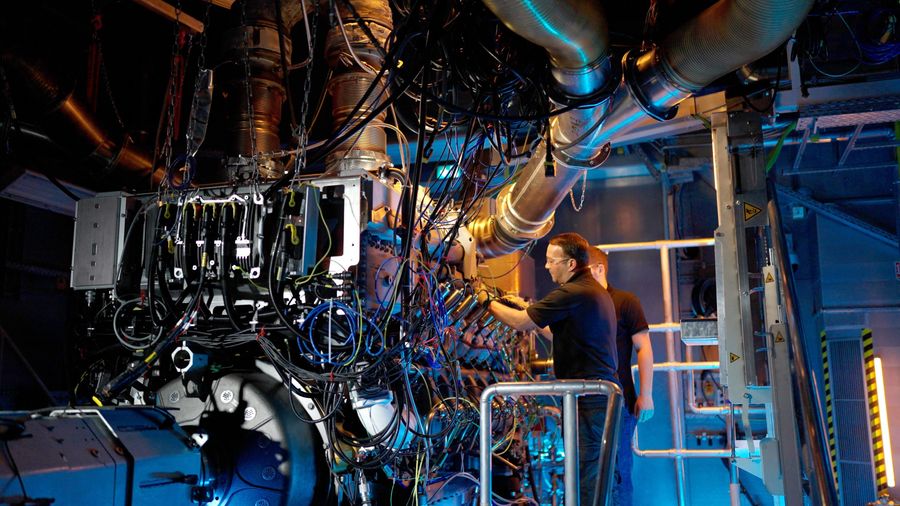
"This is a genuine world first," said Dr Jörg Stratmann, CEO of Rolls-Royce Power Systems. "No other high-speed engine in this performance class runs purely on methanol. It proves that sustainable, low-carbon propulsion with internal combustion technology is viable today."
Reaching this point required a fundamental rethink of how the engine functions. Unlike diesel, methanol will not spontaneously ignite under compression, which meant the conventional injection system, turbocharging setup, and combustion process all had to be redesigned from the ground up. Engineers developed purpose-built methanol injectors and mixture-control systems, and the test-bench infrastructure itself was adapted to accommodate the fuel's particular physical and chemical characteristics.
Early results have been encouraging. The engine runs smoothly, delivering performance comparable to diesel while producing a significantly cleaner burn. Refinement work is ongoing, with development teams focused on real-world operating conditions. "We're now fine-tuning the response under load and optimising acceleration," said Dr Johannes Kech, Head of Methanol Engine Development.
Methanol has attracted growing attention as a transition fuel for the maritime sector. In its green form, produced using renewable electricity and captured CO₂, it is effectively carbon-neutral in use. It is also biodegradable and, compared with alternatives such as LNG or hydrogen, considerably easier and safer to store and handle. Its principal drawback is an energy density roughly half that of conventional diesel, though its liquid state at ambient temperature means bunkering and storage infrastructure does not require the complex engineering demanded by cryogenic or high-pressure fuels.
[embed]https://youtu.be/TFD7x620zRg?si=W9hXAeuEvk0KA5MB[/embed]
Denise Kurtulus, Senior Vice-President for Global Marine at Rolls-Royce, framed the development in terms of both technological readiness and what still needs to follow. "Green methanol is a future-oriented fuel, and the technology for it is here. The next step is building the infrastructure to make it widely available."
Recognising that green methanol supply chains will take time to mature, Rolls-Royce is also developing dual-fuel engines capable of running on both methanol and diesel. That flexibility is intended to give operators a practical path forward during the transitional period, rather than forcing an abrupt switch before the necessary fuelling network is in place. The broader goal remains clean combustion technology capable of delivering CO₂-free shipping at scale.