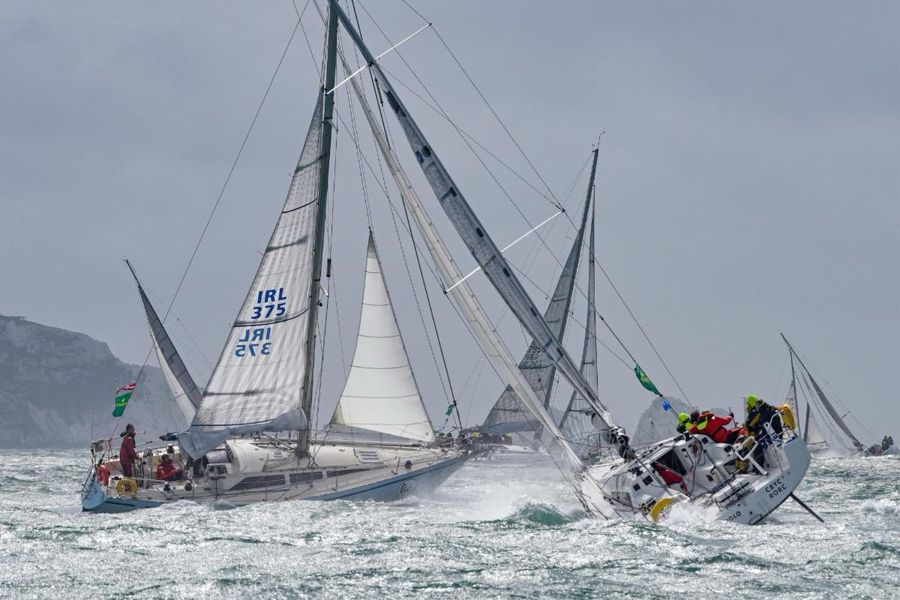
For the teams heading back out on the Rolex Fastnet Race for its special centenary 51st edition this Saturday, a glance at the long-range forecast will come as welcome news. Anyone who lined up for either of the previous two editions will remember all too well the punishment dished out, with winds exceeding 30 knots at the start and gale-force conditions persisting through the opening 24 hours. This time around, the outlook is considerably kinder.
Benign winds do not make the Rolex Fastnet Race simple, though. The tide is always a central character in this event, from the very first moments of navigating out of the Solent to the succession of notorious headlands along England's south coast: St Alban's Point, Start Point, the Lizard, and Land's End. At the far end of the race, the powerful Alderney Race will have the final say, for better or worse, as competitors make their approach to Cherbourg.
Woven through all of this are the mandatory Traffic Separation Schemes, or TSSes, which shape the tactical picture at every stage. Heading out of the Solent, the Casquets TSS sits mid-Channel and puts a limit on how far south boats can travel before they must tack, though the faster classes such as the Ultims and IMOCAs frequently push south of it altogether. One of the most consequential decisions comes off Land's End, where the direct route threads between the headland and the Scilly Isles, but wind and tidal conditions can make the longer passage, between the TSS and Land's End itself, the smarter choice.
South of the Fastnet Rock, another TSS functions almost like a spreader mark, naturally separating inbound boats from those rounding and heading for home. Further TSSes lie to the west and south of the Scilly Isles, and competitors face yet another tactical fork in deciding whether to leave the western one to port or starboard. The Casquets TSS reappears on the homeward leg, pushing the fleet south of it again and, for some, all the way past Guernsey to dodge the worst of the tide. Last year, the Ultim Banque Populaire took a different line, choosing to pass north of the Casquets entirely.
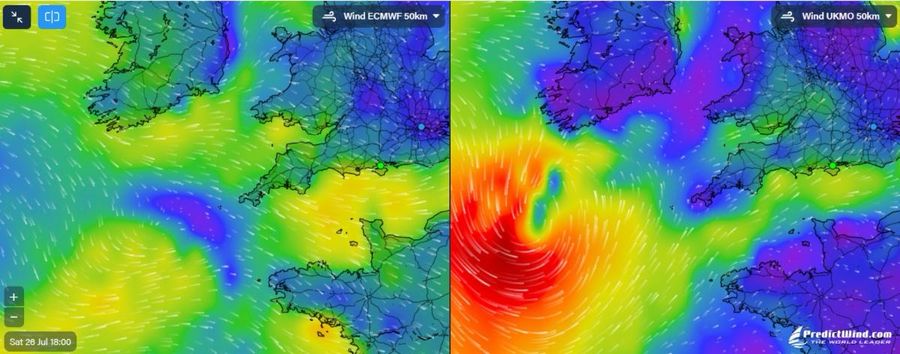
The dominant feature on this year's weather chart appears to be a substantial high pressure system sitting to the west and southwest, but its precise shape, combined with a small system that may or may not be developing in the Celtic Sea on start day, is currently making life very difficult for the routers, particularly aboard the bigger boats.
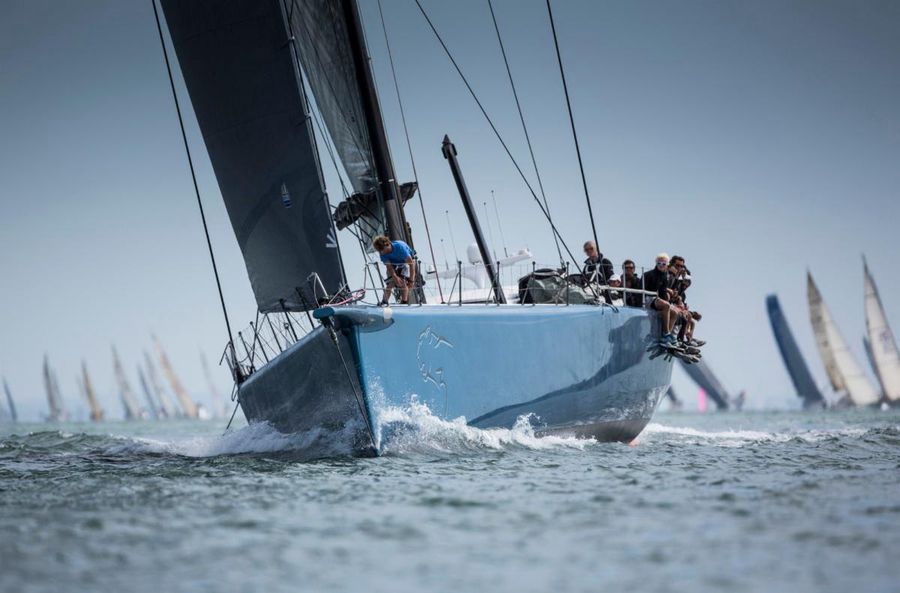
Will Best, navigator on Leopard 3, sums up the challenge. "It's really tricky," he says. "The difference between yesterday and today is almost 24 hours in routing for us. There's a system coming and at the moment the timing, intensity and associated weather are not lining up. The UK model is quite a big outlier at the moment. The EC model is looking better today compared to what we expect, probably two and a half days for us. Yesterday it was a pure windward-leeward with quite light VMG downwind to the finish and today it's not crazy wind speeds, but it just turns into a reach to the finish which saves us hours on these 100s. It's pretty normal for it to be this inconsistent so far out. It will settle down and line up in the next day or so."
Beyond the potential Celtic Sea depression flagged by the UKMO model, the forecast is otherwise free of the depressions and associated fronts that can define this race. The greater variation in conditions looks likely to fall over the weekend rather than early next week.
Leopard 3 is a 100ft boat drawing 5.5 metres, which rules out the kind of rock-hopping that smaller vessels can exploit close inshore. Her size works in her favour through the tidal gates early in the race, and her towering rig becomes a powerful asset if conditions go light. Best believes that combination played a significant part in the boat's commanding victory in the Cowes-Dinard-St Malo race earlier this month.
RORC Rear Commodore Joe Lacey will race doublehanded aboard Midnight Blues, a Pogo RC belonging to Jean-Eudes Renier. The Pogo RC is a new 33ft one-design offshore racer designed by Bernard Nivelt and Sam Manuard. Lacey reads the weather picture this way: "Big picture, the weather is basically stable. There's high pressure over the Atlantic, which the entire fleet is probably going to be in for the entirety of the race. The exact position of that high pressure changes the angles. For example, going along the south coast, it could be upwind, it could be reaching. And going across the Irish Sea, it could be upwind and it could be reaching.
"At the moment, it says we're going to be upwind in 12-15 knots at the start, but then it will take us 24+ hours to go along the south coast of the UK, so by Sunday we should be reaching. Maybe we will still get some shifts, but I don't think it's very stable. The forecast is changing daily. At the moment, it's giving us some positive readings: our fleet will finish in 3.5-4 days and it goes well for us if we can reach along the coast of England. At the moment we'll never have more than 20 knots of wind and never less than eight knots. Our boat is a reaching and downwind machine, and we're racing against others with the same rating, but 10ft longer. So if there's a lot of upwind we're going to struggle to save our rating, but if it turns into a reaching course, then that's great news for us."
Five Pogo RCs have been launched to date, and a sixth, Aruba, entered by Achille Nebout and Tanguy Bouroullec as the Pogo Structures works boat, will also be on the start line.
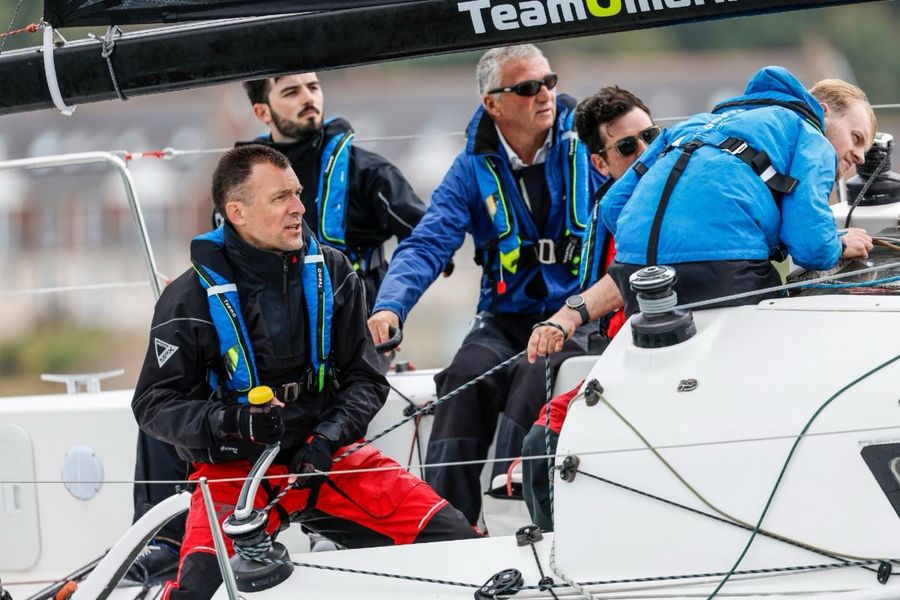
Mark Brown's JPK 1010 Jetpack currently leads the RORC Season's Points Championship in IRC Four, and navigator Sam Jones has been keeping a close eye on the models. "It looks like it's going to be north westerly for the majority of the race," Jones says. "The models seem to be fairly in agreement for that, quite different from the last couple of editions.
"Our late start in IRC Four is obviously going to have an impact with the light winds and our making it through the tide gates along the south coast. So it will be a challenge to get around St Alban's Head.
"It's going to be a pretty standard beat out of Solent, but because it's a prevailing north westerly, once we get out into Christchurch Bay, it could swing round a bit. I don't know whether it'll go fully into a reach until we get towards Weymouth."
The JPK 1010 goes well upwind. "Mid-teens upwind, we seem to do quite well in that, like we had in the Myth of Malham, beating up to the Eddystone," Jones says. "But we're not quite as fast as the Sun Fast 3200s downwind, mostly because we're quite a bit heavier than them."
Jones also looks ahead to the later stages of the race: "To the Rock it looks like the wind oscillates between 10 and 20 knots, possibly slightly more as we get closer. And then it's putting the kite up and going all the way to Cherbourg by the looks of it."
Brown acquired Jetpack ahead of the 2023 season as a successor to his A-31 Assassin. In that first year with the boat, the team claimed both the inshore and offshore titles in the JOG series. They started the Rolex Fastnet Race that same year but were forced to withdraw after losing a vital sail. They now hold a lead of more than 100 points in IRC Four.
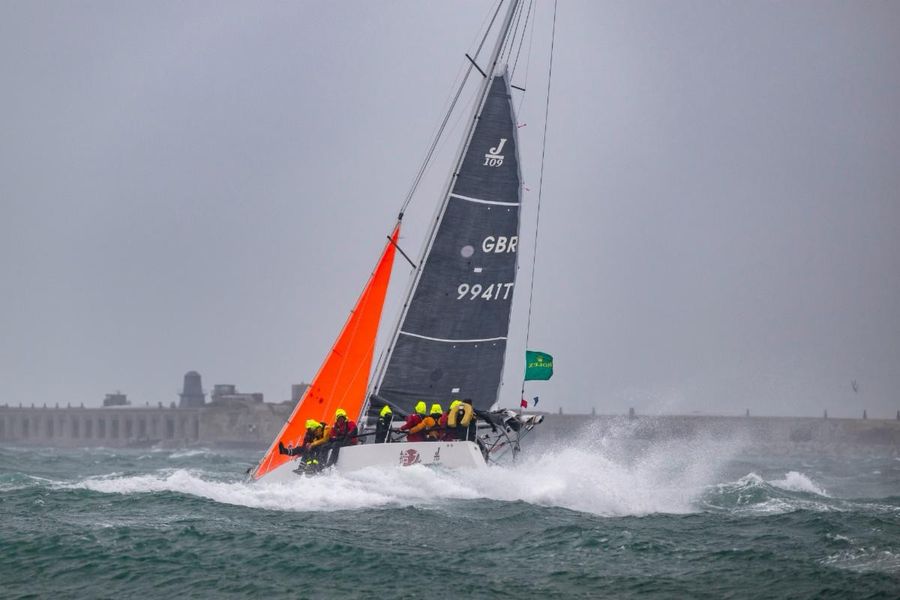
One detail that sets Jetpack apart from most other JPK 1010s in the fleet is that she races with a full crew of six, whereas many of her class rivals compete doublehanded. Jones acknowledges the trade-off that brings. "In light winds we've got a bit of a weight disadvantage, but we're hoping that we can keep pushing hard as we go all the way through."