Boat builders are showing off a technology that sounds more like something from an industrial print shop than a boatyard: full-sized yacht hulls, superstructure and all, printed by robotic arm in a matter of hours.
Large Format Additive Manufacturing, or LFAM, uses long robotic printer arms with a reach of over 12 metres to build hulls layer by layer from thermoplastic material. There are no moulds, no cutting away excess fibreglass or aluminium sheet. The printer head simply lays down what's needed and stops.
"With additive manufacturing, only the material that is needed is put into the hull and superstructure of a boat," says Charlene van Wingerden, co-founder of Dutch Boat Factory. Building in composites or metal always leaves waste behind, she points out. Even the newer HDPE sheet method still generates offcuts.
The bigger saving isn't material, though. It's labour.
"Automation is the biggest cost reducing factor," van Wingerden explains. Design and engineering still has to happen for every boat, she says, but the printer can run through the night and over weekends largely unattended. Bonding between layers is checked automatically as the print progresses, and if a flaw shows up, the machine simply stops itself.
CEAD, a 3D printing company based in Detroit, USA, with a second base in Delft, the Netherlands, has pushed the technology furthest with its Faber Navalis package, a combined machine, software and material system the company says is capable of producing military-grade boats. CEAD proved the practicality of the package by printing a 5.7 metre console fishing boat.
Strength comes down to material choice. PET, often recycled from soda bottles, is a common feedstock, while CEAD's Marine Application Center, from which Dutch Boat Factory originates, developed HDPro, a thermoplastic with the same properties as HDPE and very high impact absorption. The claim is that a boat built from it could ground on rocks without breaking or leaking.
Recyclability is where things get interesting for the industry's sustainability push. US builder Boat Evolution, from Maine, builds ready-for-launch tenders using LFAM and is aiming to use 100 per cent recycled materials while preparing its boats for electric propulsion. Doug Anderson, one of the yard's four founders, told Professional Boat Builder magazine that the yard deliberately avoids paint and adhesives to keep the boats as clean as possible for recycling.
"We don't want to paint them," Anderson said. "We don't want to add adhesives unnecessarily, or anything that could get in and hinder recycling. We're trying to keep it as pure as we can so you could literally grind it up and print another boat."
Because there's no mould involved, every printed boat can be individually customised, right down to steering position, furniture base or engine mounts, with the printer running one job at a time and able to use grains of any colour.
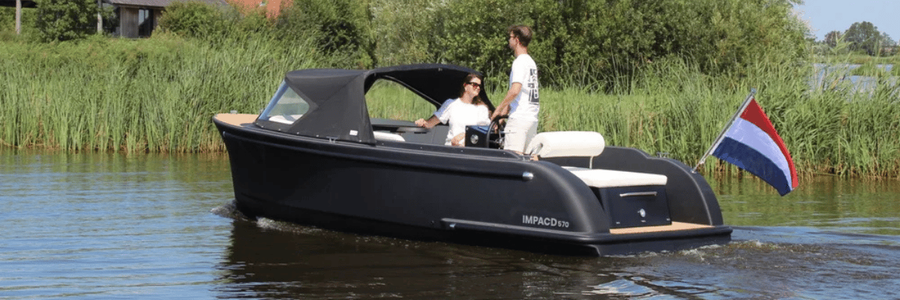
Dutch yard Impacd Boats, based in Woudsend, builds six open motor boat models between 5 and 7 metres, with a 9 metre model in development. Brand and Business Development Manager Marije de Vries says the material itself resists paint adhesion, which the yard treats as an advantage rather than a flaw.
"Our boats are robust. They do not dent or scratch," de Vries says. "We can print in any colour, so we do not paint the boats. Poor adhesion also means that marine fouling does not attach easily, either. An important extra sustainability gain is that we do not need to use antifouling paints."
Impacd also builds workboats and, for the Dutch ministry of defence, unmanned surface craft, with its innovation department working alongside marine research institutes and universities. For an industry that has spent decades refining moulds and mastering composite lay-up, it's a striking sign of how quickly the ground beneath boatbuilding is shifting.