A dramatic rescue has unfolded in the Route du Rhum after Benoît Sineau's Class40 Ekinox-Rhétores sank in the North Atlantic, with fellow competitor Jules Bonnier diverting his own boat to pull the French skipper from the water.
Sineau's distress beacon activated last Saturday. Race direction immediately launched the rescue procedure, and Bonnier, racing Plastic Odyssey, was identified as the closest boat at 36 miles away. He diverted immediately, despite sea conditions he later described as dangerous.
Bonnier had just come through a depression north of the Azores and was feeling pleased with his progress. "I'd had a big night where I'd really caught up with the boats ahead of me. I'd overtaken some of them," he said. He'd injured his thumb in the process and messaged the race doctor, only for race director Francis Le Goff to call back moments later with far more urgent news: a competitor was in distress.
Sineau had been sailing well on the right side of the depression, under two reefs and his J2, when he decided to allow himself a short nap. He set his alarm for 45 minutes. "I thought I was having a nightmare. I see an enormous wave in my boat, which was already filled with water," he said. He searched for the leak, worked the pumps, bailed with buckets, but the water rose too fast. "I did another lap of the boat, I had water up to my chest. That's when I regretted sleeping those 45 minutes, because if I'd seen the water starting to come in, I might have seen where it was coming from."

Within seconds he was in survival mode, pulling on his thermal protection suit and grabbing every beacon he could reach. Outside was worse again. "The boat was really low in the water and the sea was wild. I was getting swept by waves every five minutes."
Bonnier, roughly forty miles off, described being hit with "a big slap in the face" on hearing the news. He gybed his Class40 and diverted towards Ekinox-Rhétores's last known position. Two and a half hours of sailing followed, which he called interminable, not knowing what he would find or whether he'd even be searching for a liferaft. Race direction told him there wasn't one. The boat was sitting between two waters.
Closing in, Bonnier began sending position updates at six miles, five, then four. He heard Sineau's Mayday call directly. Sineau, perched on what little of his boat remained above the waterline, watched the sails approach with relief. "I really felt myself sinking," he recalled.
Bonnier got close, by his own estimate within five metres, on the fourth approach. Sineau jumped into the water to grab the thrown line, lit up "like a real Christmas tree" with every headtorch and flashlight he had. Bonnier hauled him aboard without much difficulty, adrenaline doing the work.
Both men made it through unharmed, rattled by the ordeal but safe.

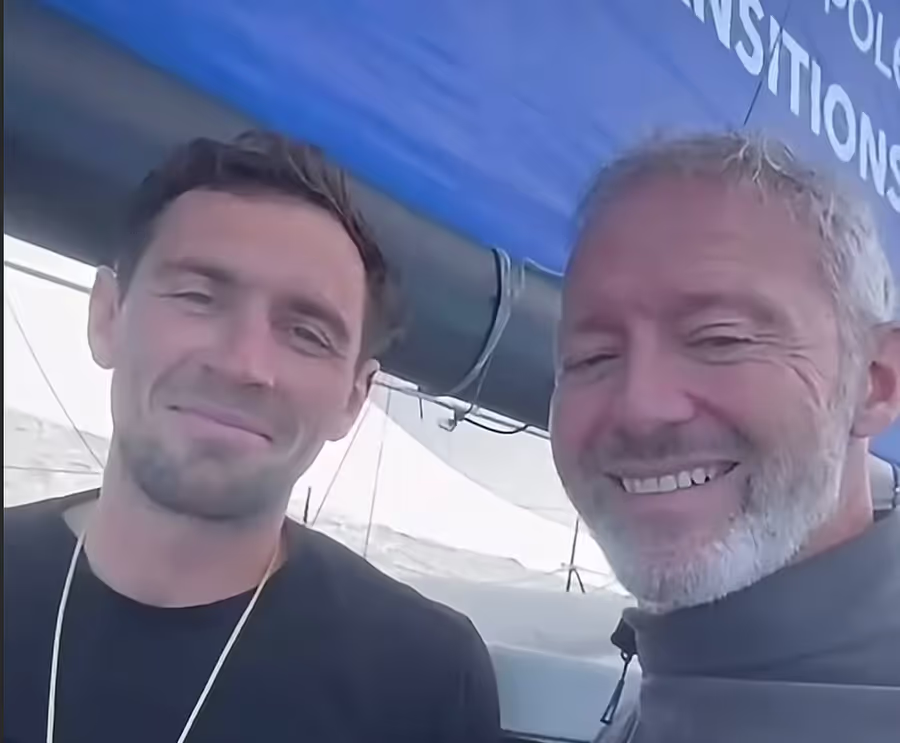
Bonnier notified race direction and the CROSS rescue coordination centre, handed over clothing and food, and made the call, in agreement with race direction, to keep racing with Sineau aboard all the way to Guadeloupe rather than divert. "The responsibility of being the only one closest, you feel it very quickly. It's heavy to carry," Bonnier admitted. "But we'll see it through. We've got water, not much food, but it'll do."
It means an unplanned doublehanded leg to Pointe-à-Pitre, with Sineau allowed to talk and crack jokes but little else. "My Route du Rhum won't be the one I imagined," Bonnier said. "We had to find a new goal: getting both of us to the pontoon in Pointe-à-Pitre."
Sineau, reflecting after a day and a half of fatigue and shock, described the mix of frustration and grief at abandoning a race that had been going well, and at not understanding what went wrong. He broke down thanking Bonnier, "who just saved my life," along with race direction and everyone involved in the rescue.
Bonnier had the last word: "He'll remember me for the rest of his life, and I'll remember him for the rest of mine."