
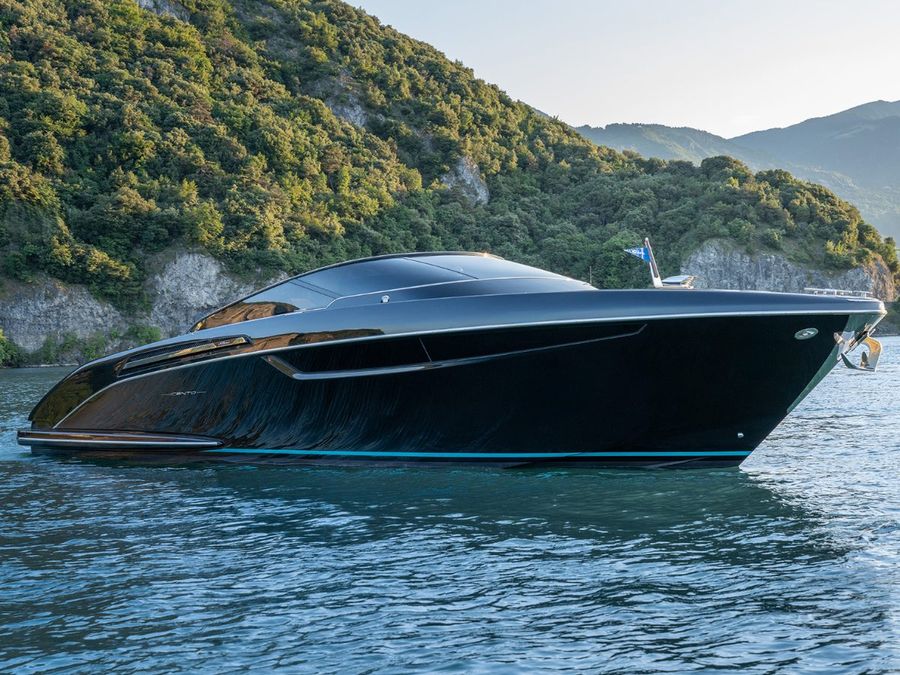
Twelve boats. That is all there will ever be. The Riva Cento is a strictly limited collector's edition open yacht, and that number is entirely deliberate, a statement of exclusivity sitting at the heart of everything the boat represents. It is built to honour the brand's modern era while drawing a clear line back to the most celebrated classics in Riva's history.
The design was handled by Mauro Micheli and Sergio Beretta, founders of Officina Italiana Design, working alongside the Strategic Product Committee led by Piero Ferrari and the Ferretti Group Engineering Department. Together they have produced an 11.88-metre open yacht with a 3.50-metre beam, combining the mahogany and stainless detailing that defines Riva's visual identity with a flowing, low-slung profile intended to look every bit as compelling at anchor as it does running at speed.
Two hull finishes are available. Fireworks Black is a metallic tone chosen to emphasise the Cento's sculptural lines, while a light grey aluminium colour offers a cooler alternative. Upholstery comes in either biscuit or a combination of aquamarine and white, with cushions finished in ribbed leather, a nod to automotive design from the 1950s and 1960s.
The transom has been reimagined as a beach platform. An electro hydraulic system opens a stern door to reveal mahogany steps and two chaises longues facing out over the water, their cushions detachable as conditions demand. Beneath the platform sit two dedicated storage compartments, one sized for fenders and one configured to take a Seabob. A retractable gangway is built into the transom and deploys automatically, while underwater lights assist with manoeuvring and mooring in low light.
{{TABLE_1}}
The cockpit is designed around social use. A C-shaped sofa wraps a stainless steel table topped with glossy lacquered mahogany, and an up-down mechanism allows the table to drop flush with the sofa, forming a second sunpad when the mood shifts from entertaining to relaxing. A retractable bimini stows within the sofa backrest and extends via an electro hydraulic mechanism. The cockpit also houses life jacket stowage, a shoe drawer, a drawer fridge, a sink and worktop, and an insulated cooler.
At the helm, a 15-inch display pairs with a 24-inch screen to cover engine data, navigation, cartography, Seakeeper readouts and audio controls. A Volvo Penta joystick handles low-speed manoeuvring alongside an electric bow thruster. Power comes from twin Volvo Penta D6 440 Aquamatic Duoprop DPI engines, with preliminary figures placing top speed at 40 knots and cruising speed at 31 knots. A Seakeeper NG6 gyroscopic stabiliser is fitted as standard, delivering comfort both underway and at rest. Trim management is handled by Volvo Penta software, which adjusts sterndrive trim to optimise efficiency and comfort.
Below the enlarged central windscreen and redesigned skylight, the interior is compact but fully equipped. A galley sits to starboard, a bathroom with a separate shower cubicle occupies the port side, and the bow sofa converts to a double berth by deploying a panel drawn from the central stowage area. Side windows bring in additional natural light, keeping the cabin from feeling enclosed.
One detail connects the Riva Cento directly to the models that made the brand legendary: the searchlight is styled after those fitted to the Aquarama and Aquariva, a quiet acknowledgement that even the most forward-looking design can carry something of the past.