On the northern shore of the Tāmaki Estuary, behind an industrial roller door that gives little away, something unexpected is taking shape. No rockets, no jets. Just foils, carbon fibre, and the kind of engineering that New Zealand has always done quietly and well.
Vessev is an Auckland-based marine technology startup with an ambitious brief: build high-speed, low-energy, electric-powered foiling vessels that don't merely gesture toward sustainability but actually deliver it. Not as a concept. Not as a trade-show exhibit. As working boats, in the water, approaching commercial deployment.
We were given a full tour of the factory, a close look at the design and construction processes, and then a ride aboard their 9-metre hydrofoiling electric craft through the Waitematā Harbour. What we found was harder to shake than we expected.
This isn't simply a new kind of boat. It's a different idea of what boating can be.
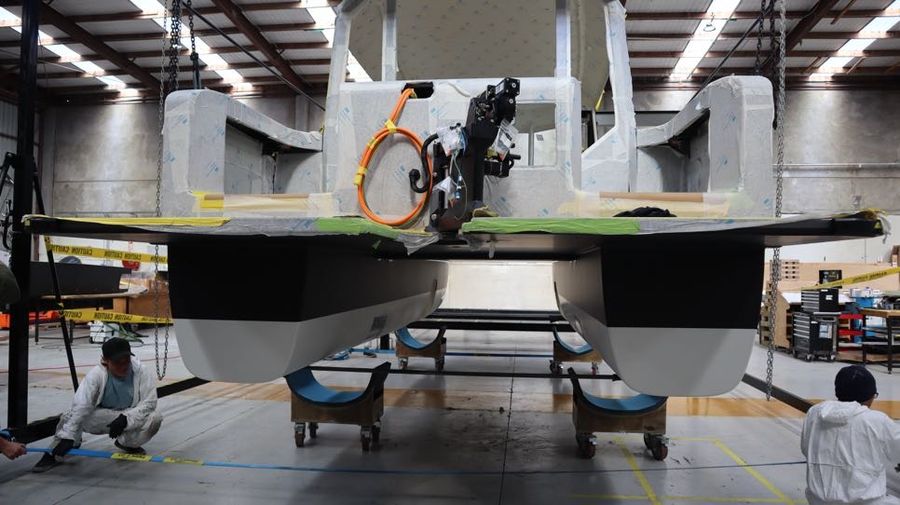
Walking into the Vessev factory, the first impression is one of concentrated purpose. Carbon fibre is everywhere. Moulds cover the floor in various stages of completion.
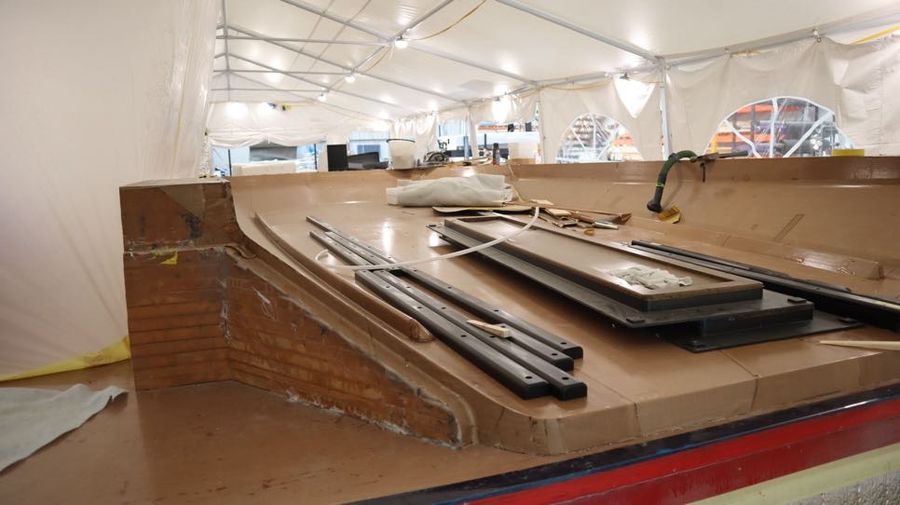
Some are rough-and-ready affairs, hand-glued MDF surfaced with Teflon, tools from the early builds that got the programme moving. Others are polished composite forms built to last for many production runs to come.
"In the beginning, these boats were artwork," explains Vessev CEO Eric Laakmann. "Each one was hand-built, one-off. But now we’re building for scale. We're turning them into products, not just projects."
The move to dedicated carbon tooling is a significant shift. Hulls and topsides will be drawn from purpose-built moulds, cutting labour time and lifting build consistency. A five-cell assembly line is being established, one that will put a new vessel in the water every five weeks.
Beneath the skin, these are not conventional craft. The foils retract fully, are modular in design, and have been engineered with long-term serviceability as a priority. "These aren't precious tech toys," says Laakmann. "They're meant to be used. Anywhere."
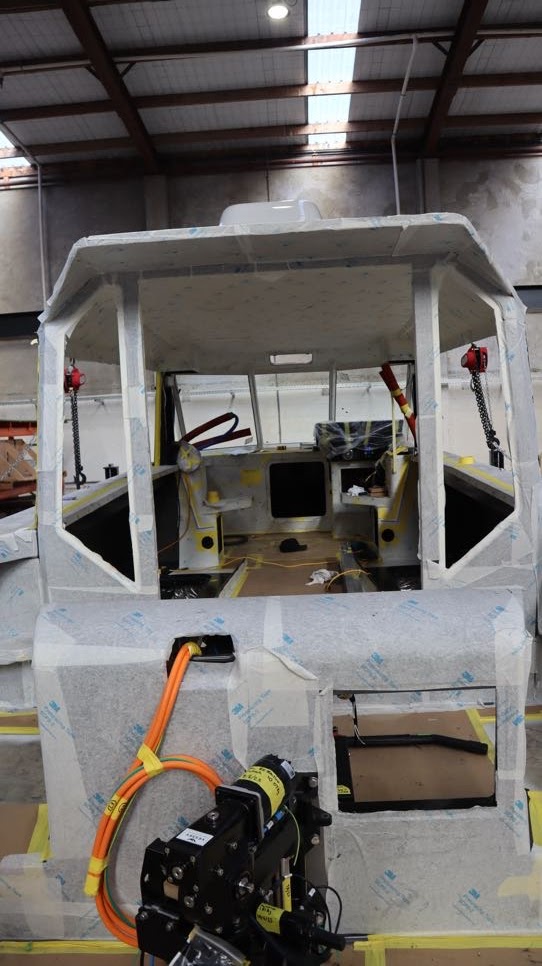
That thinking runs through the entire vessel. Seven actuators manage the rudder, foils, and flaps, and every one of them is built around the same core design. If one fails at sea, a replacement can be fitted without rewiring or recalibrating anything.
The foils themselves can be serviced in the field. They bolt apart into sections sized for practical handling, with clear material transitions between carbon fibre and stainless steel at each joint. QR codes printed directly onto hardware components link to teardown guides, repair instructions, and parts lists. The philosophy is closer to a tractor than a Tesla, and that is entirely deliberate.
"This isn’t just for New Zealand," says Laakmann. "We want someone in Palau to be able to service their own boat with a set of spanners and some basic skills."
Our time aboard the VS-9 began without ceremony. Three Vessev team members, a couple of guests, and the soft electric hum of drive components as we eased away from the dock. The Waitematā was doing what it does on a winter morning, throwing a bit of chop. And then, as speed built, the boat simply rose.
There was no shudder, no burst of spray, no dramatic announcement of the transition. It lifted and continued lifting until it was flying, and the whole thing felt almost unremarkable in the best possible way.
"You don't even feel it," someone said from behind us. That about covered it.
Once foiling, the experience shifts into something genuinely strange. The noise that defines most boating, hull percussion, water spray, engine rumble, disappears almost entirely. Steering demands almost nothing. Motion feels frictionless. Ferry wakes crossed beneath us without registering. A patch of cross-chop that might have unsettled a conventional hull was simply gone. The vessel moved across the water's surface the way a well-trimmed glider moves through air, absorbing everything without complaint.
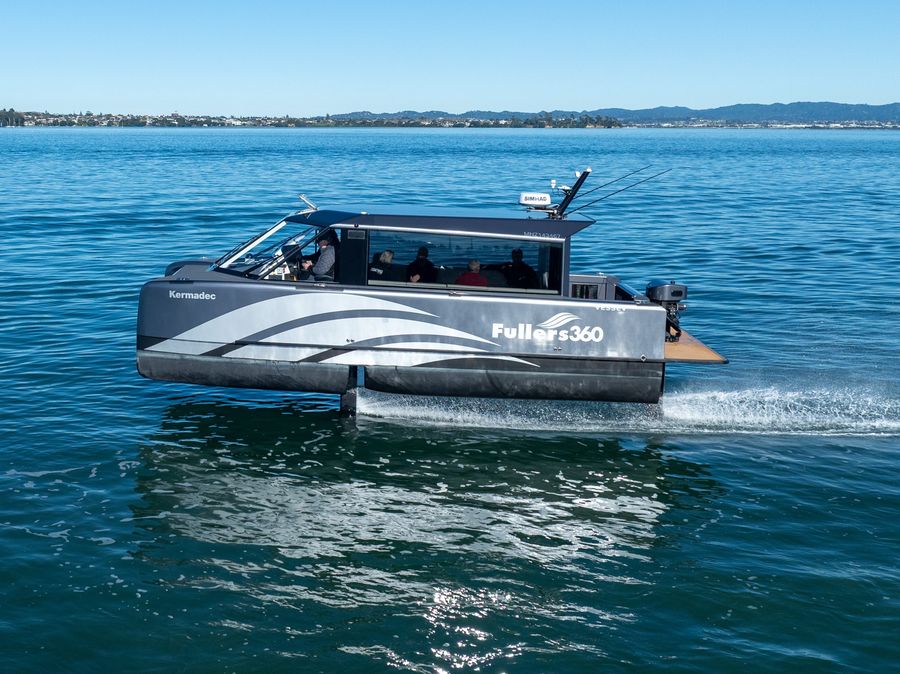
The most striking thing about the VS-9 under way is how little the helm requires. There is no foil-trimming procedure, no screen to monitor, no complex interface to manage. You steer, you control speed, and the boat handles the rest.
Vessev uses a distributed ECU layout, each foil running its own dedicated computer. Pitch, angle of attack, retraction, and lift are all calculated and adjusted continuously. The system reads loads and responds before a driver could even register the need. None of this is visible to the person at the helm. It simply works.
The design centrepiece is what the team calls the Pi Foil. The majority of lift is generated at the centre of the span, where flow is cleanest and the lift-to-drag ratio is at its best. The tips taper deliberately, borrowing a principle straight from glider wing design to reduce vortex losses at the extremities.
Full retraction solves a problem that plagues many foiling designs: fouling. "Even a little slime on a foil can kill your efficiency," one of the engineers noted. "Lifting them clear of the water is critical." No divers, no hardstand haul-out required to keep the foils clean.
Back ashore, the production strategy came into focus. Rather than an endless series of bespoke builds, Vessev is consolidating around three platforms: the 9-metre, a 12-metre, and an 18-metre vessel currently in development that will carry up to 100 passengers.
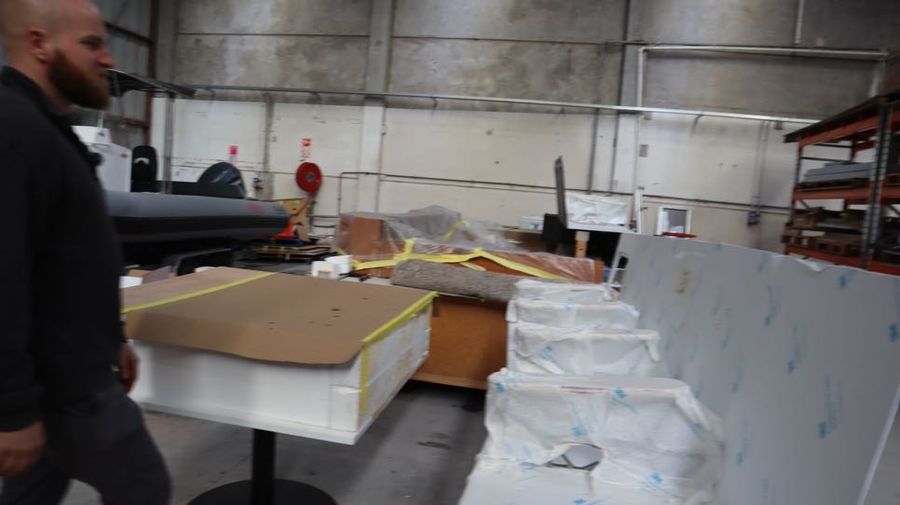
Each platform shares a common hull and foil system. Above that baseline, the topsides are adaptable. Commuter seating, enforcement fitouts, aquaculture configurations, private luxury arrangements. The variation happens where it is cheapest and simplest.
"Everything difficult is in the platform," said Laakmann. "The rest is just furniture."
The division between platform and payload borrows from aviation's approach to fleet management. It makes manufacturing repeatable while still allowing the operator-specific configurations that commercial buyers need. Vessev's partnership with Fullers is already validating the model, and interest from the United States and United Kingdom is growing. Moulds may eventually be shipped offshore. Software and foil packages could be licensed to builders in other markets. In time, the Vessev name may not appear on every hull running their technology. But the technology will be there.
For all the precision tooling and composite engineering inside the factory, one point from Laakmann stood out above the rest: building boats is not the whole story.
"We’re more like a marine technology manufacturer," he said. "We build boats as well, but we build boats because it’s the only way to integrate our technology for now. But in the long arc, like, there’s no reason we can’t be providing our technology to other boat builders out there."
The deeper value Vessev holds lies in its intellectual property, the hydrofoil geometry, the stability control algorithms, the distributed computing architecture, and the control software that ties it all together. As Laakmann put it:
"That’s how you get scale. Boats are unique and special snowflakes. And the reality is that we aren’t going to be able to serve every market on our own."
He draws a comparison to Apple, a company he previously worked with:
"Apple does very little of their own manufacturing. Apple’s a design company. They partner with manufacturers to create their hardware. We’re not Apple yet… but in the long arc of it, we could start deploying some of those tactics."
Whether that means partnering with third-party builders using Vessev's designs, or licensing foil and software systems for integration into hulls built elsewhere, the company's direction is consistent: to be the technology at the heart of a global fleet of next-generation vessels.
Our visit also included a preview of something not yet public, a fully integrated propulsion system developed from scratch for electric foiling.
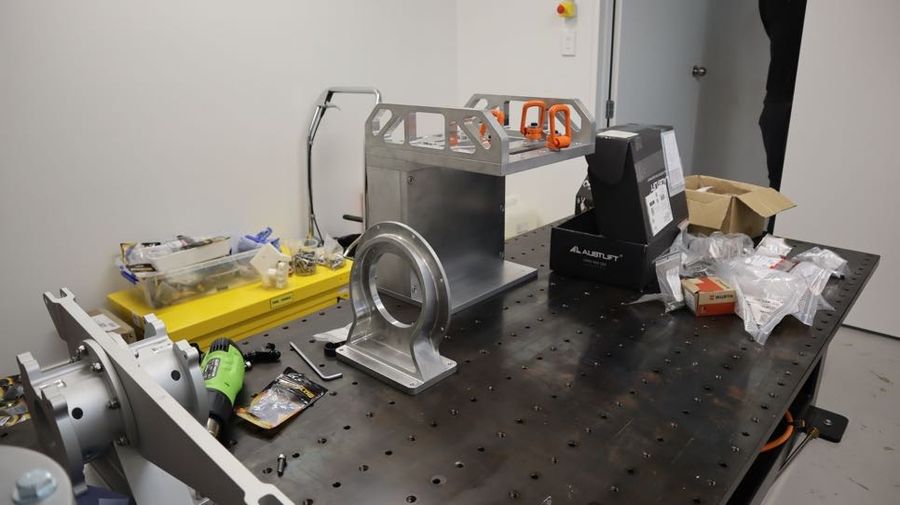
The specifics will keep for now, but the new system represents a meaningful step forward in efficiency, cooling, and overall simplicity. It is scheduled to debut in July, and we will have a full account in the next issue of Boating New Zealand.
What Vessev is building resists easy categorisation. It is not a luxury toy, and it is not a fragile prototype kept behind rope at a trade show. It is a scalable, serviceable, and genuinely elegant response to a question the maritime industry has been circling for years: how do you go faster, cleaner, and more economically without making things worse for the sea?
Their answer, it turns out, is to leave the water behind altogether.
The VS-9 is foiling now, with larger vessels to follow, and the technology underpinning all of it is already attracting serious commercial and international attention. Whether the task is moving commuters, supporting enforcement operations, or simply delivering someone an unforgettable hour on the harbour, Vessev's boats are already doing it.