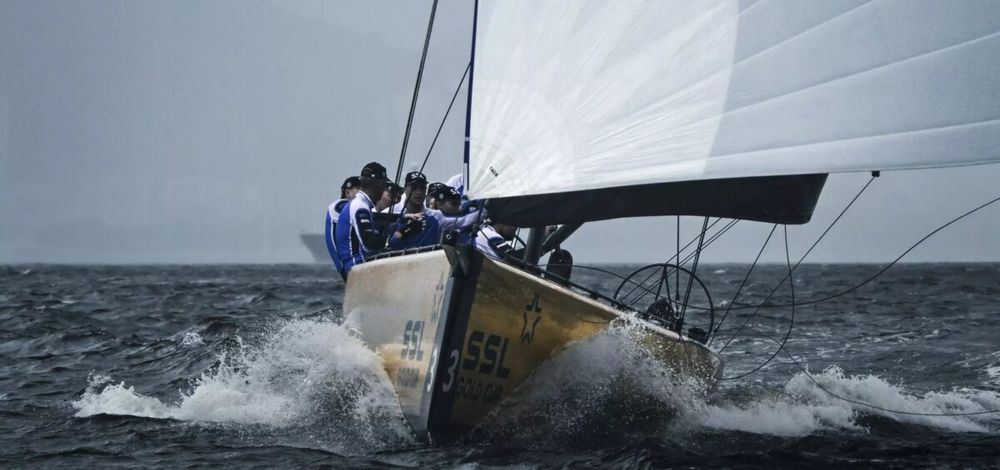
Rio served up a dramatically different welcome for the Copa do Mundo da Vela's 1/16 Finals. Sunshine was nowhere to be seen, replaced by rain and heavy cloud that swallowed Sugarloaf Mountain and hid Christ the Redeemer completely.
The wind, at least, delivered. Guanabara Bay served up 15 to 17 knots from the south-southwest, enough to make the opening races genuinely testing.
Group A's first race began badly for the defending champions. The Hungarian Shamans were buried at the start as Ecuador held the committee boat end and Tahiti's Black Pearls blitzed away from the pin, with Estonia tucked in the middle of the pack.
It didn't stay that way for long. Estonia's Icebreakers, who impressed through the 1/32 Finals, hunted down the Black Pearls upwind while the Shamans clawed their way back to round the top mark second.
Downwind it got properly wild. White water rushed over the decks as boats topped 17 knots, grinders working flat out while trimmers fought to keep the spinnakers under control. This was sailing right on the edge.
Tacticians had just as much to think about as the muscle on board, reading windshifts as rain squalls rolled through overhead.
Estonia simply extended from there, looking entirely at ease in the conditions, while the Black Pearls reeled in the Shamans to round the final windward mark just 10 seconds back. The Icebreakers went on to win comfortably. Hungary held off Tahiti by the narrowest of margins, and Ecuador will need to find more if they're to make a dent in an unforgiving group.
Icebreakers helm Mati Sepp was in good spirits coming ashore. "We were wondering: if we brought our Estonian weather, nasty and cold, we should sail well. So it was exactly like that."
On what they'd taken from the 1/32 Finals, Sepp added: "It was tricky. Many shifts, many puffs, so we tried to be conservative. We put in our best race with the crew work, and for sure those five days before are a big advantage, I'm sure."
Group B's race was, if anything, rowdier still. The breeze hit 20 knots as Chile shot off the line, Portugal forced Malaysia into an early tack, and South Africa trailed from the gun, looking ragged in the gusts.
The wind yo-yoed badly, sails flogging in the strong patches and dropping to 10 knots in the lulls. South Africa's Ubuntu crew had their race ended early when the trim tab came off the keel, their shore team scrambling out to assist.
Chile led at the windward mark ahead of Portugal's Navigators, until a heavy broach on the first gybe cost the Portuguese second place to Malaysia's Monsoon team. It only sharpened their response. The Navigators came storming back through a wall of spray to retake the position.
They kept pushing up the final beat, running down Chile's Finis Terrae and powering through into the lead. From there Chile and Portugal match-raced as the wind faded, so locked on each other that Malaysia slipped away on a better breeze to the right and grabbed the front.
It stayed unsettled right to the end. Malaysia tacked beneath Portugal on the layline with Chile close behind, and the spinnaker hoists that followed were nervous affairs. Chile's hoist was clean, Portugal's was not, and Chile shot through into the lead while Malaysia lost the pressure on the right.
Chile held the stronger breeze on the left all the way home for the win. Portugal, water pouring over the deck in what the fleet is already calling submarine mode, took second ahead of an unlucky Malaysia.
A shivering Pedro Felipe Robles, Chile's helm, summed it up on the dock. "It's a very crazy and funny day, with a lot of wind gusts in different directions. All the trimmers are needed, always trimming the sails to catch that pressure, that puff, in the right direction."
On the tactics that won it, he explained: "We had a good start, leading the first upwind and the first downwind, and on the second upwind we probably made a few mistakes with the current, and that left us in third place, but in close contact with the leader. When we arrived at the windward mark, the wind went down, and we looked at the sea, a lot of wind puffs in different directions, and the tactician and the strategist made the best choice: an early gybe, to race on the left side of the course downwind. We caught the first puff, and with that puff we could build a lead for the whole downwind."
Keeping the boat upright wasn't straightforward either. "Helming is not easy, because the wind is not steady," Robles said. "There are holes with less wind and really aggressive puffs. Together with the trimmers we need to have a steady wheel and keep control of the spinnaker so we don't capsize."
By the time the wind topped 25 knots, organisers called racing ashore for the day. Only two races got away, but the conditions made for thrilling racing all the same.