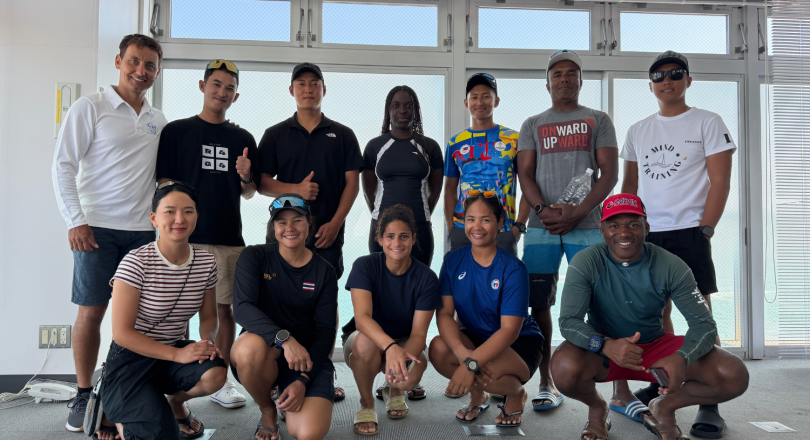
Days out from the 470 World Championships in Enoshima, Japan, sailors from the Philippines, Pakistan, Angola, Thailand and South Korea gathered for a training clinic aimed squarely at the nations still finding their feet in the class.
Igor Marenić led the sessions. The 470 Class President and Rio 2016 Olympic gold medallist brought exactly the kind of authority these programmes need: someone who has won at the top of the class and understands what it takes to get there.
The work was practical. Starting techniques, boat handling, race strategy — the fundamentals that developing programmes often have no one to drill into them back home.
"It was a very good opportunity for us to join the group and we learned a lot over the past few days," said Nichapa Waiwai from Thailand. The sentiment carried through the whole group. "We learned from a professional and got a lot of advice that we can take home and continue working on. We now have things to work on and improve to become better in the 470." Another voice in the group put it plainly: "We can learn from people who have really good knowledge, do the right things and then take that homework home and keep improving."
Seldén backed the clinic by supplying masts, booms and spinnaker poles to the participating teams. For programmes operating on thin margins, that kind of equipment support isn't a minor convenience.
South Korea arrived with seven crews, one of the larger national contingents on site. Around ten 470s are active in Korea, and a World Championship held in Asia made the trip viable for sailors who might otherwise never have got to a Worlds. "For us, it was a really good opportunity. We don't have much support, so we wanted to join this clinic. We learned a lot from Igor, and we are very thankful to the 470 Sailing Association," said Na Kyung Lee and Hae Seong Kim.
For some of the Korean sailors, this is their first World Championship. The Enoshima conditions haven't made the prospect any calmer.
"It is quite stressful but also exciting because this is our first World Championship." The venue delivers more than most Korean venues throw at them: stronger winds, bigger swells, a different scale of challenge altogether. "Normally in Korea we can't sail in more than 20 knots, so I'm really excited and looking forward to joining the competition."
Fleet starts were a specific focus of the clinic, and for good reason. "The start was very important because we don't have much experience with a big fleet. Normally in Korea we sail in a small group, so we learned how to manage the line, the bias and the strategy at the start. We learned a lot from Igor."
There was something else happening beyond the coaching, something you notice when you watch sailors from five different countries rig unfamiliar boats in a foreign harbour and slowly start talking to each other. "Some countries we had never seen before and never met before. We had the opportunity to train together and build a good friendship with each other."
The shared hope now is that this was a beginning, not a one-off. "I hope there will be many more clinics like this in the future to help developing countries improve and reach the top level in the world."