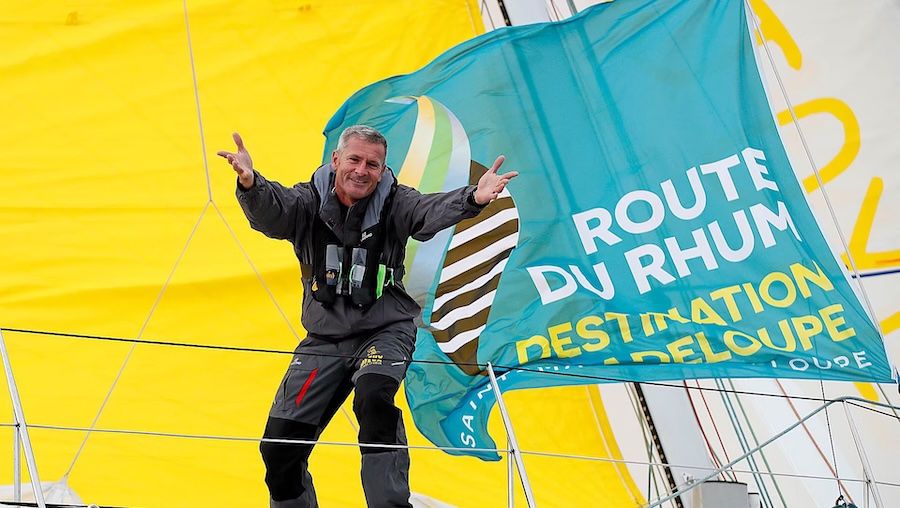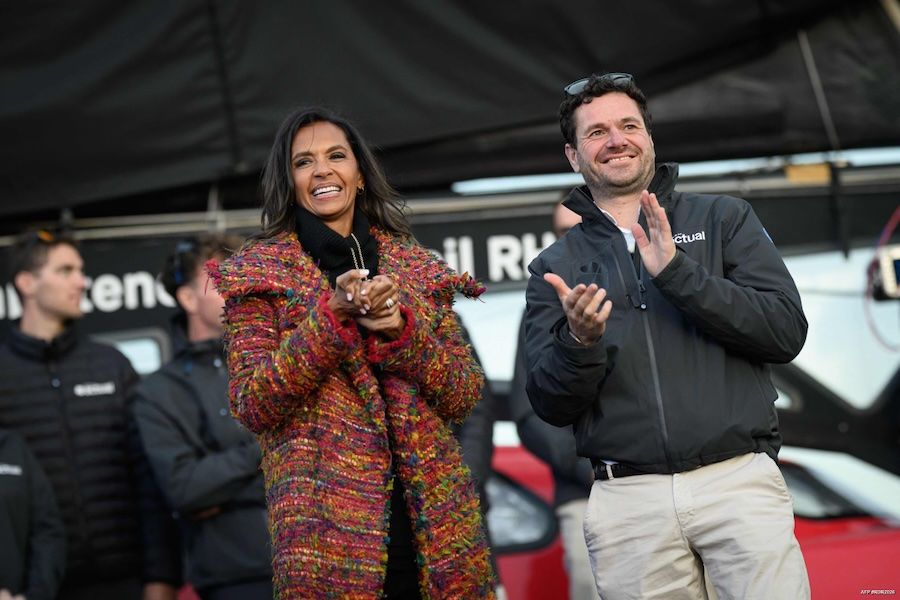
The hardest part of the Route du Rhum often has nothing to do with the ocean. It is the handful of minutes before the cannon fires, when years of preparation collapse into a goodbye on the pontoon.
Franck Cammas knows that feeling better than most. Four Route du Rhum campaigns, a win in 2010 aboard the maxi-trimaran Groupama 3, and plenty of solo miles behind him. Yet when he talks about the toughest hours, it is not the start itself he points to.
"I've always found the days before the start harder to live through than the start itself," he says. "You spend a lot of time imagining what could happen, everything that could break, the conditions you'll meet. You check the weather to see what you're in for. And then, suddenly, you know you're about to leave the comfort of land for a completely different environment."
He remembers his first Rhum in 1998 vividly. Barely 500 miles of solo sailing on the boat before the start, and a force 9 gale forecast for the very first night. "I had no particular ambition for performance. My goal was simply to get through it. In a way that took the pressure off too. I accepted I'd sail my own race, without trying to match the best straight away."
As the start nears, action takes over from anxiety. Leave the hotel, get to the boat, say goodbye, cast off, almost to the minute. "The hardest part might be saying goodbye to everyone, with all the uncertainty of the hours and days ahead. Once you've left the pontoon, you move through a programmed sequence of actions. You're no longer imagining what might happen, you're responding to what's in front of you. And that actually relieves the stress."
An hour after the gun, Cammas says he has often felt almost relieved, not because the difficulties had vanished, but because he could finally act.
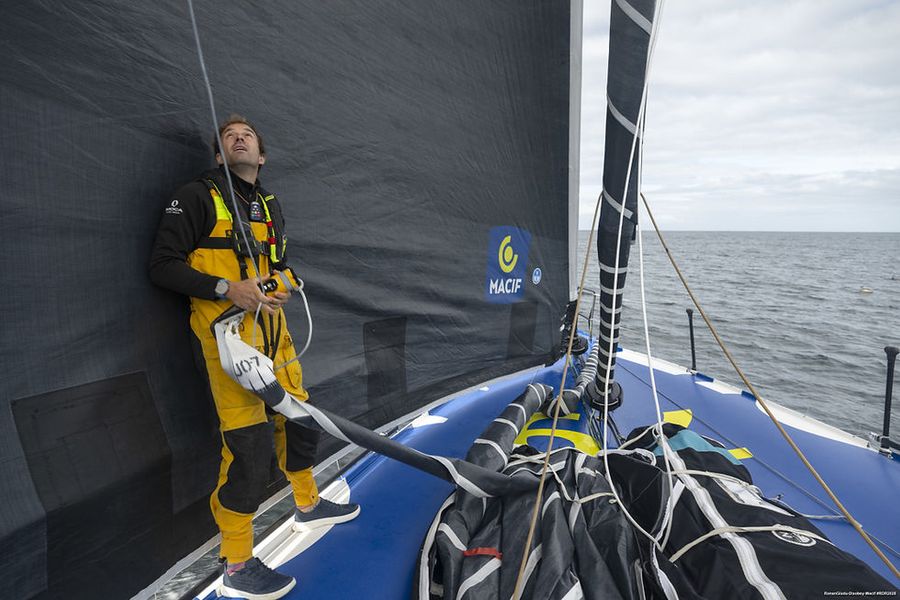
Sam Goodchild, aboard MACIF Santé Prévoyance, describes something similar, with a dash of humour about the buildup in Saint-Malo. "You need to arrive fit for the start, but you spend a week in Saint-Malo where everyone asks if you're stressed. You weren't necessarily, until someone asks ten times in one day!" Once aboard, though, there is no time left for second-guessing. "When you start looking at sail choices, getting your bearings on the line, talking with the team, you're in action mode. It's almost a relief. This is it, we're here. Afterwards, once racing, other worries arrive. You don't want to break anything, you don't want to make bad strategic calls, you're watching the others. But at the moment of the start, there's no time left to think about stress."
For Florian Gueguen, sailing Graine de Courage, the story starts long before his first Rhum. Growing up in Cancale, he watched the fleet leave for Guadeloupe every four years from the same stretch of water where he learned to sail. "When you're a kid growing up here, the Route du Rhum is mythical. We'd come watch the starts in the little catamarans from sailing school. Back then the skippers were stars, it seemed completely out of reach. I never imagined I could take part one day."
The dream eventually took shape almost without him noticing. He found himself entered in 2018, boat not fully prepared, the whole thing feeling slightly unreal. "I think I really realised what was happening to me once I was in the village, then on the start line. It was almost surreal. I was so absorbed in building the project I hadn't prepared enough for the race itself." That campaign ended in Spain, a retirement he now views as a useful lesson.
Four years later he reached Guadeloupe. On 1 November he will start his third Rhum, this time aboard the trimaran Graine de Courage.
"The first times, it's otherworldly. It's not quite the same feeling now, but it's still just as consuming. Living in Saint-Malo, people talk about the Rhum all year. By February or March folk are already asking if the boat's ready, if you're qualified. It feels like nothing else matters."
Even so, the goodbyes might be the hardest part of all. "I'm not big on farewells. I often tell the people close to me I'd rather not see them on the day of the start. It's almost harder than the race itself. It takes a few hours to really get into it."
Behind the spectacle for the thousands on shore lies a much lonelier truth. "You go from a world full of people around you to two weeks completely alone on your boat. The first times, you wonder how you'll cope. Then night falls, it's cold, damp, the boat moves, creaks. It's not exactly a holiday departure!"
David Ducosson, racing Trilogik in Rhum Multi, knows that jolt too, having lived through two very different editions. "It's a wonderful moment, but also really hard emotionally. You leave family, friends, and suddenly you're alone in the pack. It's a real shock. And you can't really let yourself dwell on it, you need to focus straight away on what's happening around you." This year adds another layer. "My family situation has changed. I have kids now, so emotionally it's different again."
Ducosson's two previous Rhums were sporting opposites. In 2018, aboard a Multi50 he knew intimately, he led his class rounding Cap Fréhel, sailing among the best IMOCAs. "I managed pretty well. I found my rhythm and it gave us some great footage of the boat." Four years later, far less rosy: a new trimaran bought in spring, barely sailed before late summer. "Last time, even though I was behind on preparation, I knew my boat really well. I'd helped build it and sailed it a lot. In 2022 it was the opposite. We bought it in May, started sailing late July or early August, and didn't really have the manual. I had plenty of dramas."
This time he has better foundations: two Atlantic crossings aboard, regular sailing around Guadeloupe, deep knowledge of the boat. Enough to approach the opening manoeuvres calmly, without overdoing it. "The goal isn't to cross the line ten minutes behind everyone else, but it's not to break the boat trying to nail the start either. Stay calm, position well, don't take unnecessary risks. Starting mid-pack isn't a disaster. It doesn't define the whole crossing."
Goodchild knows better than most how quickly things can unravel before the fleet even gets properly underway. In 2018 his Rhum ended almost as soon as it began. A technical failure sent a winch handle recoiling violently into his arm and face, brutal timing, yet he refuses to let it become baggage.
"It wasn't easy or pleasant, obviously. But we know what happened, we know why, and we learned from it. We managed to process that episode. What happened four years ago isn't just about starts either, it can happen anywhere, anytime. We apply those lessons every day." The accident demanded a different kind of focus entirely. "When a problem hits, the stress disappears in a way. You switch into crisis management. You stop wondering what might happen and start working with the situation you're actually in."
Cammas has now experienced that switch from both sides. In 2022 he was alongside Charles Caudrelier in the final minutes before the gun, aboard the Maxi Edmond de Rothschild, before stepping off. This year he will again watch from a competitor's camp, working within SVR-Lazartigue's performance team alongside Tom Laperche.
"When you're part of the team, you know roughly what's in the skipper's head. So you try to spare them as many questions and distractions as possible. You know it's not the moment to bother them." Back on shore, though, he can finally enjoy the show. "As a spectator you obviously feel emotion, but it's nothing like being aboard. It's far more relaxing. You appreciate the start more, you see how beautiful it really is. When you're on the boat, you're busy managing yourself before you can enjoy any of it."
For those staying ashore, the Route du Rhum is pure spectacle, noise and colour and feeling. For those sailing away, it marks the end of the waiting and the last shared moments with the people they love.
The coast will soon fade, and attention will shift to the first tactical calls of the race.
On 1 November, off Saint-Malo, each sailor will make that same crossing from land to sea in their own way, carrying their own history. Before facing the Atlantic, each of them first has to find their own way of leaving it behind.