The Class40 fleet lining up for the Route du Rhum, Destination Guadeloupe 2026, is the largest and most fiercely contested in the race's history, and no one is pretending to know how it ends. Favourites, outsiders and newcomers will share the same start line, with wildly different budgets and ambitions behind them.
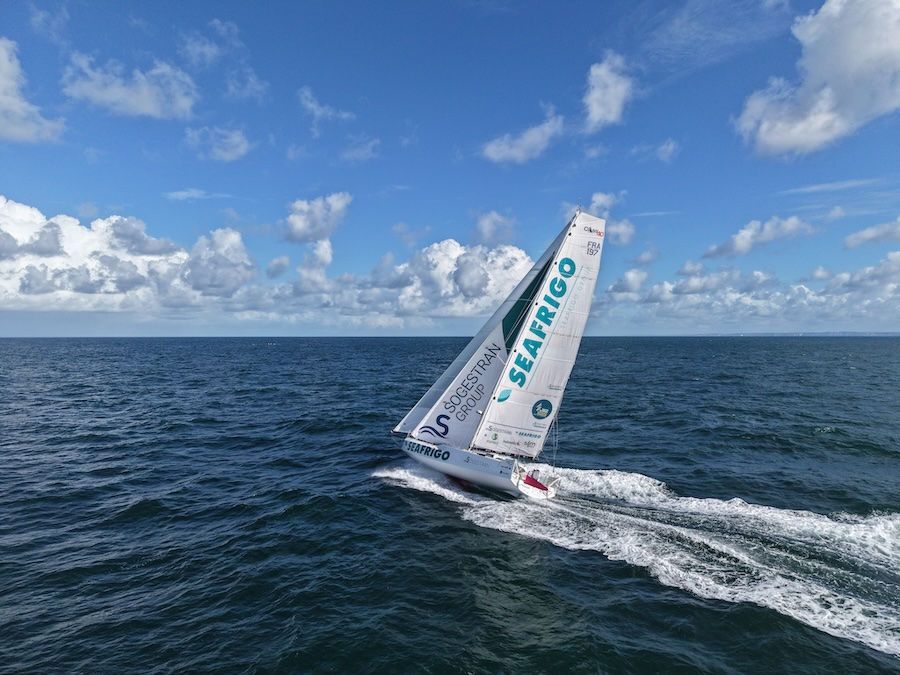
Two names stand above the rest on paper: Corentin Douguet (SNSM, Faites un don!) and Guillaume Pirouelle (Sogestran, Seafrigo). But the chasing pack is deep, led by what Alexis Loison (Groupe RÉEL) calls the "troublemakers", a phrase that sums up the mood nicely. This looks like an open fight, with the pecking order still to be written somewhere out in the Atlantic.
It is hard to talk favourites without starting with Douguet and Pirouelle. Over the past two seasons the pair have left little for anyone else. Douguet had a stellar 2025, with three wins and a second place in the Transat Café L'Or, and has kept the form going this season with another victory. Pirouelle, who won the Route du Café alongside Cédric Château, has backed that up twice more in recent months, and also sailed as part of the crew on Sodebo Ultim 3, the new holder of the Jules Verne Trophy.
"We've worked hard, we've built a great boat and it's well prepared. Now people expect us to live up to that," says Douguet, third in the previous edition and a veteran of three solo transatlantics already. Rivals less accustomed to long solo passages will be reckoning with that experience.
Pirouelle knows plenty about solitude too, though this crossing will stretch that solitude much further than he is used to. "On paper I'm arriving in very good shape. I've built up a lot of confidence, the whole team has improved. But you also have to know how to reinvent yourself once you start winning. And remember you never control everything."

The sailor from Le Havre knows he will need to pace himself differently than in Figaro racing. "In Figaro you can push hard for five or six days. Here you'll need to manage yourself. Handling fatigue and clear thinking will matter as much as handling the boat." Still, he is not about to go soft. "I like pushing myself, going right to the limit of what I can do. When conditions get hard, I remind myself it's hard for everyone. Those are the moments you can make a difference."
Behind the leading duo, there is a serious queue forming. Fabien Delahaye (Legallais), Axel Tréhin (Exalt), Luca Rosetti (Maccaferri Futura), Ian Lipinski (Crédit Mutuel), William Mathelin Moreaux (Patapain Les Invincibles), Quentin Le Nabour (Bleu Blanc Planète Location), Timothé Polet (Team Zeiss), Pierre Leboucher (Institut Imagine), Milan Koláček (Inland Roots Ocean Soul), Pep Costa (VSF Sports), Mikaël Mergui (Hirsch, Centrakor), Achille Nebout (Amarris) and Alexis Thomas (AfterData, Elcia), recently crowned French Elite offshore racing champion, round out a strong field. That list alone gives a sense of just how deep this fleet runs.
Loison is among those capable of upsetting the picture. The sailor from Cherbourg, winner of the 2025 Solitaire du Figaro, won the 40' Malouine, La Trinquette on his first competitive outing aboard his new Lift V3, launched in July. He is careful not to read too much into it. "There are two guys who have won pretty much everything over the past two years. Behind them there's a whole pack of troublemakers. I put myself in that category. I like shaking up the hierarchy." It will be his first solo transatlantic, though he brings nineteen years of Figaro Beneteau racing with him, even if he is still learning his new boat's quirks.
"The Route du Rhum is a sprint, but one that lasts fifteen days. You have to find the right balance, sail cleanly, not make mistakes by trying to go too fast. And solo racing shakes things up. It's less predictable on paper, which opens up opportunities. That suits me fine," Loison says.
Leboucher agrees. Sailing Institut Imagine, a boat no longer from the latest generation, he will need to find ways to compete against inherently quicker rivals. "The new Lift V3s have a real edge. But the weather could reshuffle the deck. And solo, it's hard to push a boat at 100 percent the whole time. There's more risk of breakage and mistakes." So the rankings on paper may look quite different once the fleet actually hits the ocean.
The roughly 3,500 miles between Saint-Malo and Guadeloupe could throw up plenty of surprises. With no compulsory course marks, each skipper is free to choose their own route. There are fronts to negotiate, pockets of wind to chase down, and routes that could diverge wildly, enough to give the planners headaches, and the gaps between boats could open up fast. "Conditions over the first five days could favour some boats over others. And because the strategic options on this race can be so different, the range of possible outcomes is actually huge," Leboucher says.

Douguet puts it more bluntly: "On a transat, there's one thing you're sure of, and that's that you're sure of nothing." Pirouelle takes a similar view. "You can hit several difficult patches, sometimes lasting days. You have to get through all of them. Whoever comes out of them best can then go for the win." That drive comes with a dose of caution, and no desire to be boxed in by expectation. "A podium would obviously be great. I even think I'm capable of going for the win, but I don't want to put that pressure on myself. Above all I need to sail well and look after myself."
The fleet also includes ten straight-bowed Class40s, older designs that are naturally slower than the newest boats in certain conditions. Their skippers have no intention of playing bit parts. Loïc Féquet (Funae) and Belgian sailor Djemila Tassin (Djemila Sailing-Belgium Ocean Racing) deserve particular attention. Féquet, who bought his boat in January, has spent recent months largely on refitting and reliability work rather than time on the water.
"I'd rather do things properly from the start than have to redo them three times. The boat is ready now, and so am I. Since I haven't sailed a huge amount, I'm just really keen to get going." He accepts the scow-bowed boats have a speed edge in certain conditions, but has no plans to simply watch his nine classmates from a distance. "The idea is also to try to eat a few scows along the way. I don't know exactly how it'll turn out. I'll sail my own race, push where it feels right, and we'll see."
For these sailors, satisfaction will not come down to finishing position alone. "We put so much into these projects. The first reward is making it to the start line. The second is making it to the other side. And the Route du Rhum only comes round every four years, so you have to make the most of it."
Beyond the favourites and the fight for places, everyone in this fleet has their own reasons for being there, and fifteen days of Atlantic ahead of them to find out where those reasons lead.