
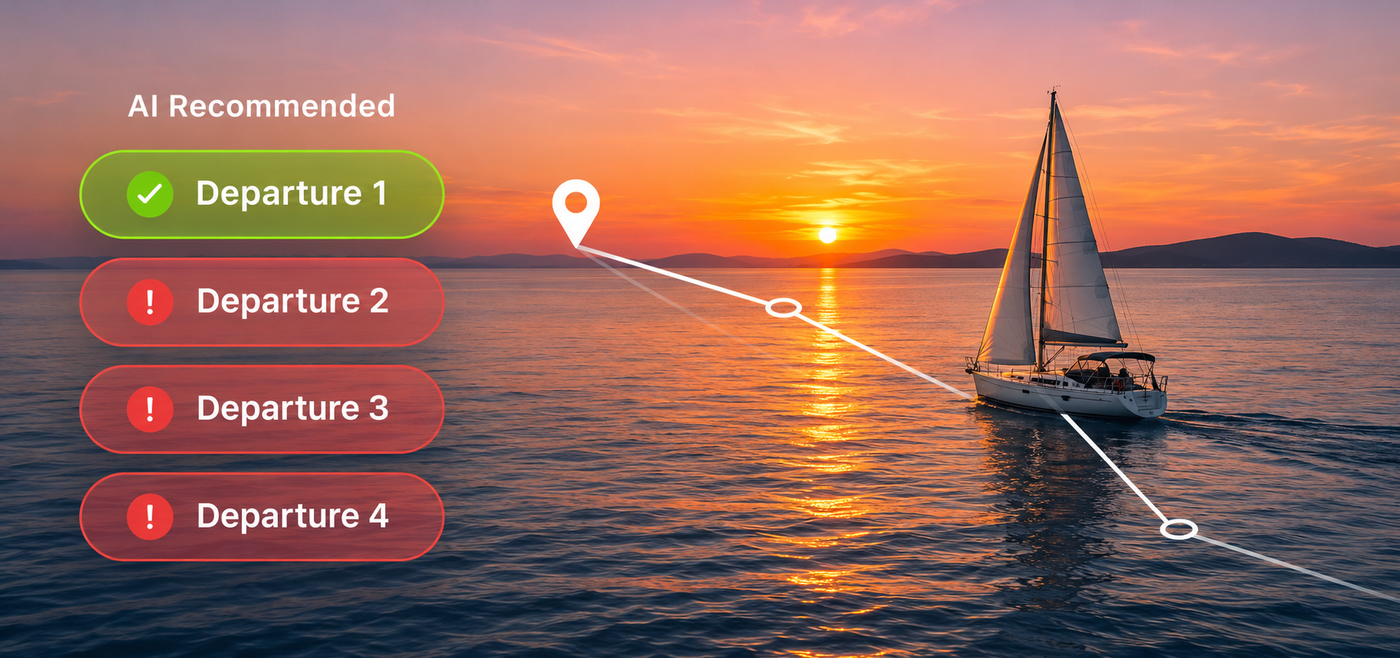
PredictWind's new AI briefings explain weather routing results in plain language, helping sailors and powerboaters compare departure options and prepare for the conditions ahead.
Auckland-based PredictWind has introduced an AI Weather Router that takes much of the legwork out of interpreting passage forecasts. Rather than leaving boaters to work through weather maps, tables and model comparisons, the software produces a written briefing explaining what they can expect along the way.
Announced in October, the feature sits within PredictWind's existing Weather Routing and Departure Planning tools. It doesn't produce its own forecasts. Instead, it examines routes already calculated by PredictWind's software, drawing out information relevant to the passage.
For experienced skippers, it's another way to assess the weather before making a decision. Those less familiar with weather routing may particularly appreciate having the results explained in everyday language.
Choosing the right departure window
Leaving a few hours earlier can make a surprising difference to a passage. You might get ahead of a building breeze, avoid an uncomfortable sea or find that waiting until tomorrow gives the crew a much easier ride.
PredictWind's Departure Planning tool compares up to four departure options, using weather forecasts and information about the vessel. The AI briefing examines those results, weighing wind strength, rainfall, passage duration, motoring requirements and possible thunderstorm activity.
It can recommend a preferred departure, suggest caution or advise that none of the options looks particularly appealing.
There's one detail worth understanding. The underlying Departure Planning calculations aim for the fastest passage without applying the skipper's comfort settings. A quick route could therefore involve some fairly unpleasant conditions. The AI may identify those concerns, but the calculation hasn't necessarily avoided them.
Anyone planning a coastal or offshore cruise will recognise the dilemma. The quickest passage isn't always the one the crew would choose.
Making sense of the passage ahead
PredictWind says its Weather Routing briefing examines calculated routes across eight forecast models. It divides the passage into periods, highlighting when conditions are expected to build, ease or become more demanding.
A skipper might find the first day looks relatively settled, followed by stronger winds and an uncomfortable sea during the second night. Having those changes explained in a written summary makes it easier to identify which sections deserve closer attention.
Sailors can review expected wind conditions and demanding stages of the route. Powerboat owners can also examine estimated fuel consumption, based on their vessel information and forecast conditions.
PredictWind's Professional subscription adds Wave Polar calculations, including predictions of rolling, vertical acceleration and slamming. These provide an indication of potential discomfort, although actual conditions aboard depend on the boat, its loading and how it is handled.
The familiar weather maps, graphs and tables remain available for anyone wanting to investigate the details.
What still needs the skipper's attention?
Before putting too much faith in the briefing, it's worth checking the boat's settings. PredictWind uses sailing polars to calculate how a yacht should perform in different conditions, while powerboat routing draws on vessel dimensions and engine settings. If those figures are out, the estimated passage times and fuel consumption could be too.
Then there's the weather itself. PredictWind acknowledges that forecasts become less certain further into a passage, particularly beyond five days. The AI can flag that uncertainty, but conditions can change considerably between planning a trip and actually heading out.
For all its clever technology, the AI is interpreting predictions, not reporting conditions from the water ahead. Skippers will still want to look at the underlying forecasts, particularly when the weather looks marginal.
Getting started with PredictWind AI Weather Router
The AI briefing is included with PredictWind's Standard and Professional forecast subscriptions. Professional users receive additional boat motion information through Wave Polars.
To use it, calculate a route or compare departure windows using the existing software, then open the AI briefing to read its assessment. PredictWind confirms availability in both its standard app and the Offshore App.
New Zealand sailors have already had a look at the technology. Ahead of the 2026 Coastal Classic, PredictWind's Mike Olson demonstrated the AI routing summary and explained its potential value to crews. His presentation featured in Go Boating's Coastal Classic weather coverage.
For boaters already using PredictWind, this is an addition to familiar forecasting tools rather than a completely different way of planning a passage.
It brings the important details to the surface, leaving skippers more time to consider the weather, their boat and the people aboard. And sometimes, understanding why a departure looks uncomfortable is more useful than simply knowing which option is fastest.
More information: PredictWind AI Weather Router