Vision Marine Technologies is placing a considered bet on one of the highest-volume segments in global recreational boating, and the product category at the centre of that bet would likely surprise anyone who learned to boat on New Zealand waters.
At a Kiwi marina, the words "pontoon boat" paint a recognisable picture. Brands such as Stabicraft, Senator, Surtees, Osprey, and Frewza have shaped what the term means here: sealed alloy hulls with buoyancy chambers running along the sides, engineered for coastal conditions, able to take a hammering offshore and keep their crews safe when the weather turns.
Across the Pacific, the same phrase describes something else altogether.
The North American pontoon is a broad, flat-decked platform sitting atop two or three large aluminium tubes. Its designers have never been interested in open-water performance. Lakes and sheltered waterways are its natural home, and the priorities that shape it are stability, generous seating, and unhurried social cruising rather than speed or sea-keeping ability.
The commercial weight behind that market is hard to ignore. Drawing on figures from the National Marine Manufacturers Association, industry data puts new pontoon unit sales in the United States at somewhere between 52,000 and 55,000 for 2024 alone. NMMA numbers show the category accounting for more than one third of every new outboard-powered boat sold across the country, ranking it among the busiest recreational boating segments anywhere in the world.
That is exactly where Vision Marine Technologies has directed its attention.
The company operates across two areas: electric propulsion development and multi-brand marine retail. Its approach to electrification has been deliberately grounded in commercial reality. Instead of developing experimental vessels and hoping buyers will appear, Vision Marine has concentrated its engineering resources on segments where substantial demand already exists. The pontoon category offered a persuasive fit, with its consistent cruising speeds, predictable power draw, and high passenger numbers.
Vision Marine's central propulsion product is the E Motion 180E, a 180 horsepower electric outboard system designed to go head to head with conventional petrol outboards in everyday recreational use. Pontoon hulls made strong engineering sense as a platform. Their stable forms, steady operating profiles, and spacious decks accommodate battery systems well, and these boats typically live in marina and lake environments where shore-power charging is becoming increasingly accessible. The company reports that its two most recent 180E-powered deliveries have both been pontoon platforms, suggesting the commercial strategy is starting to gain traction.
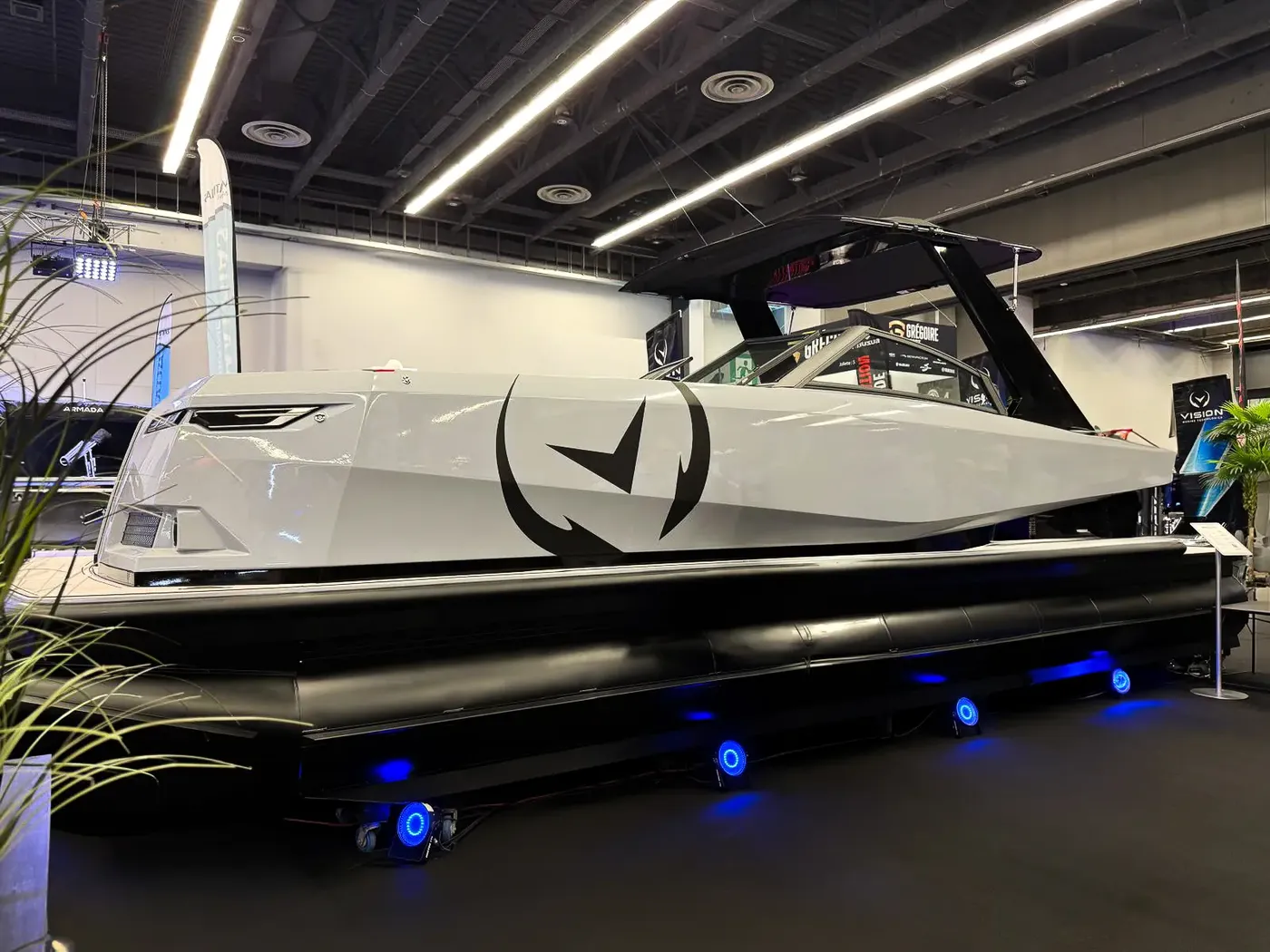
The SPECTR 26 is the fullest expression of that thinking to date.
At 26 feet 6 inches, the boat rides on a three-tube aluminium hull, a tritoon arrangement that adds a third pontoon down the centreline. Compared with a conventional twin-tube layout, the extra tube sharpens handling through turns, improves stability, and increases load-carrying capability. Vision Marine has paired that underbody with a reinforced fibreglass deck and 25 inch aluminium tubes built to stay composed through turns and moderate chop. Integrated lifting foils and hydrofin optimisation work together to improve hydrodynamic efficiency, helping the boat get onto the plane more readily and stretching its electric range further.
The finished package aims to deliver the easy, sociable time on the water that has kept the American pontoon category popular for decades, while doing so without a drop of fuel.
Vision Marine chief executive Alexandre Mongeon says the company's focus on this segment was deliberate from the start.
"The pontoon segment represents one of the strongest foundations in recreational boating because it combines volume and repeat usage," Mongeon said. "As boaters first, we engineered our 180 horsepower electric system around where the market already exists. SPECTR 26 reflects our commitment to delivering a high powered electric solution that performs at the level boaters expect while elevating the premium standard in this segment."
For anyone watching from New Zealand, the story surfaces an interesting question about the way boating traditions diverge and occasionally find common ground again.
Kiwis arrived at the concept of hull-side buoyancy tubes through an entirely different path, pushed there by the demands of rough coastal water rather than the appeal of calm inland lakes. What emerged was a family of tough, purpose-built alloy boats that share almost nothing visually with the wide, leisurely platforms Vision Marine is now fitting with electric drives. Yet both traditions are built on the same underlying idea: tubes deliver buoyancy, stability, and safety margins that a conventional monohull of the same size simply cannot match.
Whether electric pontoon boats of the North American style will ever take hold on New Zealand waters is far from clear. The conditions here are different, and the boating culture built around them has its own well-established character. As electric propulsion continues to reshape parts of the marine industry, the platforms carrying that technology toward the mainstream are worth watching. The pontoon, already reinvented once by American lake culture, may turn out to be an unlikely but effective vehicle for the next reinvention.