Auckland's EV Maritime cut its teeth building two 24-metre carbon fibre ferries for Auckland Transport, vessels that rank among the quickest fully electric ferries in operation today, each capable of carrying 200 passengers and engineered end to end by the company itself using an in-house standardised design. Now that track record is heading to Western Australia.
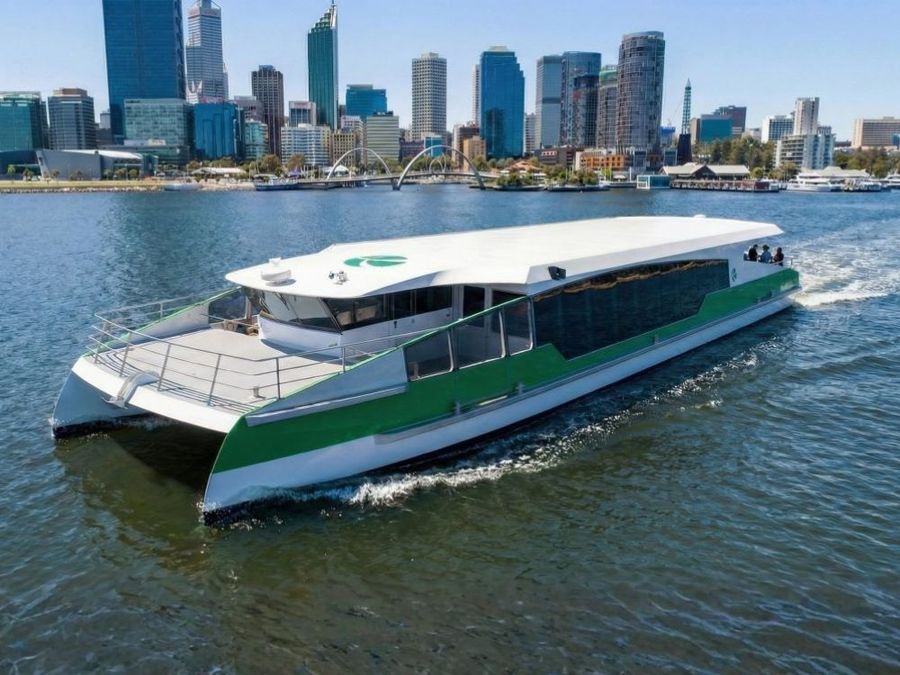
Echo Marine Group, the Henderson shipbuilder awarded a A$66 million contract to build five high-speed vessels for Western Australia's Public Transport Authority, has signed EV Maritime on as its electric propulsion systems integrator. The fleet forms part of the METRONET programme expanding ferry services on Perth's Swan River, and will give the state its first electric ferries.
Unlike Auckland, where EV Maritime controlled the whole build, this one runs on a naval architect's terms. One2three Naval Architects has drawn up a fully custom design for the five 24-metre aluminium vessels, each rated for 100 passengers at up to 25 knots, featuring a low-wake hull design, and EV Maritime's job is narrower by design: electrical systems integration only, plus the mechanical engineering that supports it. That covers power conversion hardware, the vessel and power management software, and an added layer for data intelligence.
Michael Eaglen, the company's founder and CEO, says stepping into a supporting role on a custom build rather than owning the design outright is still a landmark moment. He's "grateful to Echo Marine Group for trusting EV Maritime to deliver the integration package which underpins the capability of these vessels," and points to the Public Transport Authority's "bold vision and commitment to transport decarbonization" as reason the project matters beyond just Western Australia.
Damian Camp, EV Maritime's chairman, sees the custom nature of the job as the real story. Perth's low air draft requirement meant a one-off hull, but bolting EV Maritime's standard driveline onto it, in his words, means the firm "can now support naval architects and deliver high-confidence electric vessels worldwide" without walking away from the platform strategy that built the business. That strategy stays intact too: EV Maritime "will continue to develop and promote our platform designs as a proven pathway for shipyards around the world," Camp says, with custom jobs like this one simply adding to it, since "partnering with like-minded naval architects on custom project designs gives us far more reach and impact."
For Echo Marine Group, the appeal was experience rather than novelty. Anthony Livanos, who is managing the project for the shipbuilder, points to EV Maritime's track record: "some very impressive first boats that are directly relevant to our project," paired with hands-on knowledge of "the many challenges of deploying these new technologies." That combination, he says, is what gives his company and Western Australia's transport authority "real confidence in the delivery of this fleet."
None of this happens on the old technology, either. Shawn Balding, the company's chief electrical engineer, notes that even the Auckland vessels, which "set a new standard for capacity, performance and range for electric commuter ferries," are being superseded by what's headed for Perth: a next-generation driveline and automation platform he calls "a significant step up from there again, delivering higher performance, in shorter timeframes, for less cost and simpler installation."
Background:
Founded in Auckland, EV Maritime describes itself as a clean-tech engineering outfit on a mission to decarbonise the world's harbour cities, ferries first. It runs a pair of standard platform designs, available as full electric builds or plug-in hybrid variants, and supports boatbuilders across Australia, Canada, the United States and New Zealand with electrical and mechanical integration. The company's founder, Michael Eaglen, picked up the 2025 BLAKE Leader for Business title, and the company landed a place on 2025's Meaningful Business 100, the only Oceania name on that list and one of only four mobility firms included globally.
Echo Marine Group remains under family ownership, operating out of the Henderson-based Australian Marine Complex in WA, and specialises in construction, refit, maintenance and full custom design for large, complex vessels. Its contract to build this fleet on the Swan River is expected to create roughly 130 jobs for locals, apprenticeships among them, and will deliver Western Australia's first all-electric transit network.
---
*Echo Marine Group [states](https://www.echomarinegroup.com/echo-marine-group-awarded-landmark-contract-to-build-western-australias-first-electric-ferry-fleet/) the vessel has a maximum structural design capacity for up to 140 passengers.*