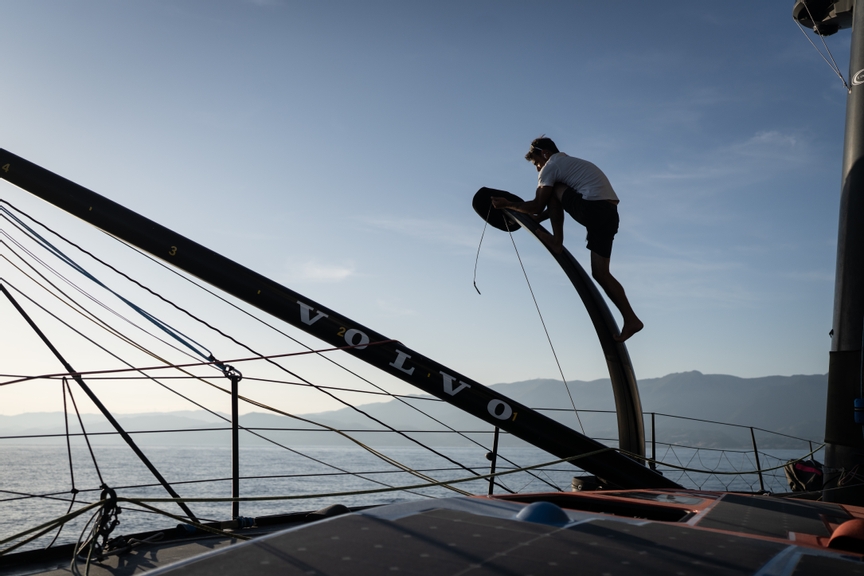
Since departing Genova the previous day, the fleet has been crawling through conditions that have barely offered 5 knots of breeze. With so little to work with, crews have gravitated toward the coastline, searching for any subtle shift or puff that might give them a marginal edge. The result is a tightly compressed fleet, with fewer than 10 miles separating all the boats and Paprec Arkéa holding a slender lead at the front. The road south still stretches a very long way ahead.
A philosophical mood settled over the skippers almost immediately after the start. Every small course adjustment, every tactical nudge, keeps circling back to the same pair of questions: can you race a sailboat without wind, and can a race even exist when nobody is going fast?
Before leaving Genova, Paprec Arkéa skipper Yoann Richomme had already sensed what was coming. "It looks like it's going to be slow and very light — we could take 48 hours to cover the first 200 miles," he said. Those words proved accurate almost immediately, with boats moving at no more than 4 knots through a near-windless sea.
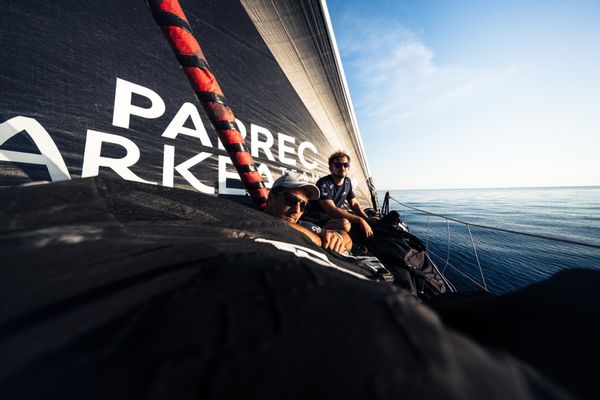
Paul Meilhat, skipper of Biotherm, offered an honest account of the opening miles. "We've had very little wind and not much more since the start," he said. Picking through the early stages required careful nerve: "It was tense, everyone wanted to turn right, but we decided not to take any risks." One small consolation, he noted, was that "the sea is the flattest we've had since the start." Richomme echoed the sentiment: "We've had flat seas since we left — it's really enjoyable."
Two distinct tactical choices presented themselves during the first 24 hours, as Meilhat outlined. The fleet could push toward Corsica, or it could hug the coast and work the thermal breezes that develop along the shore. Every boat opted for the coastal route. "It's very beautiful because it forces us to stay close to the land, but it's also very technical," Meilhat said. Richomme described the underlying logic: "The challenge is to pick up some breeze off the coast and then hope to catch a bit of thermal wind."
The competition itself has been anything but processional. Allagrande Mapei Racing led from the gun, delighting the home crowd and giving skipper Thomas Ruyant genuine satisfaction. "We got off to a good start by managing to catch the little bit of thermal breeze that was near the coast. It was erratic, but it helped us move forward well," he said. Biotherm subsequently moved through into the lead, with Paprec Arkéa following suit. Richomme was pleased to have made the move stick: "We tried to break away at the front, and it's really cool to have managed it." By this morning, Paprec Arkéa remained at the head of the fleet, with Holcim-PRB second and Biotherm third. The margins are tight, with fewer than 10 miles covering all seven IMOCAs and only 5 miles between the top three.
Allagrande Mapei Racing endured a frustrating episode during the night when a sudden speed drop pointed to a problem on board. "We definitely had a speed problem, but it was hard to understand why," Ruyant explained. Shining a light on the keel revealed the answer: lots of branches had accumulated at the top of the keel fin. Ambrogio Beccaria dived in to clear them, and the boat was able to resume racing. "Of course, it was a bit frustrating, but we got going again and are trying to hang on to the pack," Ruyant said.
The light-air battle looks set to continue through the day, with no obvious change on the horizon. "We don't really know yet when we'll get more wind, so it'll give us plenty to think about in terms of strategy," Richomme said. "It's always the wind that decides where you can go!" Meilhat put the broader situation plainly: "It's going to be fun but it's going to be very long. We're nowhere near arriving at the first waypoint off Sardinia. It's going to take us two days to get there!"