From turbines to timber: tracing the roots of offshore power
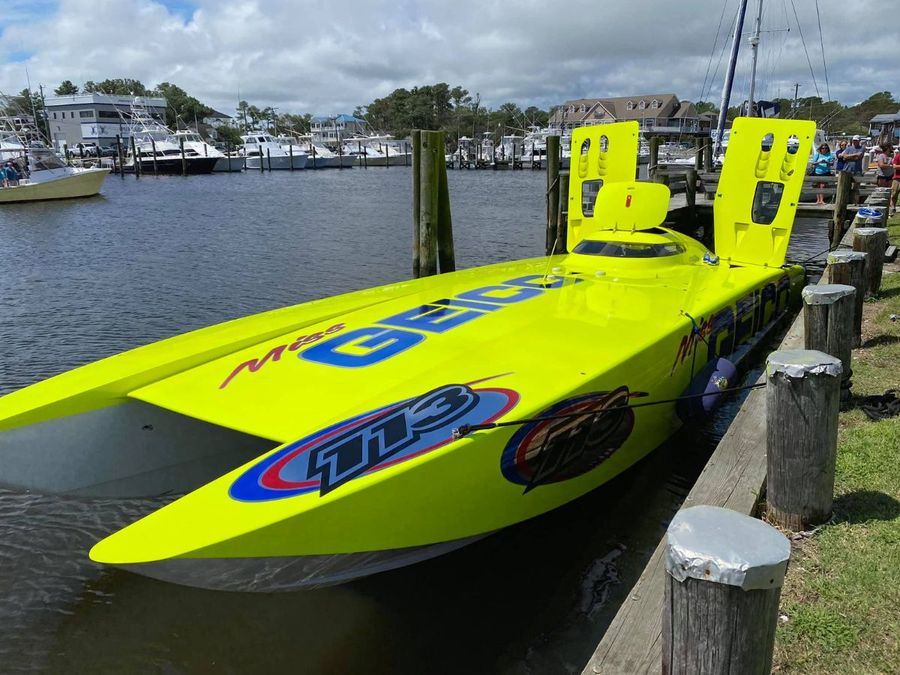
There is a vessel at the heart of offshore powerboat racing history that came to represent the absolute limit of what a competition boat could be. Miss GEICO, a 50-foot Mystic catamaran driven by twin Lycoming T-53 turbine engines, was capable of exceeding 210 mph (340 km/h) across open water. Its hull, built from carbon fibre, Kevlar, and S-glass, channelled more than 4,200 combined horsepower into pure, terrifying speed. It dominated race courses, shattered records, and drew attention from well beyond the boating world.
Yet the story of how humanity arrived at a machine like Miss GEICO begins not with aerospace materials or turbine thrust, but with a six-metre timber hull, a nervous crowd on a German riverbank, and 1.5 horsepower of engine that some onlookers were convinced could only be the work of the devil.
The year was 1886. The boat was Rems. And what it demonstrated that day on the River Neckar would set the entire course of engine-powered boating.
To understand why Rems mattered, it helps to picture the world it arrived into. Through the 1880s, small watercraft meant rowing boats, skiffs, and sail launches. Steam propulsion did exist, but it brought with it a catalogue of problems for anyone outside a commercial or naval context: heavy machinery, volatile pressure, licensed operators, and genuine danger. Experimental naphtha-powered launches had appeared briefly, running on volatile hydrocarbon fuel rather than steam, but they were temperamental and hazardous, and they would soon be overtaken by safer petrol alternatives. The broader context was one of rapid change. Germany, newly unified and industrialising at pace, sat at the centre of the Second Industrial Revolution. Electrification was spreading through cities, combustion engines were beginning to appear in factories and road vehicles, and engineers across the continent were asking what else these new power sources might transform. For a small boat on an inland river, the practical breakthrough still hadn't come.
Friedrich Lürssen had been building that kind of small boat since 1875, when he opened a modest workshop in Aumund, a riverside village near Bremen in northern Germany. The circumstances of his start were shaped by his father, Lüder Lürssen, himself a respected boatbuilder, who insisted Friedrich had to succeed independently rather than under the family name. So at 24, Friedrich set up his own workshop with a single assistant and got to work. He specialised in lightweight timber construction: rowing skiffs, small ferries, and fast sport launches designed for performance under oar or sail. His first customers were Bremen oarsmen looking for competitive racing craft, but the reputation spread quickly across Germany. Lürssen boats were celebrated for their elegant lines, precise workmanship, and genuine speed on the water. Their lightweight build gave them a consistent edge in regattas, making them exactly the kind of vessel a visionary engineer might look to when testing something new.

That small Aumund workshop, founded on timber, hand tools, and a father's insistence on self-reliance, would eventually grow into one of the world's most prestigious shipbuilders. Today, Lürssen is synonymous with the upper end of superyacht construction, responsible for vessels including the 180-metre Azzam, recognised as the world's longest private yacht, and Dilbar, the largest diesel-electric vessel by gross tonnage at 156 metres.
None of that was imaginable in 1886, of course. What was imaginable, to at least one man, was a small engine moving a boat across water under its own power.
Gottlieb Daimler was not a man who sat still with a good idea. Born in 1834, he had trained as a gunsmith before studying mechanical engineering at Stuttgart Polytechnic, then worked his way through France and Britain before joining Gasmotorenfabrik Deutz in 1872. There he worked alongside Nikolaus Otto, the engineer who pioneered the four-stroke engine, but Daimler's ambitions extended further than his employer's. Disagreements over direction eventually led him to leave, and he set up an experimental workshop in the garden of his villa in Cannstatt. Working with Wilhelm Maybach, he developed a compact, high-speed petrol engine using hot-tube ignition, light enough to be fitted across different modes of transport: road, rail, air, and water.
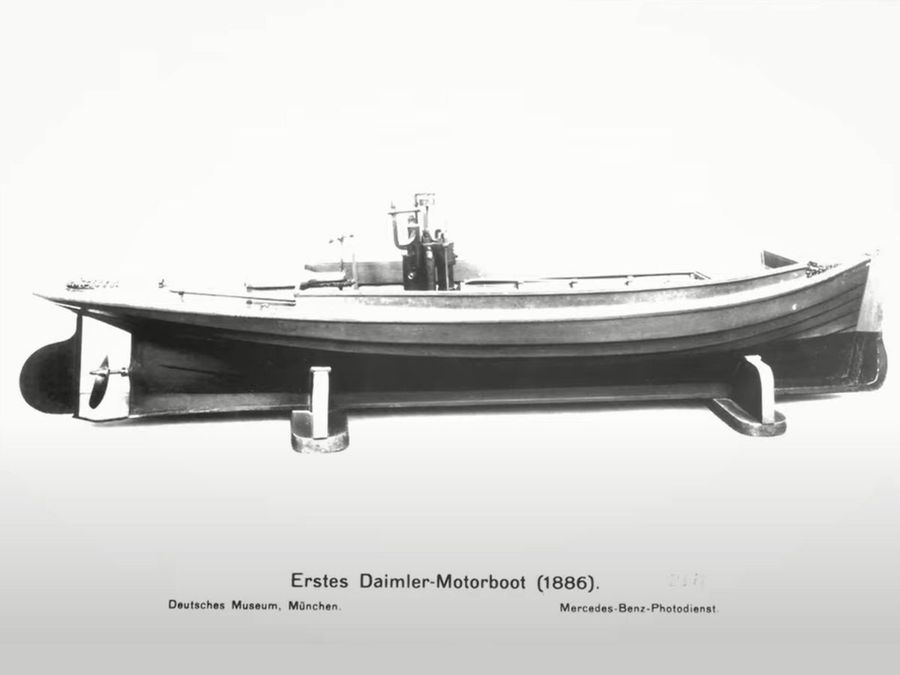
Water was the hardest test. In 1886, Daimler commissioned Lürssen to build a hull capable of taking this engine onto the river. His reasoning was clear: a successful marine trial would prove the engine's versatility beyond land vehicles and open the way to a much wider market. The boat that resulted was Rems, a six-metre timber launch, clinker-built with Lürssen's characteristic precision. The hull incorporated a fine entry, a modest beam, and a gently rising sheerline to manage spray and improve tracking. Copper rivets and marine glue provided light but durable fastenings suited to calm inland conditions. Steering came via a transom-mounted rudder controlled by a simple tiller. The engine sat amidships, weighing around 60 kilograms, turning at 700 rpm and producing 1.5 horsepower.
Daimler was sufficiently aware of local anxieties about combustion engines that he went to the trouble of describing the engine as electric to avoid alarming anyone who might fear an explosion. The precaution proved warranted. When Rems moved along the Neckar under its own power, with no oars and no sails, some onlookers reportedly called out that the devil himself must be aboard.
The trial succeeded. Rems motored reliably across the water, demonstrating for the first time that a lightweight petrol engine could propel a watercraft without drama or disaster. The world had its first motorboat, and with it, the foundation for everything that would follow: engine-driven launches, powered pleasurecraft, working vessels, and eventually the purpose-built raceboats that would define an entirely new sport.
Offshore powerboating as a distinct discipline took decades to take shape. Endurance events such as the 1956 Miami–Nassau race pushed hulls and engines into genuinely punishing territory, and each generation of competition produced faster, more specialised machinery. By the time the 2000s arrived, turbine-powered catamarans had become the dominant force in the sport's top classes.
Miss GEICO stood above them all. Originally founded by John Haggin and later operated by a team that included Marc Granet and Scotty Begovich, the programme produced one of the most decorated offshore racing boats in history. Its most formidable configuration, the 50-foot Mystic catamaran with twin Lycoming T-53 turbines, delivered over 4,200 combined horsepower to a hull built from carbon fibre, Kevlar, and S-glass. At full speed it exceeded 210 mph (340 km/h) over open water. During its competitive years, Miss GEICO claimed multiple world championships, broke offshore speed records, and crossed into mainstream media and documentary coverage. The programme was officially retired in 2021.
In almost every measurable way, Miss GEICO was the opposite of Rems: different in scale, materials, power, and purpose. But the thread connecting them is direct. Both were built to answer a question about what a powered boat could do. Both pushed past what had come before. The distance from 1.5 horsepower on a sheltered German river to more than 4,200 horsepower across open ocean is, in the end, one continuous line.