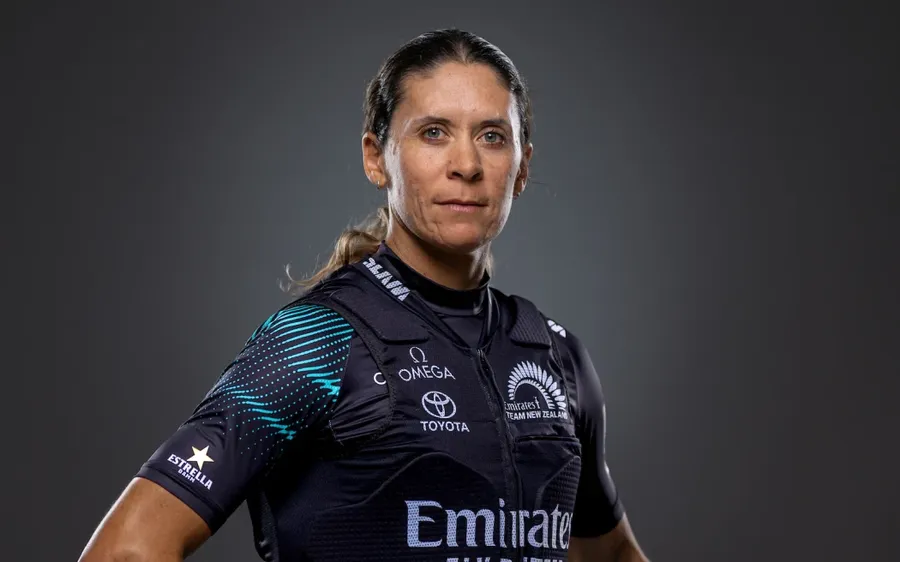
Jo Aleh has become the first woman to join Team New Zealand's main America's Cup sailing team, and for now she may well remain the only one.
Her inclusion follows a revised protocol for the 2027 America's Cup in Naples, which requires at least one of the five sailors aboard to be a woman. The rule has stirred considerable debate across the sailing world.
Team New Zealand chief executive officer Grant Dalton has been open about his early opposition to a mandated female sailor on the AC75, and Aleh herself shared that reluctance. When the team took to the water for the first time this year on Friday in Auckland, though, both had reached the same conclusion: having the three-time Olympian in the squad was the right move.
Once Dalton accepted that a woman needed to be part of the crew, his mind went straight to Aleh. She had already sailed an AC40 for Team New Zealand during the inaugural Women's America's Cup in Barcelona last year. Being called into the defending crew alongside three new male sailors, Aleh said, represented a genuine milestone for the sport.
"I don't actually think last year any of us thought that there'd be a position on the race boat for a woman as yet so it's pretty awesome they've taken that step and I think it really kind of cements the women's AC as a pathway to the Cup," Aleh said.
On the question of quotas, Aleh is straightforward. No one relishes being selected to fill a mandated slot, and she is no different.
"None of us like a quota, as a woman who's been involved with yachting for a long time, I don't want to be on something because of a quota, but you've kind of got to take what you can get sometimes and I think it's an awesome way to just encourage new people into these roles and see what we're capable of."
Before the new protocol arrived, she noted, there had simply been "nothing to aim for" for women working at this level of the sport. The America's Cup is not the first major sailing competition to take this step. The Volvo Ocean Race introduced a similar requirement in 2017 and retains it today. Aleh acknowledged there was "a lot of grumbling at the time" but argued it had "changed the game in off-shore sailing".
"There is a whole lot of women who would not have a career and now they do, so I think it's a hard step to take and it's always a little bit hard when one of the reasons you're picked for something is because there's a quota but I think it's about what you do with it."
For the 39-year-old, the immediate excitement is simple: "getting on the big boat". Her precise role on board has yet to be defined, and the AC75 itself is entirely new territory for her.
"Never actually been on the AC75 before, had a look in the shed last time around, but it will all be new for me. It's a pretty incredible piece of technology and the speeds, a lot to figure out still and a lot for me to learn."
Team New Zealand will field a Women's America's Cup boat in 2027, though whether a second woman might join Aleh on the main race boat remains an open question. Dalton showed no urgency on the matter, admitting the team had not settled on a contingency should Aleh be injured, or on how they might train a second woman in an AC75.
His shift on the quota question came gradually, shaped by the success of the Women's America's Cup concept and by recognition that the physical demands of the AC75 at the 38th America's Cup would differ from earlier assumptions. He had come to understand that women would never make the leap from the women's event to competing for the Auld Mug unless it was enforced.
"I was against having a quota, quite verbally against it because I felt exactly what [Aleh] has said that it just feels like you got stuck on there and everybody goes geez you've got a woman onboard, and for that reason I was against it," Dalton said.
Without a mandate, he concluded, crews would simply default to familiar choices and the door would never truly open.
"Rightly or wrongly, instinctively the guys are going to pick the guys and so if you don't mandate you actually won't ever actually make it happen.
"Because it is not a power-based role it's a skill based role they're infinitely as capable as the guys."