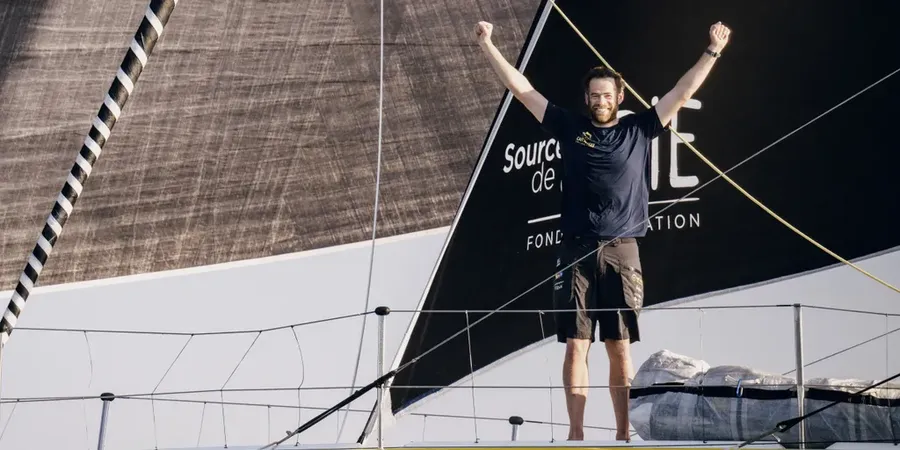
Nico d'Estais brought Café Joyeux across the finish line at Les Sables d'Olonne on 18 June at 20:17 NZST, completing the Vendée Arctique in 10 days, 7 hours and 15 minutes to finish sixth overall. That ranking, though, tells only part of the story. Café Joyeux was the sole boat in the fleet fitted with dagger boards rather than foils, and d'Estais returned to the dock with his confidence unshaken and his appetite for the work fully intact.
It was his first season in IMOCA competition, and the Vendée Arctique pushed him into waters he had never navigated: the Arctic Circle, days without darkness, a succession of deep depressions, and seas that turned rough and unpredictable without warning. Every skipper in the class holds the Vendée Globe as the ultimate measure, and nothing d'Estais had done previously had brought him anywhere near that kind of test.
The Café Joyeux campaign carried no illusions about matching the foiling fleet for raw speed. Rather than chase boats beyond his reach, d'Estais built his race around sound judgement. He chose direct routing when conditions justified it, hunted weather opportunities without overcommitting, and brought consistent attention to every decision throughout. The discipline paid off. He stayed competitive across multiple stages and demonstrated a clear ability to extract the best possible performance from a platform working at a speed disadvantage. Across 3,062.73 nautical miles, he averaged 12.4 knots.

No figure in the results sheet captures what crossing 66 degrees North meant aboard Café Joyeux. The cold was the penetrating kind, finding its way through everything. D'Estais woke inside the cabin shivering, visibility reduced to almost nothing around him. "I had the real feeling I was at the end of the world," he said after finishing. Eight skippers crossed the Arctic Circle during the race, an IMOCA first, and d'Estais took time to absorb the full strangeness of where he was.
The racing itself taught him the most. Situations he had never before encountered on a 60-foot monohull arrived in succession: accumulated fatigue, demanding weather, mechanical failures that required attention mid-passage, and the constant wet that slowly wears you down. Each one added something to his understanding. He had identified Arnaud Boissières and Manu Taitz as realistic targets before the start, and his move north to pass Boissières was no improvised gamble. He had mapped out that possibility before leaving port and waited for the weather to open the right moment. When it did, he acted.
"This race is probably what comes closest to preparation for the Vendée Globe," d'Estais said at the dock. He spoke about the ocean miles already in Café Joyeux's history before he ever touched the helm, and the trust that had grown between them through the passage. One moment tested that trust. In 30 knots of wind the rudder kicked up without warning, and he spent twenty minutes flat on the cabin sole working through the problem. After that, he said, they made peace and everything went fine. He was candid about the ocean's authority over any sailor who crosses it, and he seemed to regard that humility as something worth carrying forward. It will matter when he eventually points south toward the Southern Ocean.