Twenty years is a long time to wait for the market to catch up. For New Zealand Yachts, that wait may finally be over.
The company made a quiet but purposeful return to the global stage at the 2025 Fort Lauderdale International Boat Show, arriving with a refreshed portfolio and a design philosophy that, after two decades on the fringe, now sits squarely at the centre of what superyacht buyers are asking for. It is a striking turnaround for a Kiwi outfit that stepped back from new builds in the difficult years following the 2008 global financial crisis, and the renewed energy feels less like a relaunch than a reckoning.

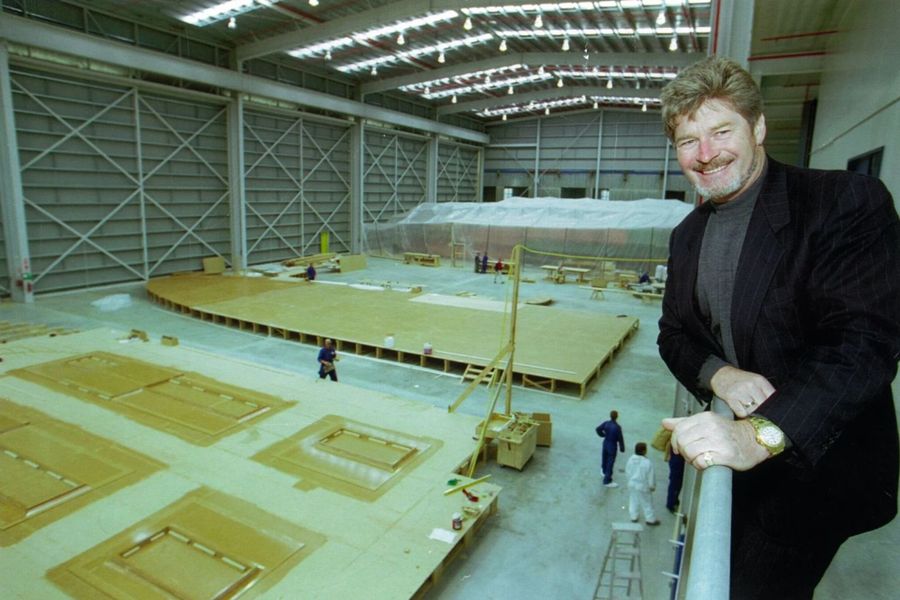
The origins of New Zealand Yachts are not the kind of story that appears in business school curricula. Allen Jones had sold a business, retired to the Bay of Islands, and found himself restless. He drove to Whangarei with the modest ambition of securing a small plot of port land where he could build a few boats and fill his days.
"I thought I'd build a few boats and keep myself busy," he laughs.
What happened next surprised everyone, including Jones. The port did not offer him a corner. It offered him the entire waterfront precinct. He put forward a low number, they accepted it, and what had begun as a retirement pastime became a full-scale marine development almost overnight. The yard grew, the plans expanded, and then the economic shock following September 11 compressed everything down to a single project: a 35 metre wave-piercing superyacht named Spirit.
That vessel would prove far more significant than anyone anticipated at the time.
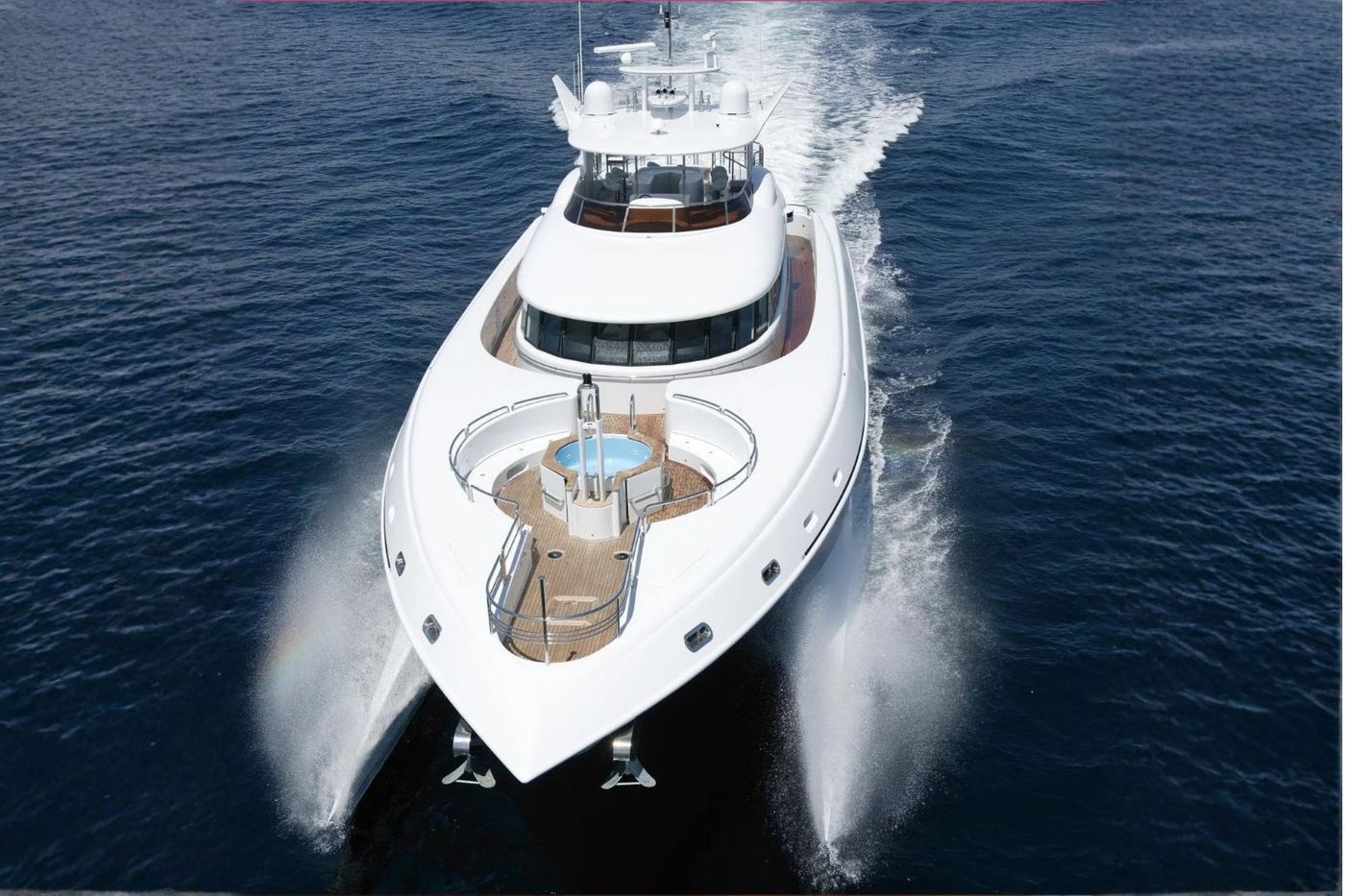
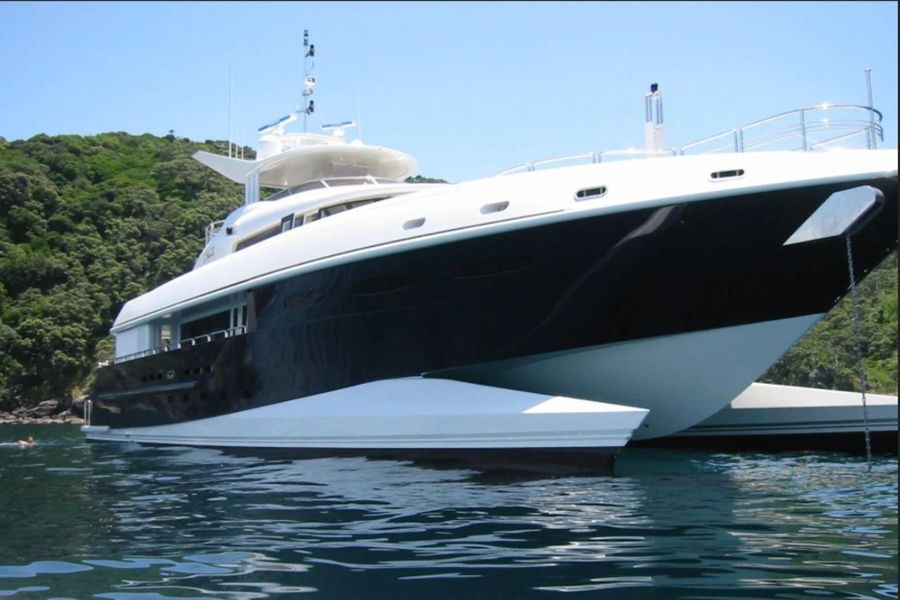
From the outside, Spirit looked every bit the sleek superyacht. Beneath the waterline was another story. Running along the centreline were two narrow demi-hulls, a configuration borrowed from commercial fast-cat thinking, that gave the boat a motion and an efficiency profile unlike anything else in its class. In rough following seas it held its line. At extended range it sipped fuel at rates that left surveyors puzzled.
"At ten knots she uses almost nothing," Allen says. "People don't believe it until they see the hull."
The concept was a genuine hybrid, blending monohull aesthetics with multihull hydrodynamics, years before either term became a marketing staple. The difficulty was that the market of twenty years ago had no ready framework for a boat that looked like one thing and performed like another. Buyers were uncertain, brokers were unsure how to position it, and Spirit remained a singular achievement rather than the beginning of a fleet. Today, that same blend of stability, space, and fuel economy is precisely what the superyacht market has been gravitating toward. The world simply needed time to arrive at the same conclusion.
The new range from New Zealand Yachts spans 30 to 50 metres and carries the same foundational hydrodynamic logic forward, though the team has continued refining the hull form considerably since Spirit first launched. The New Zealand Yachts Wavepiercer hull has evolved to deliver both greater fuel efficiency and stronger performance than was achievable two decades ago.
One concept shown quietly at Fort Lauderdale attracted considerable attention on the strength of its presence alone. Dark in colour, with a razor-edged bow profile that commands a second look, the design has been nicknamed "Darth Vader" by the New Zealand Yachts team. Even in rendered form it is clear the vessel carries substantially more volume and visual weight than Spirit ever did, while maintaining the lean aggression that defines the hull form.
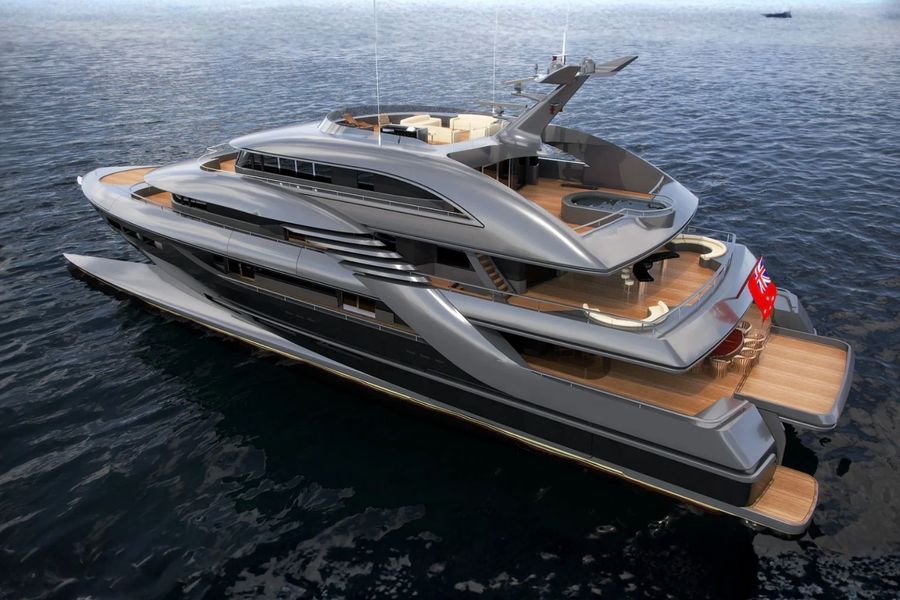
The broader market context makes the timing hard to argue with. Large multihulls and semi-multihulls have been gaining ground steadily in the superyacht segment, driven by buyers who want stability at anchor, usable deck space, and running costs that do not punish long passages. Efficiency has become a genuine purchase criterion rather than a footnote. The narrow demi-hulls that underpin the New Zealand Yachts design address all three. Slim hull forms reduce drag at the waterline, the wave-piercing bow cuts through steep chop rather than riding up and over it, and the result is a vessel that holds its course with a composed, rail-like steadiness that wide-body designs struggle to replicate. Allen has long described the fuel consumption at ten knots in terms of a "teaspoon of diesel", a phrase that sounds like salesmanship until you examine what the hydrodynamics are actually doing.
To bring these designs from concept to composite hull, Allen has formed a partnership with Yachting Developments Limited in Auckland. Ian Cook's team brings both the composite expertise and the production capacity that a build of this complexity demands. The hull forms translate naturally into composite construction, allowing the structure to stay light while retaining the stiffness and strength the design requires. Interest has already been generated from the United States and the Middle East, where owners are searching for long-range vessels that charter well and offer a profile distinct from the conventional displacement fleet.
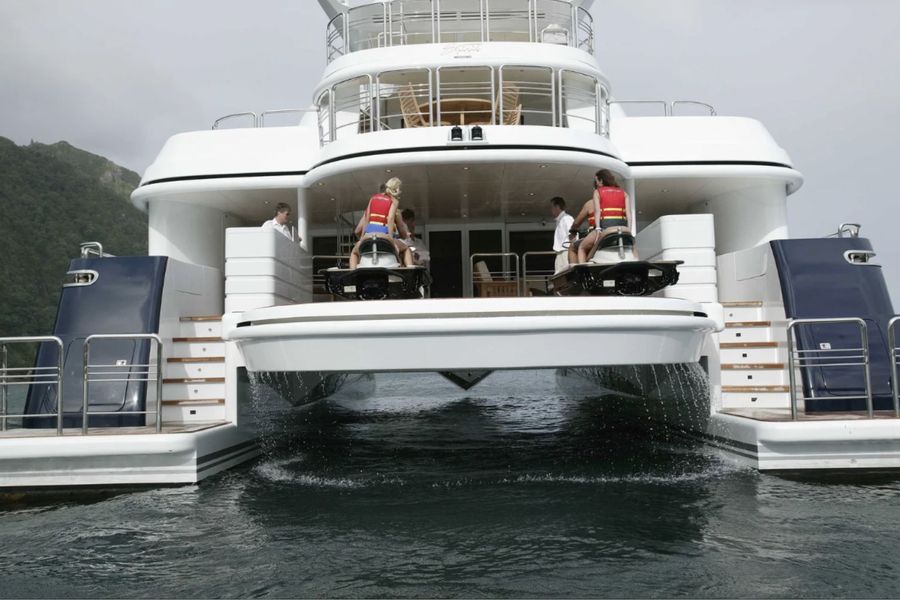
One design detail continues to stop conversations. The central garage is positioned below the main deck and opens via vertical doors that part like a cargo bay. Drop the aft platform and crew can move under the hull to deploy tenders directly into sheltered water. Guests board at deck level, away from wind exposure and the awkward sideways chop that makes side-launch arrangements uncomfortable on anything but a calm day.
"Everything gets easier," Allen says. "It changes how people move around the boat."
For charter operators calculating turnaround times and guest experience, that kind of operational simplicity is a meaningful selling point.
The superyacht world has shifted in the years New Zealand Yachts spent away from it. Owners increasingly want vessels that perform without punishing fuel bills, feel composed in difficult conditions, and carry a visual identity that stands apart from the mainstream. New Zealand Yachts has a design that occupies the space between categories while drawing on the strengths of each. The concept has more than twenty years of real-world validation behind it, a track record that no rendering alone can claim.
For a company that started with an impulsive conversation in a port office and a number pulled from the air, the renewed momentum feels better placed than at any point in its history. The market has moved toward the boat, not the other way around, and New Zealand Yachts is building again with that wind behind it.