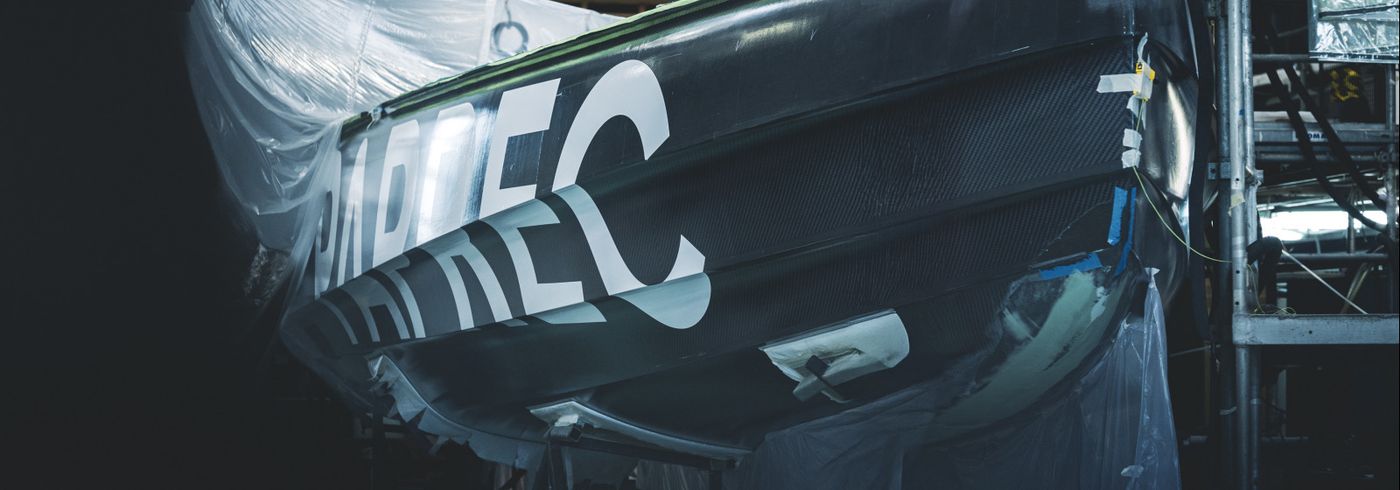
Twenty billion data points, one radical hull. That's the equation behind Yoann Richomme's new IMOCA 60, revealed this week by Team Paprec as the boat that will carry the Frenchman's Vendée Globe ambitions into 2028. Built on exhaustive analysis of the last edition of the race, the new hull is strikingly narrow and carries three chines, a significant jump from the single chine on the previous Paprec Arkéa. Launch is scheduled for March 2027.
"In the Paprec family, we're passionate about sailing, for the human and technological adventure it represents," said Sébastien Petithuguenin, Vice-President of Paprec. "As in our industry, the sailing sector embodies French excellence, one built on innovation and collective effort. French know-how in designing and building IMOCAs is exceptional, and we're committed to helping develop it further. With Yoann Richomme, our ambition is to land the holy grail of offshore racing: building a winning campaign for the 2028 Vendée Globe. To get there, we've drawn on the experience gained during the last Vendée Globe, in which Yoann Richomme secured a remarkable second place."
That data haul, twenty billion points in total, was gathered and analysed after Richomme finished second in a race where the fleet also smashed the round-the-world record, circling the globe in 65 days and 18 hours. From the winter of 2025, Richomme, the Team Paprec engineers and naval architect Antoine Koch worked through the numbers to draw up specifications for the new boat.
The brief was clear: keep what worked on the old boat, particularly downwind speed, while finding real gains upwind and through transitions. The new hull is designed to punch through waves more cleanly, accelerate faster, and get back up onto its foils sooner.
The boat is very much a collective effort. The Multiplast yard is building it, while Koch, drawing on the design offices of Finot and GSea, has worked closely with the team throughout. "In 2020, working with the Team, we were informed observers; now we are essential contributors to the design of the boat," said Richomme. "The team has moved into a new dimension. It's exciting to see we've reached this level of mastery and know-how."
Three chines instead of one is the headline change. Setting the design brief after the last Vendée Globe gave Team Paprec several months to analyse the data and study different hull shapes, work that led to a bold architectural decision: a particularly narrow hull with three chines, compared with just one on the previous Paprec Arkéa.
Gautier Levisse, head of Team Paprec's design office, explained the thinking. "The addition of two chines compared to our old boat brings even more lift and therefore more power to the hull, to better bounce over waves, accelerate faster and get the foil working earlier. Trials in the digital towing tank ran flat out! Perfecting the shape we've invented is a real feat for the construction teams."
Richomme doesn't shy away from how extreme the shape is. "This will probably be one of the narrowest IMOCAs in history. The hull width is close to that of a Class40, yet a Class40 is a third shorter! We wanted the boat to get through waves better and, above all, to get back up on the foils more quickly."
There's risk in it too. "There's a significant risk in pushing innovation this far," the skipper admitted, "but that's the price of winning the big races."
Part of the build is being shared. "It's also our ambition to place environmental responsibility on the same level as sporting excellence, and that led us to team up with 4CAD Group and its skipper Benjamin Dutreux, who share the same values," Petithuguenin added. To meet new IMOCA class rules requiring a 15 percent cut in CO2 emissions for every new boat, the two teams are building two sisterships, 95 percent identical, at the Multiplast yard using the same hull shapes, tooling and manufacturing processes. Around 70 percent of technical solutions, particularly structure, safety and reliability, are being developed jointly, though each team retains freedom over ergonomics, onboard systems, propulsion and sails.
The collaboration brings gains on several fronts: the life-cycle assessment improves by 25 percent, and costs drop by 12 percent.
Construction began in Vannes in November 2025. It runs through to December 2026, followed by final fit-out by Team Paprec in January and February 2027, ahead of launch that March.
Richomme and his team will then begin sailing the boat, testing the design office's projections against the reality of offshore conditions. Team Paprec is hoping that period will hand them a fast, reliable IMOCA they fully understand heading into the 2028 Vendée Globe.
Team director Romain Ménard is confident in the timeline. "We're convinced that our schedule, built on analysis of the 2024-25 Vendée Globe to design a new IMOCA, will allow us to deliver a real evolution on our previous boat, and to maximise the time our new Paprec spends flying."
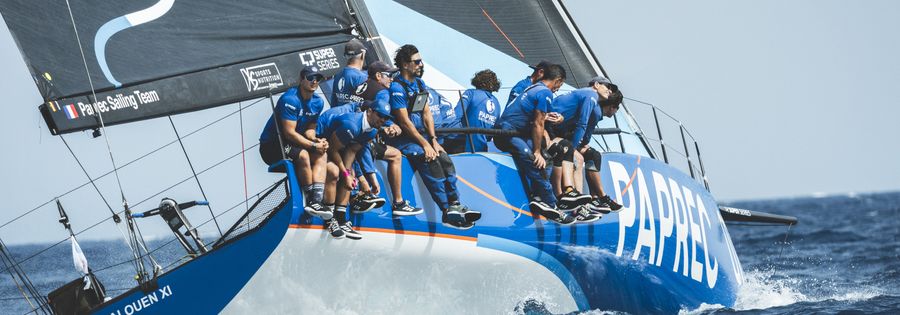
The new IMOCA sits alongside a busy stretch for Richomme away from his own boat. He has spent recent months stepping into the TP52 Paprec on the 52 SUPER SERIES, including as navigator when the team claimed its first circuit win in fifteen years at Lanzarote, an event he later returned to for a follow-up regatta that left Paprec ninth but still building momentum toward the bigger project now taking shape in Vannes.
%20sailing%20Rustler%2036%20%E2%80%98Lazy%20Otter%E2%80%99-900x600.jpg)