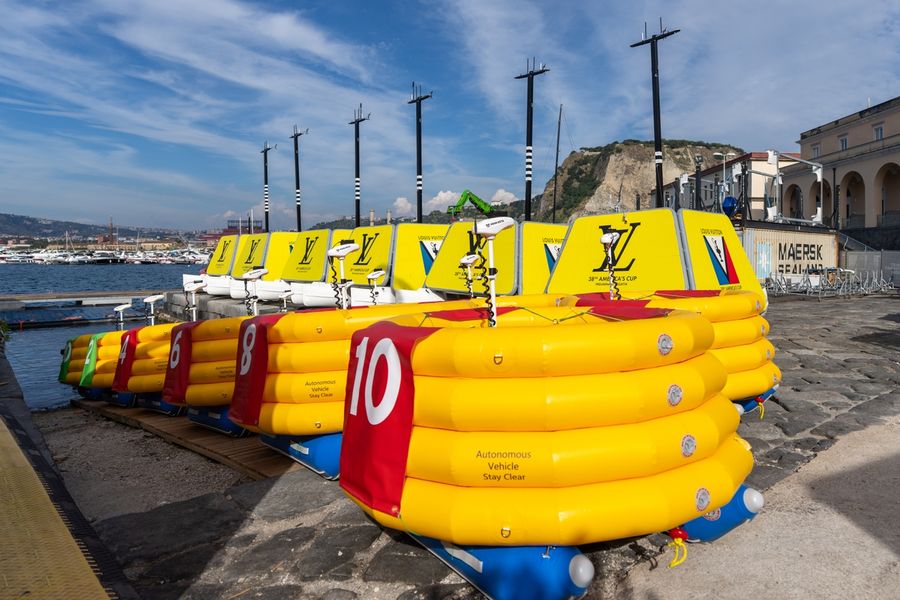
Autonomous buoys will once again mark out the racecourse for the Louis Vuitton 38th America's Cup, and for PR2 Naples that means Iain Murray, the Regatta Director, and his professional race team will have full GPS control over the marks.
Murray's team can adjust both the axis and the leg lengths of the course to hit a target race time of between 20 and 25 minutes per race. The days of long delays while marker buoy chains were reeled in and anchors dropped to the seabed are gone. Everything now happens at the push of a button, backed by software designed to deliver racing that is both consistent and fair.
There's a twist to the story in Naples, though.
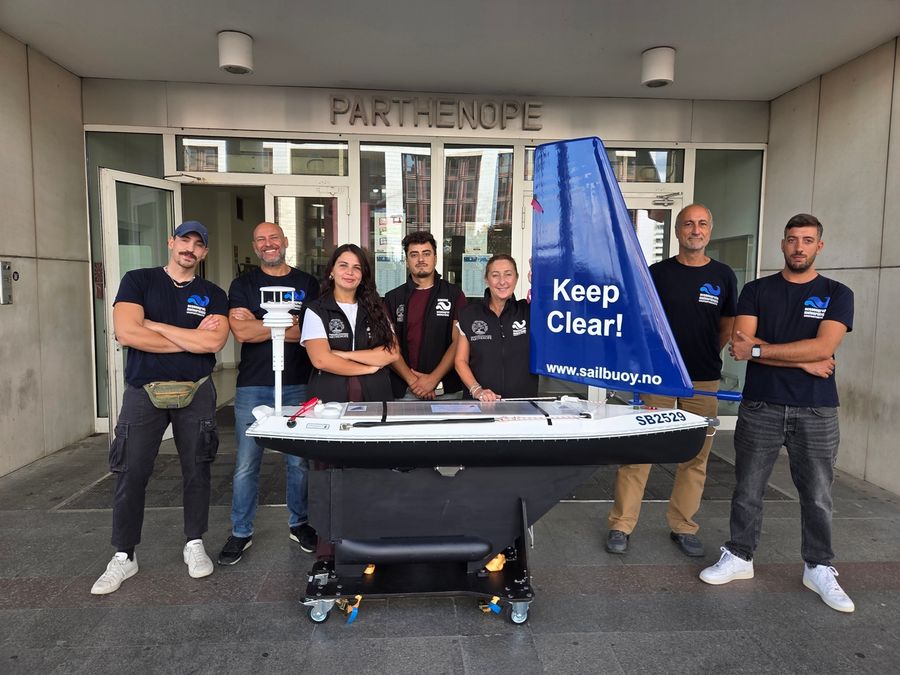
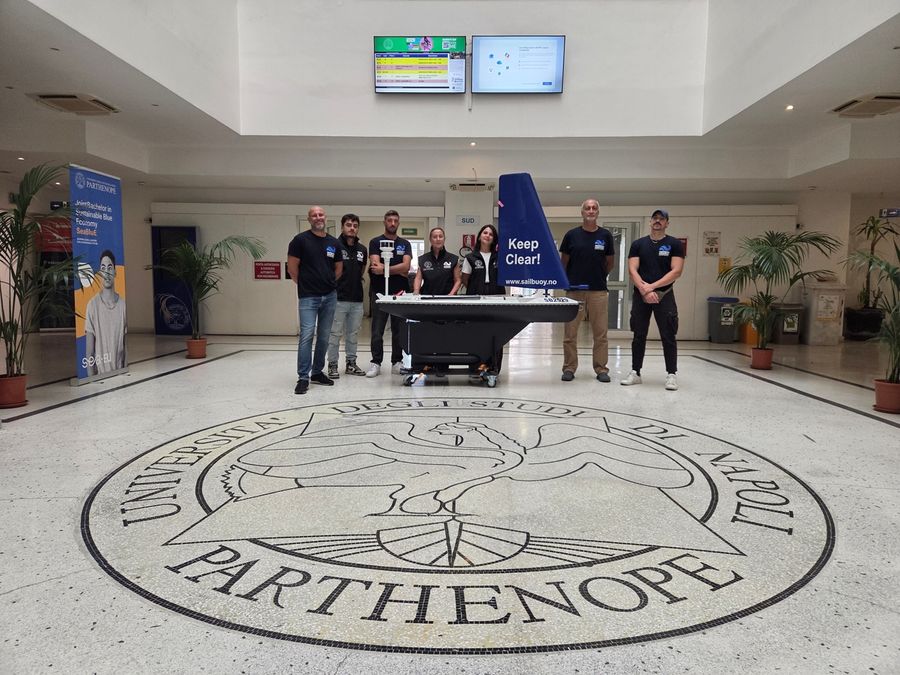
The Universita' Degli Studi di Napoli Parthenope will be showing off its own autonomous surface vehicle, one built to gather data from the world's oceans rather than mark a racecourse. It carries a name with serious weight in America's Cup history.
Azzurra. The same name as the yacht that made Italy's first Cup challenge back in 1983, sailing under the burgee of the Yacht Club Costa Smeralda.
This Azzurra will be unveiled for the first time on Friday 25 September, at the Commune di Napoli & University stand in the Official Race Village. Visitors to PR2 will be able to see it in the flesh. The vessel is operated by the Department of Science and Technology at Parthenope University of Naples.
Azzurra is Italy's first sailbuoy, an autonomous marine surface drone roughly two metres long and powered entirely by wind and sail. It runs pre-programmed routes, but a real-time connection means its missions can be modified remotely while under way.
Solar panels power its full suite of instruments. Combined with wind propulsion, that gives Azzurra a silent, zero-impact way of operating and, paired with its distinctive hull design, virtually unlimited endurance.
Out on a mission, Azzurra measures and transmits key atmospheric parameters: temperature, pressure, humidity and wind conditions at the sea surface. It works in coastal waters and out in the open ocean, where this kind of data is harder to come by and correspondingly more valuable. Its oceanographic instruments also transmit data on wave height and direction, water temperature, salinity, chlorophyll and oxygen concentrations, turbidity, and the speed and direction of currents from the surface down to 50 metres depth.
The sailbuoy itself is manufactured by Offshore Sensing, a Norwegian company that collaborates with universities and research centres around the world. Its autonomous vessels now operate across all the world's oceans.
After trials and missions in the warmer waters of the Gulf of Naples and the Mediterranean Sea, Azzurra will take part in several research projects in the cold waters of the Southern Ocean around Antarctica, a region where Parthenope University has been conducting research for approximately 35 years. Its distinctive features make the drone particularly well suited to operating in remote areas and extreme environments.
Surface marine drones such as Azzurra, together with the underwater vehicles operated by Parthenope University, make it possible to expand oceanographic data collection without requiring scientific personnel or research vessels at sea. These technologies gather data 365 days a year, even in sea and weather conditions that would rule out traditional observation methods.