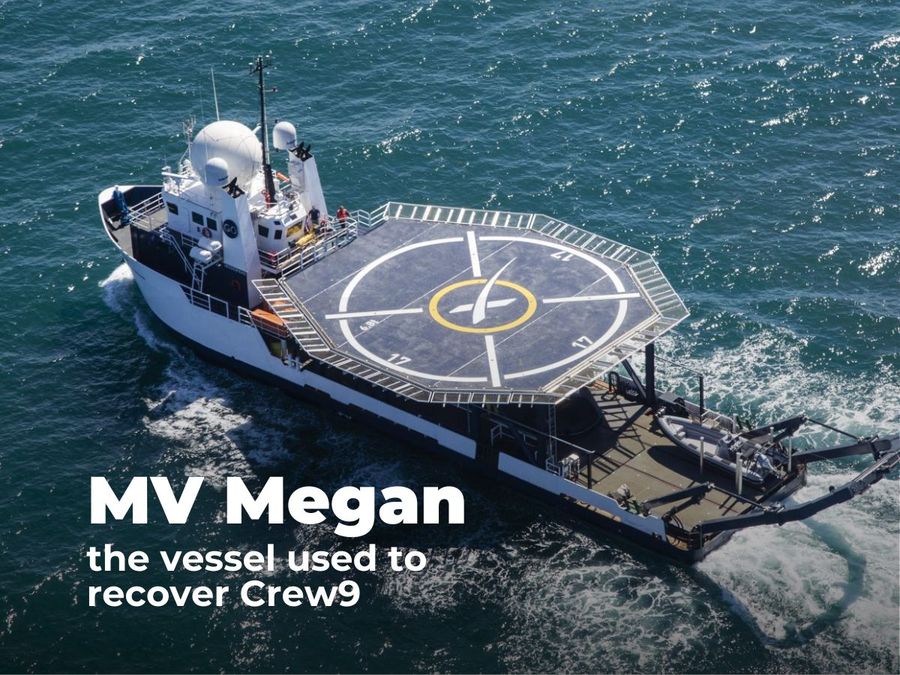
Once a humble offshore supply ship,
SV Megan
now plays a crucial role in the recovery of SpaceX's Dragon capsules and their astronauts, bridging the gap between space and shore with remarkable precision. It's latest expedition was the safe recovery of Crew-9.
A landmark mission
The Crew-9 mission was anything but ordinary. Originally slated for an August 2024 launch, delays involving the Boeing Starliner forced NASA to adapt swiftly, reshaping Crew-9’s mission to carry astronauts Nick Hague and Aleksandr Gorbunov to the International Space Station (ISS). This mission notably became the first crewed launch from Cape Canaveral Space Launch Complex 40 and marked the first active U.S. Space Force Guardian, Hague, entering orbit.
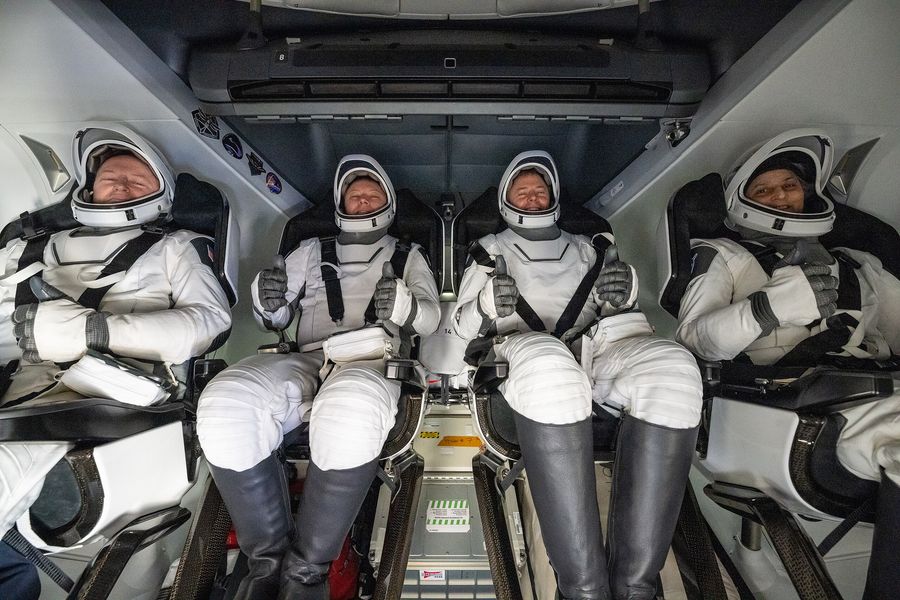
NASA astronauts Nick Hague, Suni Williams, and Butch Wilmore, as well as Roscosmos cosmonaut Aleksandr Gorbunov, completed a long-duration science expedition aboard the ISS, returning important time-sensitive research back to Earth. After nearly six months in orbit, Crew-9’s splashdown was equally historic—this marked the last Dragon capsule recovery planned for the Gulf of Mexico, with future missions shifting back to Pacific recoveries. The return required meticulous timing, careful logistics, and a reliable recovery platform.
From MV Go Searcher to MV Megan
Built over a two year period, in 2010
MV GO Searcher
(the original name of
SV Megan
) began her working life serving offshore oil and gas platforms. Acquired by Falcon Landing LLC (a SpaceX entity) in 2016,
MV Go Searcher
underwent significant refitting to specialise as a Dragon capsule recovery ship.
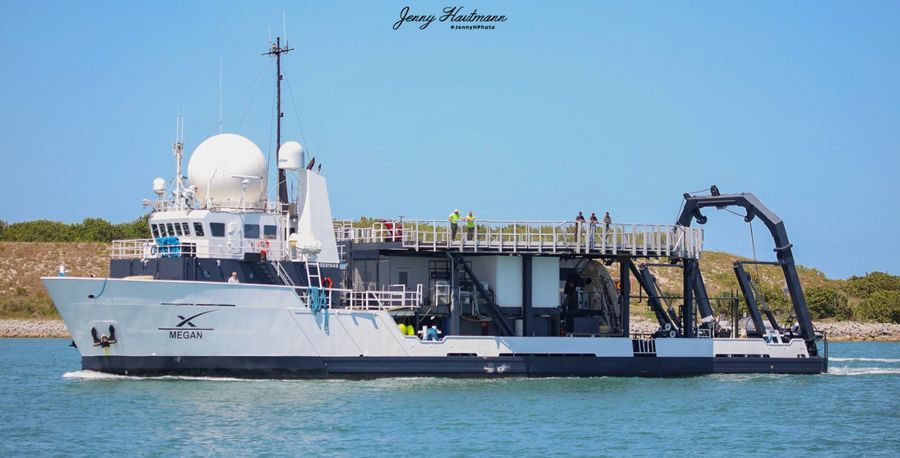
SpaceX transformed the offshore supply vessel MV GO Searcher into a specialised recovery ship for its Crew Dragon space capsules. The refit involved several key modifications to support astronaut retrieval operations. A prominent addition was the installation of a helipad, to facilitate rapid transport of astronauts and critical cargo to shore for immediate medical evaluations and debriefings.
The vessel was also equipped with a specialised crane on the stern to lift the Crew Dragon capsule from the water onto the deck. To ensure the health and safety of returning astronauts, a medical treatment unit was installed, providing necessary care post-splashdown.
These enhancements enabled MV GO Searcher to serve as SpaceX's primary recovery vessel for Crew Dragon missions, ensuring efficient and safe retrieval of both crewed and uncrewed capsules upon their return to Earth.
The vessel was renamed,
MV Megan
in early 2022 in honour of astronaut Megan McArthur, the second woman to fly on board a SpaceX Dragon capsule.
MV Megan
measures 51-metres (167 ft 4 in) in length overall (LOA) and has a beam of 12-metres (39 ft 4 in). With a draught of 3-metres (9 ft 10 in), her size and build provide the stability and capacity required for complex maritime recovery operations.
A careful and precise recovery
When Crew-9 splashed down,
MV Megan
’s meticulously trained recovery team swiftly executed their carefully rehearsed protocols. Fast-approach boats immediately raced towards the capsule, performing initial safety checks and verifying the well-being of the astronauts. Rigging lines from
MV Megan
allowed the capsule to be safely hoisted aboard using the vessel's stern-mounted crane, a process performed under NASA's stringent requirement that astronauts exit the capsule within 60 minutes of splashdown.
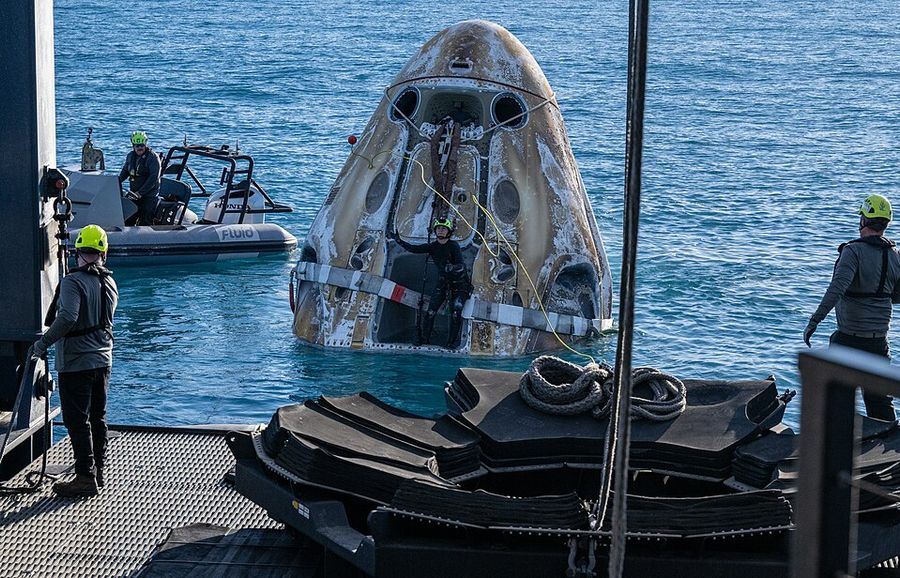
NASA and SpaceX closely monitored weather conditions, as Dragon’s undocking depended on multiple factors including spacecraft readiness, recovery team readiness, weather, and sea states. The exact splashdown location was confirmed shortly before Crew-9’s return. Once onboard, the crew underwent medical evaluations at
MV Megan
's fully-equipped medical centre, ensuring astronaut safety and health post-mission. Helicopters then quickly transported the astronauts back to Kennedy Space Center, highlighting
MV Megan
’s crucial role in efficiently returning space travellers from orbit to solid ground.
MV Megan’s notable recoveries
MV Megan
is no stranger to high-profile missions. Her first significant test came during SpaceX’s Inspiration4 mission in September 2021, the groundbreaking first orbital spaceflight crewed entirely by private citizens. Since then,
MV Megan
has reliably handled numerous Dragon recoveries, from the historic Inspiration4 and Axiom private astronaut flights to regular Crew and Cargo Dragon missions.
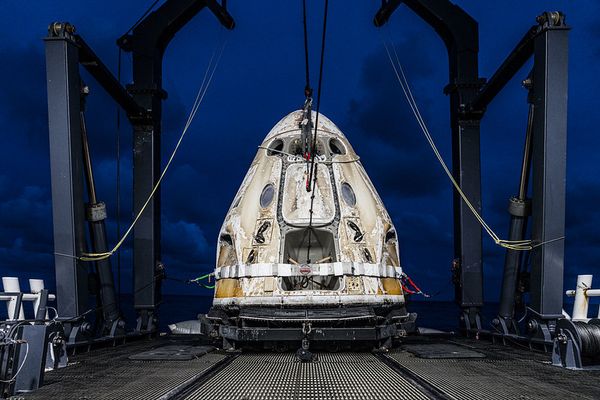
MV Megan
’s adaptability is notable; she has also temporarily supported fairing recovery operations, showcasing SpaceX’s trust in her reliability and versatility.
The shift from the Gulf to the Pacific
SpaceX's decision to shift future recovery operations from the Gulf of Mexico to the Pacific Ocean—specifically towards the isolated Point Nemo "spacecraft cemetery"—is significant. This change reduces risks associated with re-entry debris, ensuring safer, cleaner recoveries.
MV Megan
’s operational history demonstrates why specialised recovery vessels are essential, and her adaptation to different roles showcases flexibility in mission support.
Megan’s maritime and space legacy
MV Megan
highlights the unique intersection between maritime traditions and the frontiers of space exploration. Her transition from an offshore workhorse to an essential component of astronaut recovery operations highlights the evolving nature of marine technology and its increasing importance to the space industry.