German boatyard MIZU GmbH will return the Twiel Z7 to Interboot in Friedrichshafen next week, following its 2025 debut on the lake it was built for.
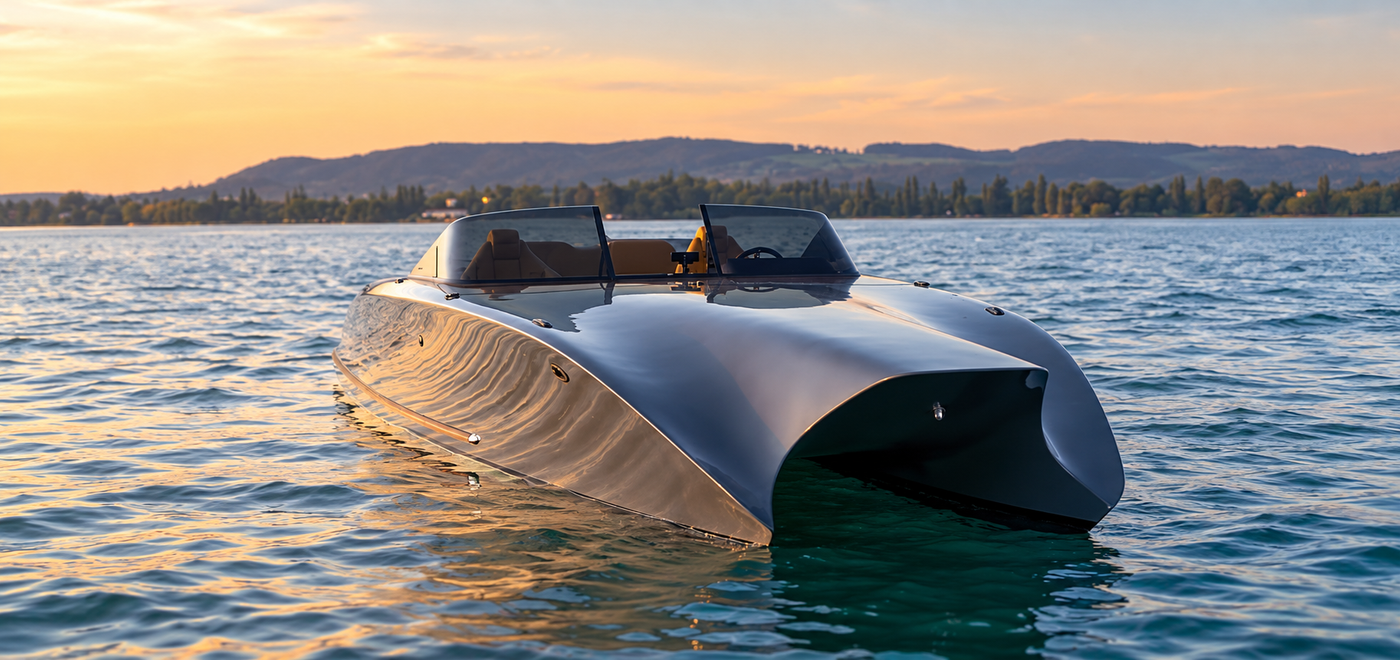
At 7.90 metres with a 2.55 metre beam, the Z7 presents as a single sleek hull with a low, sculpted nose. It is not. Two slender hulls sit beneath that bodywork, visually disguised so that from the side the catamaran structure almost disappears. Head on, the twin-hull configuration becomes obvious.
MIZU founder Michael Zupritt developed the patented shape to reduce resistance and propulsion demand without building what he considered another conventional design. "We didn't want to build another Riva," he told Float Magazin (translated from German). "It had to be something completely different." The solution, he said, came overnight: pull the nose forward rather than back, letting the central bodywork project ahead of the hulls to draw them visually into one dramatic bow. The design evolved over five years before MIZU's formal development programme began around 2021.
The Z7 was built specifically for Lake Constance, where regional governments are pursuing climate neutral shipping by 2040. A feasibility study commissioned by the Bavarian State Chancellery found battery-electric propulsion suited to shorter distances and lower speeds—the category this boat occupies—while pointing to e-methanol for most of the existing fleet. Lake Constance's strict emissions and noise regulations reinforce the case for clean, quiet propulsion. The name references Hohentwiel, the extinct volcano overlooking MIZU's home town of Hilzingen.
Architect Klaus Wetzstein worked with Zupritt on the design, with structural engineer Juliane Hempel and boatbuilder Till Grabowski handling construction. The team spent more than 1,800 hours on woodwork using abachi, pine and mahogany over a plywood frame. Two ePropulsion i20 electric inboards provide 20kW (27hp) each for 40kW total, driving conventional shafts. Four ePropulsion G102 100 batteries supply roughly 40kWh, with overnight charging from marina shore power. At approximately 1,600kg, the boat is light for its length and rated for six people.
Early projections suggested three to four hours at 10 knots, with Zupritt estimating 40 knots mathematically possible though untested. Interboot 2026 promotional material now claims more than 70km/h (around 38 knots), though MIZU's current spec sheet does not repeat this, listing only "2 x 20kW". Independent testing found the boat performed as designed: comfortable cruising at 15km/h (8 knots), staying flat under acceleration, producing little wake, with two to three hours' endurance depending on use. Independent motor control allows tight turns and steady astern tracking. MIZU is addressing one issue identified in testing—stern wave ingress when slowing or reversing hard—with counter-rotating propellers and revised prop design.
The Twiel Z7 appears at Interboot 2026 from 23 to 27 September on shared exhibition stand at Interboot 2026 with the Cobrey Yachts 28SC and Futuro Boats' ZX20 E. MIZU's partnership with Futuro Boats includes production at Hilzingen and international sales from Stein am Rhein, Switzerland.