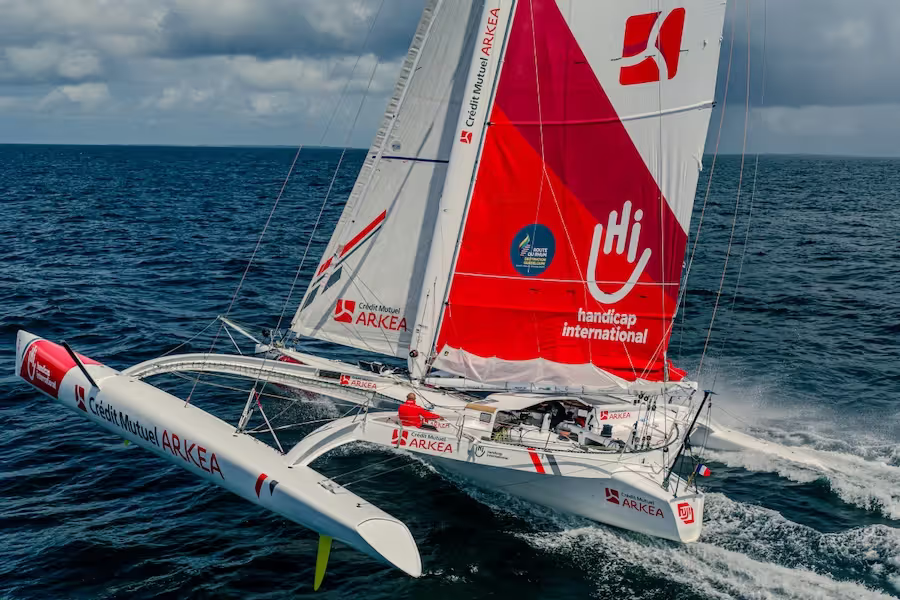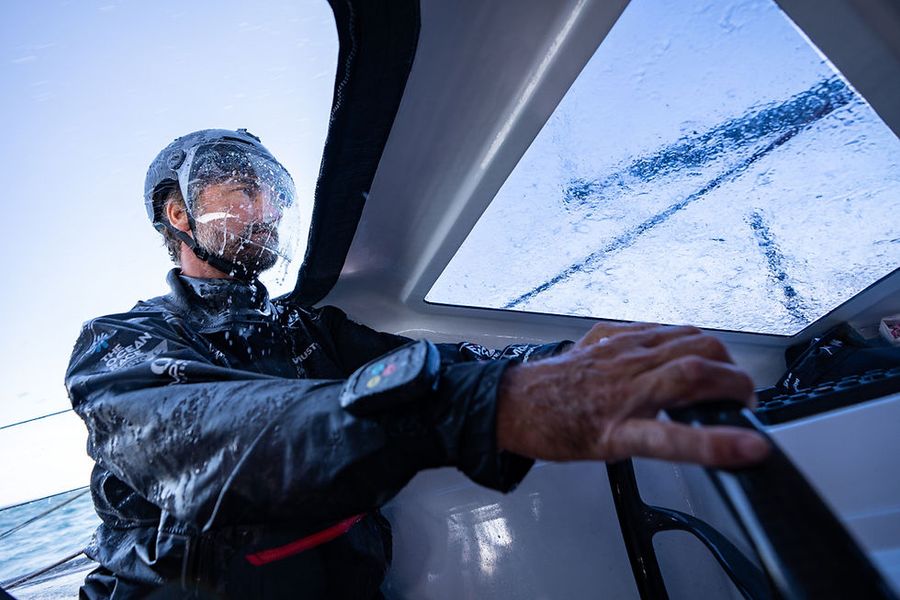
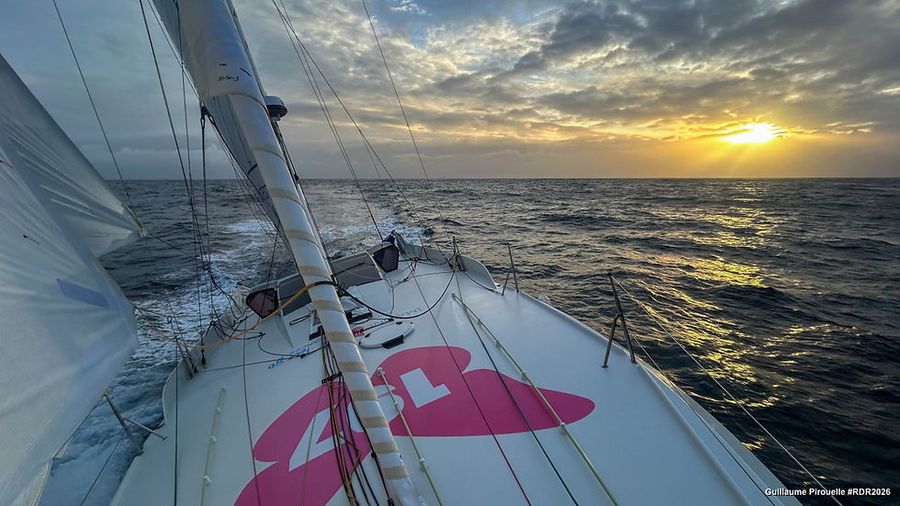
Four days after the fleet left Saint-Malo, the Route du Rhum - Destination Guadeloupe has turned into a weather puzzle. The trade winds have gone missing, shorts remain at the bottom of the bag, and between two depressions, unpredictable squalls and constantly rewritten routes, all six fleets are moving at their own pace, rarely the one they planned for.
Armel Le Cléac'h, whose capsize aboard Maxi Banque Populaire XI sparked serious concern on Wednesday, was recovered safe and well yesterday afternoon by a Panamanian cargo ship. A huge relief in an edition that has shown little mercy to its sailors so far.
Out front in the Ultim class, Tom Laperche on SVR-Lazartigue still holds a comfortable lead. His problem is an unusual one: working out how much he can afford to slow down. After some fast sailing in relatively kind conditions, the leader is due to meet the first effects of a stormy depression northeast of the Greater Antilles this Thursday evening. Tomorrow he'll need to thread south of the system before turning upwind towards Guadeloupe through a rough, disorganised sea.
"I've never crossed this kind of depression before. I'll need to find the right balance between the theoretically optimal route and what's actually doable on the water. The boat wants to go fast, you have to let it slide, but not too much!" Laperche said. Sail choice is part of that balancing act too. "Above all you need to avoid being overpowered. Sometimes you're a touch undercanvassed and it's frustrating, but when you've got margin, it's easier to live with."
Fatigue is shaping his calls as well. The finish is getting closer, but the scenery is anything but tropical. "Two days from the finish and I'm still in a down jacket, wet-weather trousers and boots!" He was promised the Caribbean. He got Irish Sea weather instead.
Further east, the Azores depression has already begun shaking up the leading IMOCAs and Ocean Fiftys. Corentin Horeau got an abrupt demonstration of the system around 4.30am this morning. "I've just taken a fairly violent squall! I went from 8 to 40 knots in fifteen seconds. I wasn't expecting that at all. I had to bear away to furl the headsail. Thankfully nothing broke," said the skipper of MACSF.
Horeau also had to work through patches of light wind, while Boris Herrmann on Malizia 4, better served, clawed back some of his deficit. He'd held as much as a 230-mile lead yesterday. He's down to 145 now, not exactly cause for alarm, though once you've tasted a big lead, it's hard not to want more of it. The hours ahead will demand a different kind of vigilance, with conditions set to build further and these fast monohulls not always easy to rein in. "The trouble with these boats is that even when you want to slow down, you can't always manage it," Herrmann said.
Basile Bourgnon, aboard the Ocean Fifty Edenred, didn't need to glance at the anemometer to know how rough things had got. "I'm not far off minimum sail area. It's sending it! There's 30 knots average behind the front and in an Ocean Fifty, in that kind of conditions, you don't mess around. The goal isn't to go fast, it's to get through without breaking the boat." The leftover swell from the front made things worse. "It's hitting us from the side, it's horrible. I can't wait to get out of here!"
Tomorrow could bring a brief lull between systems for the leaders of these two fleets, a pause in hostilities rather than a peace treaty. Further deterioration remains possible as the fleet nears the Antillean arc this weekend.
Ashore, with dry feet and coffee close at hand, the routers are tearing their hair out too. Philippe Legros, who works with Léonard Legrand on Sodebo Fifty, summed up the challenge. "We're looking for routes that won't necessarily be optimal, but that are achievable. This is a Route du Rhum without trade winds, so it's particularly tricky."
In Class40, Guillaume Pirouelle on Sogestran-Seafrigo is enjoying a relatively kind sea today. After a windless transition, his chasers picked up better conditions and closed the gap. "I'd built up a bit of a lead, then the gaps tightened right up. It's never pleasant, but it was expected." For now he's savouring small luxuries. "It's nice being able to move around without hanging on at every step, eating better, sleeping more deeply. But that's going to change quickly." Friday brings the 40-footers face to face with the same depression northwest of the Azores, with strong winds, violent shifts and a building sea in store. Depending on their position and the routing option chosen, not everyone will cop the same dose. "Near the centre, you'll need to stay on your toes. After that, you're looking at a day and a half, maybe two days, of difficult conditions."
For the Rhum Mono and Vintage Multi fleets, scattered further across the Atlantic, the equation is different again. Systems are evolving as each boat progresses, and no common strategy is possible. Each position opens its own opportunities, but imposes its own constraints too.
There's one odd detail worth noting. Four days after leaving Saint-Malo, Mathieu Claveau on Inherent-Phare 40 and Stéphane Bodin on Wasabiii are still sailing at roughly the same latitude as the old corsair port itself. Plenty of miles sailed, plenty of manoeuvres made, but barely any progress south. It's hard to find a better illustration of a transat stripped of its usual trade winds, and judging by what the charts are showing, this Route du Rhum - Destination Guadeloupe is far from finished with surprises.