Few things reveal a boatbuilder's true character more clearly than what happens after the sale. When a vessel is out in remote waters, days from the nearest marina, the quality of engineering decisions made years earlier in a factory suddenly becomes very personal. This long-view thinking sits at the core of everything Maritimo does, and it has earned the Gold Coast builder a reputation for producing motor yachts that owners genuinely trust with their lives and their comfort across thousands of nautical miles.
The concept Maritimo describes as "service practicality" is not a marketing phrase. It is a design discipline that begins before a single piece of fibreglass is laid and continues through every stage of the build, the fit-out, and the decades of ownership that follow. Nick Barry-Cotter, Manager at Maritimo's Hope Island Marina, puts it plainly: "Maritimo's design philosophy centres on one key principle: building durable boats that minimise the need for repairs from the outset."
That philosophy rests on a deliberate, experienced commitment to simplicity. Not simplicity as a shortcut, but simplicity as a hard-won engineering choice refined over many decades. "We're big believers in the 'keep-it-simple' principle," said Barry-Cotter. "We stick to tried-and-true designs that we've refined over a very long time." The result is a range of vessels that deliberately avoids overengineered electronic systems and exotic construction techniques in favour of solutions proven across a huge variety of sea conditions and ownership styles.
The clearest structural expression of this thinking is Maritimo's patented liner system, a method of integrating the hull, hardtops, and internal components into a single, coherent structural unit of exceptional strength. Far from being a recent development, this system has been central to the build process for two decades. "The system we developed 20 years ago is still working brilliantly," Barry-Cotter explained. "We've had virtually zero failures, and we just keep refining it to ensure it remains best practice."
That integrated rigidity pays dividends in ways owners feel every day on the water. When hatches, skin fittings, and engine beds are manufactured and installed within such a solid foundation, the whole vessel becomes vibration-free in a way that protects everything aboard, from cabinetry and electronics through to the people sleeping in the aft cabin. "If the boat doesn't vibrate, then cupboards don't fall off the wall and beds don't squeak the whole time," Barry-Cotter adds. "We've put a lot of time into making our driveline and steering systems smooth. Our boats really stand out when it comes to shaft-driven performance." Shaft drive is standard across every Maritimo model, a consistent choice that reflects the brand's preference for proven technology over novelty.
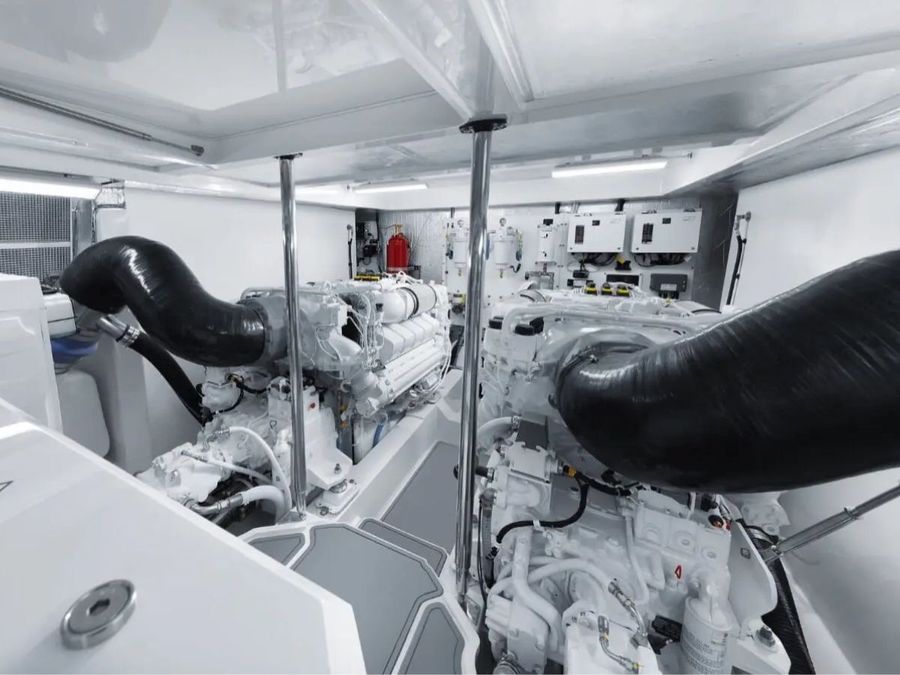
Redundancy is built into the design at every level. All Maritimo vessels run twin engines as standard, and the steering system includes a manual override independent of the primary hydraulic pressure pump. "Even if you lose the pressure pump, the orbital pump in the helm will still let you steer the boat," says Barry-Cotter. "We've had real-world situations where engines failed, but the owner could still steer and manoeuvre using just the rudders." Beyond propulsion and steering, each vessel is divided into three sealed buoyant compartments, each with its own independent bilge system and sealed bulkheads. Should the hull be breached in any one section, the remaining compartments maintain positive buoyancy and the boat stays afloat. For owners cruising long distances in remote regions, this is not an abstract safety feature.
That attention to contingency extends to smaller but equally practical details. Dripless shaft seals are fitted as standard, and spare seals are pre-installed on the shafts themselves. Should debris find its way through a seal on passage, the fix does not require decoupling the shaft and calling for assistance. "As we have the pre-fitted spare shaft seals, should you get debris through the seal, you can swap it without the need to decouple the shaft," said Barry-Cotter. "It's all about thinking ahead and designing for what might go wrong."
Below the waterline, Maritimo uses 316 grade stainless steel exclusively, with all fittings produced in-house and every component fully bonded. Bronze fittings are not used. "We don't use bronze below the waterline. Everything is 316 grade stainless, and everything is bonded," Barry-Cotter emphasised. This approach extends component lifespan considerably and eliminates the risk of stray electrical currents, a concern that is becoming increasingly significant in busy marinas around the world.
The broader maintenance philosophy flows from the same thinking. By aligning every major service requirement to a single annual cycle, engines, gensets, anodes, antifoul and everything else, Maritimo keeps ownership as straightforward as the design itself. The boat is not in the yard more than necessary. It is on the water, doing what it was built for. "The more complex we make it, the more likely it is that something will go wrong," said Barry-Cotter. "We'd rather build a boat that just doesn't need fixing in the first place."
Real-world experience bears this out. One Maritimo owner recently completed a passage from Auckland to Fiji, covering hundreds of nautical miles at an average speed of 7.61 knots. On arrival, the only issue to address was a minor gland problem, one that the vessel's built-in redundancies had already accounted for.
The relationship between Maritimo and its owners does not conclude at the point of delivery. At the Hope Island facility, factory-trained technicians carry out everything from routine annual servicing to comprehensive refurbishments, using the same standard of materials and workmanship applied to new builds. "We've got 15-year-old Maritimos coming back in for rebuilds. We're fitting hydraulic swim platforms, new interiors, and upgraded systems. It's all about keeping those boats alive and modern, using the same quality we'd put into a brand-new build," said Barry-Cotter. This ongoing support does more than keep older vessels relevant. It also protects resale value in a meaningful way, because a Maritimo holds its worth not simply as a luxury product but as a thoroughly maintained, well-supported piece of marine engineering.
In an industry that sometimes equates complexity with innovation, Maritimo's position is straightforward and consistent. Sound design, proven materials, structural integrity, and honest simplicity produce boats that are a pleasure to live with over the long term, reliable on passage, and genuinely hard to break. For owners covering serious distances in serious conditions, that combination is not a luxury. It is the whole point.