The aquarium strain of Caulerpa taxifolia poses a serious ecological threat wherever it establishes itself. Cold-tolerant and vigorous, it can grow rapidly to form dense, smothering monocultures that take over all available seafloor habitat. As it spreads, it strips away the diversity of benthic communities, with consequences that ripple upward through the food web to affect fish and other mobile species. Beyond the ecological damage, the weed creates practical headaches for anyone on the water, tangling easily in fishing gear and boat propellers. In the Mediterranean Sea, fish that feed on Caulerpa taxifolia accumulate toxins within their tissue.
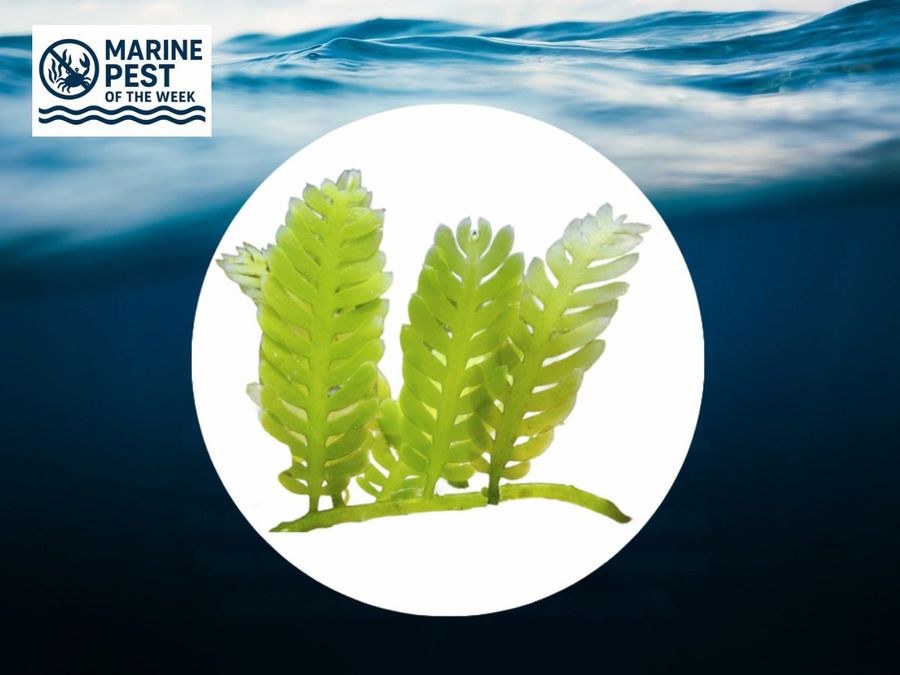
Knowing how to recognise this species is an important first line of defence. The plant is bright green, with fronds that are flattened and feather-like in appearance. Each frond has a smooth central midrib, with branchlets known as pinnules growing at even intervals along both sides. The fronds themselves emerge from a horizontal runner called a stolon, which is secured to the seafloor by root-like structures called rhizoids. In the aquarium strain, individual fronds can exceed 40 centimetres in length.

This pest is not currently known to be present in New Zealand. If you spot anything suspicious, report it to the Ministry for Primary Industries.
For further information on this species, visit the Marine Biosecurity Porthole.
Source: Marine Biosecurity Porthole.