Power management sits alongside fuel and provisioning as one of the genuinely critical considerations for any time spent afloat. Riviera's Electrical Design Manager, Matt Weetman, has put together a practical guide for owners who want to better understand what's happening with their boat's electrical systems, and how to keep those systems in good shape, whether they're out for a weekend or living aboard for an extended period.
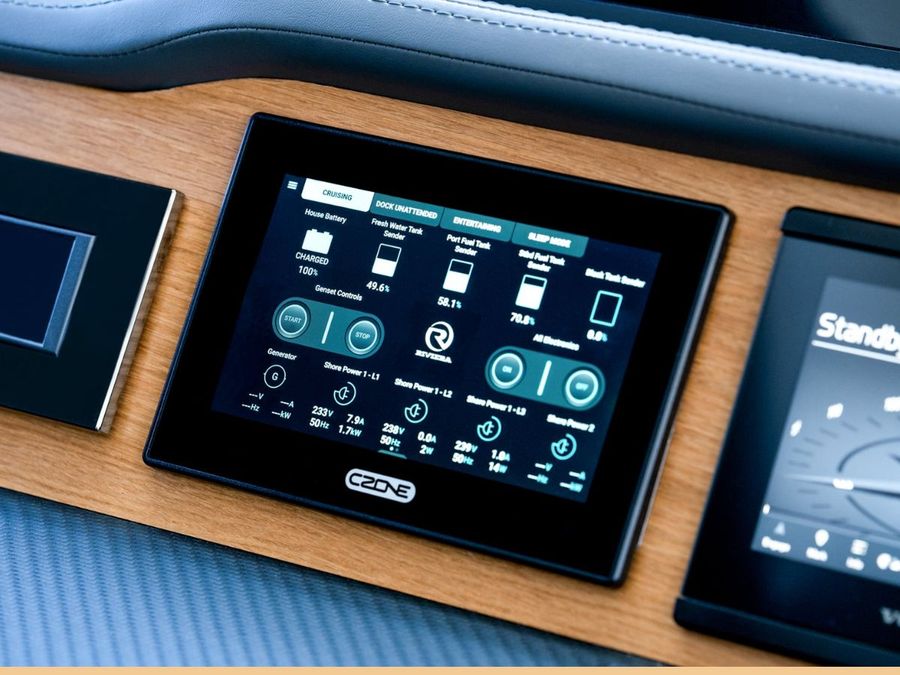
The moment you leave your marina berth, you're essentially operating off-grid. Fuel, food, and water tend to get careful attention before departure, and Weetman's message is straightforward: your electrical power deserves exactly the same level of thought. Everything from refrigeration and lighting to air conditioning and the entertainment system draws from three fundamental sources, namely the battery bank, the generator, and shore power. On a Riviera, as on many contemporary cruising vessels, these are integrated into a unified supply and distribution network monitored through the CZone control system.
Understanding where your power comes from is the logical starting point. House batteries carry the load for essential household functions, including lighting, navigation electronics, refrigeration, and entertainment. CZone tracks their charge state continuously and will alert you when levels fall to a point of concern. Weetman recommends checking battery status at least hourly, even during charging, because the system's demands can shift quickly depending on what's running.
The generator functions as the vessel's own floating power station, delivering AC power to the high-consumption systems that batteries alone can't sustain for long, such as air conditioning, galley appliances, and the cockpit barbecue. It also drives the battery chargers that replenish the house bank. Shore power, when available at a marina berth, should always be connected. The amperage on offer will vary from one marina to another, but regular use of shore power takes pressure off the batteries and keeps the generator from accumulating unnecessary run hours.
Beyond the sources themselves, three transfer systems determine how electricity actually moves around the yacht. The inverter converts DC power from the batteries into AC power, making it possible to run selected outlets, televisions, icemakers, and similar comforts. The trade-off is that inverters draw heavily from the battery bank, so keeping a watchful eye on consumption is important to avoid running reserves down faster than anticipated.
Charging arrives via two separate mechanisms. Alternators, driven by the engines, typically charge each battery bank individually. Battery chargers supplied by shore power or the generator restore capacity across the full bank. Heavy DC usage during a charging cycle, such as repeatedly opening refrigerator doors or running multiple fans, can offset the incoming charge and slow progress considerably.
A battery parallel system rounds out the setup as a safety backstop. Should one battery bank fail, this arrangement allows power to be drawn from another bank to start the generator or keep navigation equipment running in an emergency.
Weetman's practical recommendations for keeping batteries in sound condition are straightforward to follow. Always bring house batteries to a full 100 per cent charge before turning in for the night. Keep inverter use to a minimum when battery levels are already low. Run the generator or remain on shore power for at least half of each day, ideally in four-hour blocks, which supports long-term battery health. Arrange for a Riviera-qualified electrician to inspect the system on an annual basis. At night, activate CZone's sleep mode to eliminate unnecessary drain from systems that don't need to be running.
Weetman's wider point applies regardless of what brand of vessel you own: take the time to genuinely understand how your electrical system behaves under different loads. CZone offers clear diagnostics and real-time information, but there's no substitute for an owner's own familiarity with how things respond when multiple systems are running simultaneously. Good habits, consistent monitoring, and a little planning go a long way toward ensuring that power anxiety never becomes part of the cruising experience.