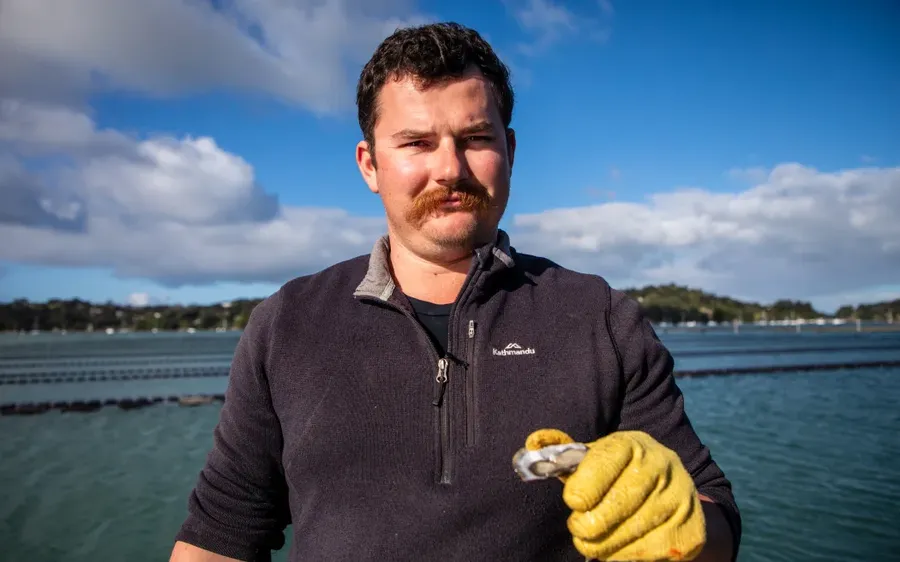
Jim Aitken, owner of Mahurangi Oysters, received an email from Watercare on Thursday advising him of an overflow at its Lucy Moore Memorial Park pump station. According to that email, the pump station overflowed into the stormwater pond at around 2.30pm, and wastewater began entering the Mahurangi River shortly after.
"We believe the overflow was caused by a power surge that tripped our pumps," the email stated. "Unfortunately, this was not flagged by our internal alert system, and we did not discover the overflow until a site visit this morning. The pump station was reactivated, and the overflow stopped about 8am [on Thursday]."
Watercare estimated the overflow at approximately 1200 cubic metres, though it could not confirm how much had reached the harbour.
Aitken left no doubt about what the incident means for his operation. "We're going under, simple as that. I'm now burning through my personal cash flow. I actually advertised this week for another staff member to help us out over Christmas and next year. I've pulled the pin on the whole thing, I can't afford it."
"It's heartbreaking to see New Zealand, once known for clean, green food production, become unsafe because of repeated spills by Watercare. The future we've invested in for our family's legacy and our retirement is going down the drain. Watercare needs to be held to account."
The family-owned farm must now close for 28 days. Aitken said it had 80,000 dozen oysters ready for sale, many of which will have to be dumped.
Tom Walters of Matakana Oysters said his concern reaches beyond his fellow marine farmers to the broader health of Mahurangi Harbour. He believes the accumulation of sewage spills has already inflicted serious damage on the harbour's marine ecosystem. "You'll have oxygen levels depleted and marine organisms that are coming, like snapper that are coming into spawn right now, they'll be affected too."
He raised the alarm about recreational users as well. "Fish, people swimming, kayaking, fishing, boating. It's coming up to that time. We see people out there all the time at the moment bringing boats in. They'll have no idea that they're literally playing in a whole bunch of sewage."
Walters said he had lost faith in Watercare, dismissing its latest apology as "ticking a box." He noted that this spill carried a particular risk not present in earlier incidents, given it occurred during dry weather. "There's no dilution factor here, being a dry weather spill and also a high sewage component. You're not looking at much stormwater being in there, even though that is a stormwater pond. All of it would have been wastewater going in."
With the peak of the oyster season approaching, Walters said he feared for the industry's future in the harbour. He is currently keeping his business viable by sourcing oysters from other areas. "You're just trying to keep the lights on and the doors going until you open back up again."
Mahurangi Oyster Association chairperson Lynette Dunn told Morning Report the overflow had struck at the worst possible moment. "We need financial support from Watercare as this is going to continue happening for the next two years until the new treatment plant is up and running." She said oyster farmers in the area had been battling sewage-related problems for seven years. "So we are just pretty worn out about the whole thing, just the whole non caring about the harbour itself as well."
Dunn warned that repeated discharges risk creating dead zones in the harbour where marine life cannot survive, and said every business operating in the harbour was struggling.

Watercare chief executive Jamie Sinclair confirmed the "significant" wastewater overflow in a formal statement, saying the company had notified Auckland Council's pollution response team and the Ministry for Primary Industries. "We are extremely disappointed and sorry that this has happened, particularly for the impact it is having on the local oyster farmers, who now face a 28-day harvest closure," Sinclair said.
Sinclair noted the frustrating timing, given that recent work on the network had begun to show results. "We had been seeing a positive impact from our recent improvements to the Warkworth wastewater network that had allowed oyster harvesting to resume, so we know this news will be very upsetting to farmers who are nearing the end of their harvest season. I have been in touch with the oyster farmers to convey how disappointed we are, and hope to meet them soon so I can apologise in person on behalf of Watercare and offer our support."
Sinclair confirmed that although the pump station had internal storage, it was overwhelmed, sending wastewater into the adjacent stormwater pond and from there into the river. By Thursday afternoon, crews had pumped the combined wastewater and stormwater from the pond back into the pump station, which was by then operating normally. "We have begun an investigation into what caused the power surge, and to look into why our alarm systems and monitoring didn't work as we'd expect. We are determined to learn from this and ensure we don't face a similar incident in the future."
NZ First MP Jenny Marcroft, who also serves as under-secretary for oceans and fisheries, told Morning Report that Watercare bore a clear responsibility to compensate affected farmers. "Their businesses have been crippled by these ongoing continuous overflow incidents and this latest one is probably going to break some of these oyster farmers' businesses," she said. "At this stage 'sorry' is just not good enough. We have seen some financial support earlier for the oyster farmers, and I do acknowledge that. One of the important things they could do now is actually get their hands in their pockets and find some financial support for these oyster farmers."
Marcroft said the 28-day closure was stripping farmers of their most valuable trading period. "This is when the oysters are their fattest and creamiest, and they feature premium price. Closing down now for 28 days, they will not be able to harvest those beautiful oysters and get top price for them."
She was clear about the constraints facing central government. "In terms of what central government can do, there are no levers that we can use to get money out the door to them. This is a failure of Watercare, which is an organisation owned by Auckland Council. It is their responsibility."