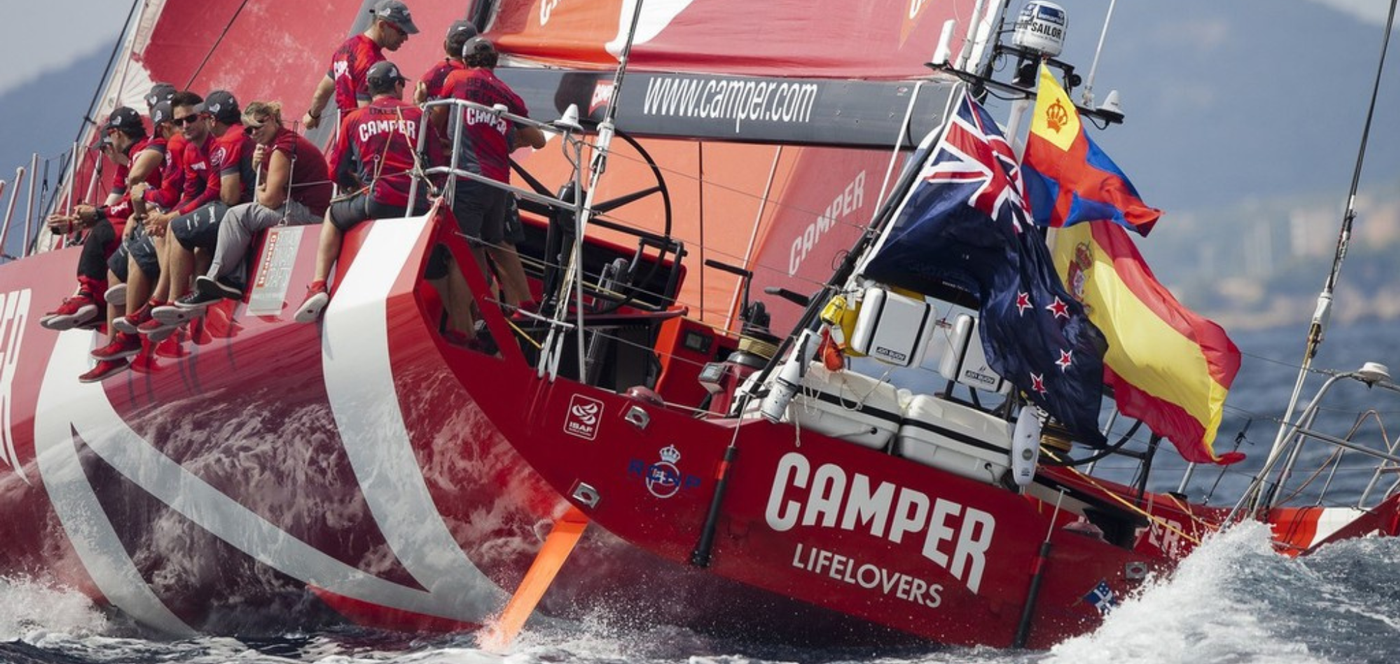
9 August 2010: Construction of the Radical Camper VO70 – Emirates Team New Zealand hit a major milestone in their legendary Volvo Ocean Race campaign. Following months of design scale-testing, the structural construction phase of their high-tech Camper VO70 yacht officially commenced at Cookson Yard in Auckland.
The campaign, and why it existed
When the campaign was confirmed on 12 April 2010, Emirates Team New Zealand Managing Director Grant Dalton announced that the team would enter the 2011-12 Volvo Ocean Race, backed by a new commercial partner: Camper, a Spanish footwear brand with no prior history in ocean racing. Auckland had already been named a stopover port for the race days earlier, a detail that had made a Kiwi entry look likely.
The timing was important. Dalton explained the decision as one shaped directly by the America's Cup calendar. "There is some certainty in the America's Cup following BMW Oracle Racing's defeat of Alinghi," he told Yachting World's Matthew Sheahan. "It's apparent that with the timing of the America's Cup, either 2013 or 2014, ETNZ can comfortably integrate a Volvo campaign into its operations."
It was also about keeping the team's people working. "Our objective was always to diversify, once the team had re-established its credentials, as a means of keeping our people busy, focused and creative," Dalton said. He pointed to a pattern already underway. "With Louis Vuitton, the team started the Louis Vuitton Trophy, Dean Barker and the team campaigned successfully on the Audi MedCup TP52 circuit last year and now we have a Volvo Ocean Race campaign to organise from scratch."
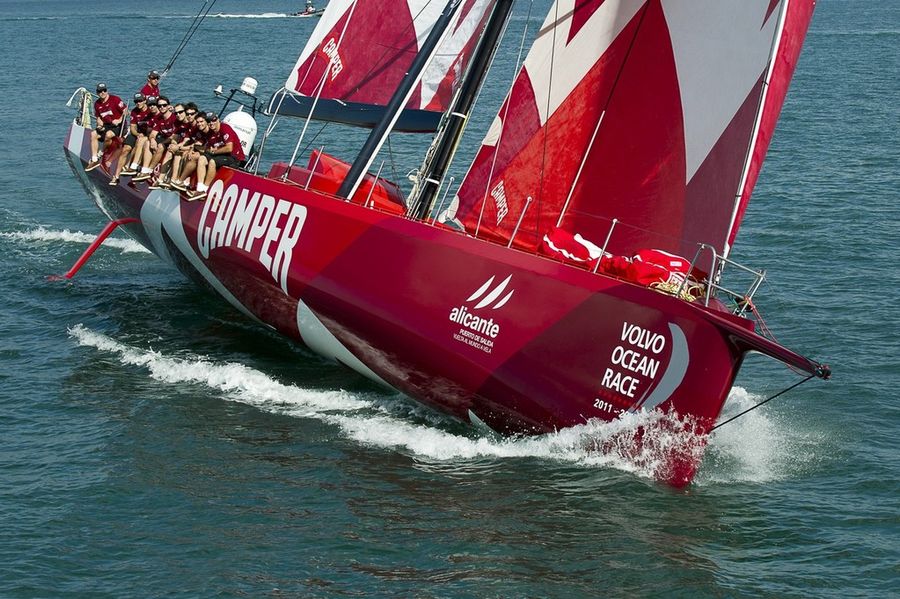
For Camper, the partnership was a first. The Mallorca-based company had been making shoes since 1877, and by 2010 operated 320 stores and shop-in-shop locations across 42 countries, distributed through 2,800 independent retailers. Camper's Project Director for the campaign, Dalia Saliamonas, called the crew announcement "fantastic," adding, as Sail-World's Lucy Harwood noted, when the sailing team was announced that December: "We are incredibly proud to be working with such a talented, experienced and passionate crew, and we are looking forward to the journey ahead."
The goal, on paper, was straightforward: build a Volvo Open 70 capable of racing 39,270 nautical miles around the world, starting in Alicante in October 2011 and finishing in Galway the following July. Getting there meant building a boat from nothing, and doing it inside a year and a half.
The 2011–12 Volvo Ocean Race
| Camper with Emirates Team New Zealand |
Skipper: Chris Nicholson (AUS) Design: Marcelino Botín and the Emirates Team New Zealand design team Built: Cookson Boats, Auckland |
| Abu Dhabi Ocean Racing |
Skipper: Ian Walker (UK) Boat: Azzam Design: Farr Yacht Design Built: Persico, Bergamo, Italy |
| Groupama Sailing Team |
Skipper: Franck Cammas (FRA) Boat: Groupama 4 Design: Juan Kouyoumdjian Built: Multiplast, Vannes, France |
| Puma Ocean Racing |
Skipper: Ken Read (USA) Boat: Mar Mostro Design: Juan Kouyoumdjian Built: New England Boatworks, Rhode Island |
| Team Sanya |
Skipper: Mike Sanderson (NZL) Boat: Sanya, formerly Telefónica Blue Design: Farr Yacht Design Built: King Marine, Valencia |
| Team Telefónica |
Skipper: Iker Martínez (ESP) Design: Juan Kouyoumdjian Built: King Marine, Valencia |
| Race distance | 39,270 nautical miles |
| Ocean legs | Nine |
| In port races | Ten |
| Overall winner | Groupama 4, Franck Cammas |
| Camper | Second overall |
Designing CAMPER
Before a single mould was built, Camper existed only as data. The design was led jointly by Marcelino Botín, principal designer at Botín Carkeek Yacht Design in Santander, and an in-house Emirates Team New Zealand design team headed by Nick Holroyd. Behind them sat a design and engineering group of almost 20 people, naval architects, structural and mechanical engineers, computational fluid dynamics specialists, sail and mast designers and software developers, working across bases in Auckland and Santander.
"We have almost 20 naval architects, structural and mechanical engineers, CFD engineers, sail and mast designers and software developers based at Auckland and Santander working on CAMPER project," Emirates Team New Zealand's Operations Manager, Kevin Shoebridge, told Sail-World's Warren Douglas in July 2010.
Scale models, built in England, were put through 300 tank tests over six days at a high-speed testing facility in Liège, Belgium, checking how competing hull shapes and appendage positions performed against the computer modelling, as first reported in that same Sail-World feature. The sail design team ran further sessions in the wind tunnel at the University of Auckland.
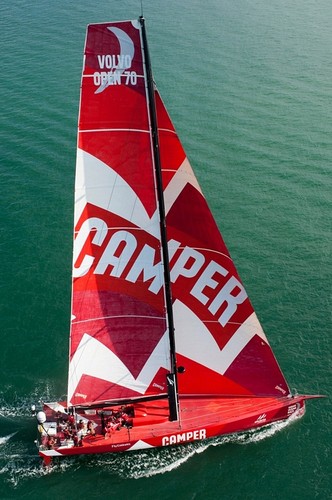
Every part of that process had to work within the Volvo Open 70 rule, a set of design constraints rather than a single fixed design. Any team building to the rule could use glass fibre, aramid fibre or carbon fibre, a material newly permitted for this class after being banned under the previous Volvo Ocean 60 rule. The keel had to be a canting design, able to swing up to 40 degrees, and the finished yacht had to fall within a weight range of 12.5 to 14.5 tonnes. A completed VO70 measured around 21.5 metres long, with a mast standing 31.5 metres tall, close to the mast height carried by an inshore America's Cup yacht of the period.
Camper's livery and graphics were designed by British creative director Mark Farrow, whose work carried the boat's colours from the Cookson shed all the way around the world.
What came next, the Volvo Ocean 65
| VO70 campaign | Campaign budgets had climbed to somewhere between €30 million and €40 million. |
| VO70 boat cost | A fully developed, race ready VO70 cost close to €10 million on the water. |
| VO65 campaign target | Volvo Ocean Race CEO Knut Frostad targeted €12 million to €15 million for a complete campaign. |
| VO65 boat cost | Around €4.5 million for the boat, ready to sail. |
| Mast costs | Under one design production, mast costs were quoted at 30 to 40 percent of the cost of a custom one off. |
| Draft | The VO65 drew 4.7 metres, compared with 4.5 metres for the VO70. |
Why Cookson Boats?
Cookson Boats had been part of Emirates Team New Zealand's story for a decade already, and had built a reputation as one of New Zealand's leading high-performance composite yacht builders.
According to the yard's own history, as documented by boat-building archive Listings Port, Cookson began life in 1974 as TP Cookson Boatbuilders, founded in Glenfield, Auckland, by Terry Cookson, a shipwright who had served his apprenticeship in Liverpool, and his son Mick Cookson. The business started out building timber boats, before moving into composite racing yacht construction from 1979 onward. Over the following decades, Cookson built a reputation strong enough that, between 2000 and 2013, it built all eight of Emirates Team New Zealand's America's Cup yachts, a relationship that kept the yard busy through some lean years for the wider industry. Its resume also included the first Volvo Ocean 60, Virbac, and the yard was capable of building anything from 36 to 100 feet.
Cookson Boats' run as a yacht builder ended in 2014, after Emirates Team New Zealand shifted its America's Cup build programme in-house. The yard closed out its final two projects, a 52-footer and an 80-footer, before winding down.
The build
Construction of the Camper VO70 began on 9 August 2010 at the Cookson yard in Auckland, as planned. What followed was close to nine months of concentrated composite construction. The hull and deck were built from carbon fibre over a Nomex honeycomb core, a construction method Sail-World reported at the time was chosen to produce a hull light but strong enough to handle the rigours of the race. More than 30 tradesmen worked on the project. Early estimates put the labour required at more than 38,000 hours; by the time the boat was finished, the actual figure came in at close to 35,000 man-hours, Sail-World's Warren Douglas reported the following April.
The finished yacht left the Cookson yard at 4.30am on Sunday 10 April 2011, trucked to Emirates Team New Zealand's Viaduct Harbour base for commissioning. Over the following days, her keel, rudder, daggerboards, mast and rigging were fitted, and her electronic, electrical and hydraulic systems brought online.
Grant Dalton, marking the occasion, was in no doubt about what the build team had achieved. "This is a great day for us as a team," he said. "Everyone has worked hard to meet all our deadlines. They have delivered CAMPER on time, just nine months after we first started the build." He added: "To be able to stand back and see the amazing job that they guys have done and now see her in her full livery, is quite humbling."
Camper was sailing on the Waitematā Harbour within days, before heading out on a programme of sea trials up and down New Zealand's east and south coasts, calling at Tauranga, Gisborne, Wellington, Dunedin and Lyttelton through late April and early May 2011. By July, the yacht had been shipped to Europe, ready for the start of the race proper in Alicante.
Skippering her through all of it, from those early sea trials to the finish line in Galway, was Australian offshore veteran Chris Nicholson, backed by a sailing team and shore crew built specifically for the campaign.
Who sailed CAMPER
| Skipper | Chris Nicholson (AUS), a veteran of three previous Volvo Ocean Races before taking the helm of Camper. |
| Watch Captain | Stuart Bannatyne (NZL), the only sailor to have won the race, under its Whitbread and Volvo names, on three different classes of yacht. |
| Navigator | Will Oxley (AUS), a marine scientist by trade, with more than 200,000 nautical miles of ocean racing behind him. |
| Driver / Trimmers | Roberto “Chuny” Bermúdez de Castro (ESP), Adam Minoprio (NZL), Rob Salthouse (NZL) and Tony Rae (NZL). |
| Bow | Mike Pammenter (RSA) and Daryl Wislang (NZL). |
| Pit / Trimmer | Andrew McLean (NZL), who worked as an engineer at Southern Spars New Zealand when not sailing. |
| Media Crew Member | Hamish Hooper (NZL). |
| Shore Manager | Neil Cox (AUS), boat captain of the winning ABN AMRO ONE in the 2005–06 race. |
| Weather Consultant | Roger Badham (AUS), known throughout the sport as “Clouds”, and with Emirates Team New Zealand since 2001. |