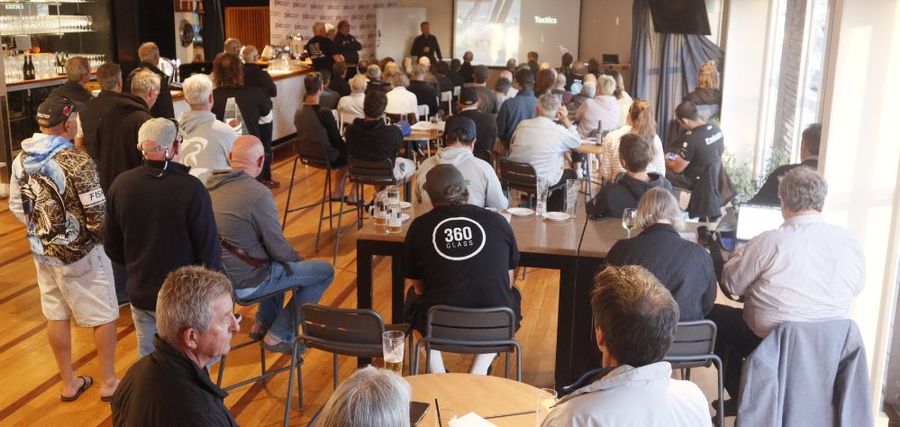
News of a slow race set the tone at tonight’s PIC Coastal Classic Forecast and Tactics Clinic, and Doyle Sails’ Mike Sanderson had sage advice for crews facing a long, light run north.
PredictWind’s Nick Olson spent the first part of the clinic, held at the Royal New Zealand Yacht Squadron, describing the race in store for the 100-boat fleet through Friday and into the early hours of Saturday afternoon. After 2pm on Saturday the race is cut off. If you haven't crossed the finish line by then, your race is over. Unfortunately for all crews racing in this year's PIC Coastal, wind, it seems, will be intolerably light. And skippers will be mindful of that cut off time.
Last year Lucky reached Russell in the small hours of Saturday. With breezes around seven knots on this forecast, nobody is expecting to arrive in Russell that early, let alone to break the race record.
“We expected maybe a little bit better news from you than that,” Sanderson told Olson at the handover.
The Doyle Sails' boss is a Coastal Classic regular and is racing his Shaw 35, Rehab, this year. Plenty of faces in the room had heard his tactics talks before, so instead of dissecting the course he went back over the fundamentals. In light air, he said, “lots of little bits are probably going to make a pretty big difference.”

Weed out the crew
If the forecast holds, Sanderson plans to send his crew WhatsApp group a simple question: who’s excited about racing to Russell in seven knots? Anyone who answers “not me” can drive up in the car.
His reasoning was part psychology, part physics. A reluctant crew member brings the mood down and adds physical weight, and the boat goes better without either. “There are lots of people that won’t want to do this probably,” he said. “So let them have it. It’s that simple.”
Sails get the same treatment. Rehab has a new jib top for the race, but it’s built for 15 knots and up, so it stays in the shed. “Just because you’ve spent good money on something, don’t bring it for the sake of it,” he said. “Hope’s not a strategy.”
He quoted the old line that the only thing you should ever add weight to is a steamroller. He also admitted to quizzing crew who arrive on the dock with a bag fit for a week in Fiji. Does anyone really need sea boots on this forecast? It might sound pedantic, but in light air every kilo shows.
The cost of slime
Sanderson had done some sums that afternoon. A layer of general slime on the hull, he reckoned, adds 20 to 30 per cent to drag. On a boat doing six knots, that’s a drop to five and a half.
Watching from the RIB at the start each year, he sees boats that could have had an extra half-knot all the way to Russell for the price of a quick swim in cold water. Over a long, light race sailed on PHRF, that adds up to a great deal of time.
He backed it up with a story from his BMW Oracle days. BMW spent tens of thousands of dollars filming the team’s Version 5 Cup boat thrashing upwind in 25 knots, for an advert built entirely around power. Then somebody asked the designers how much horsepower the boat was making at that moment. The answer was 18. That was a crushing figure for the marketing people, but it makes sense once an 80-foot yacht is up and running at 10 knots.
“Sailing boats aren’t very powerful pieces of equipment,” Sanderson said. Add drag, and you feel it.
Pace it like a 300-miler
His bigger worry is burnout. Sanderson thinks this race will be decided late, from Sail Rock to the finish. The crews still thinking clearly then will be the ones who kept up their water, sunscreen and sleep. Anyone who has spent a first night offshore trimming the jib for hours knows about the headache that follows.
Kiwi crews, he said, are good at going 110 per cent and then dropping to 40. On a day like this, a boat that holds 90 per cent the whole way will beat them. If you change sails a dozen times between the start and Tiritiri Matangi, you’ll have torn something, worn everyone out and been sworn at, all before the hard part begins.
His suggestion is to prepare as if it were a 300-mile race. On some of the toughest Whitbread legs he sailed, crews got through by accepting that being out there was simply the new normal. “This is life now,” he said. Settle into that, and you sail better and enjoy the people you’re sailing with.
Know where you’re going, and why
Sanderson’s cheat sheet splits the course into six legs: Tiri, Flat Rock, Sail Rock, Tutukākā, Cape Brett, Tapeka and the finish. He notes the bearing and distance to each. With a rough fix on wind direction and heading, he can then tell whether the boat is on the favoured tack or gybe.
The point you’re racing to isn’t always the next mark. It might be where the breeze is expected to fill in, or a spot that keeps the Hen and Chickens out of the way. Steering for Tutukākā makes little sense if the islands are in the road.
He applies the same discipline to the router. The best navigators he’s sailed with always know why the software wants to send them somewhere. Is it current or wind? Is the breeze on the water what the router expects? Which model is matching reality right now?
He also has a 20-degree rule. Sailing within 20 degrees of where you’re trying to go costs very little, so put the code zero or the kite up and sail a few degrees low. Beyond 20 degrees, the price climbs quickly. Boats spearing off across the course are “brilliant for us sailmakers,” he said, but rarely good for the result.
Climbing the ladder
The concept Sanderson leaned on hardest was the ladder rung. Picture a ladder laid across the course, square to wherever you’re racing to; every gain toward that point is a step up. Offshore, with no reliable weather information, gaining rungs is almost always the right call. Chasing puffs, clouds or a patch of pressure only pays if it doesn’t cost you rungs.
It has been his offshore mantra for years. Working through Rehab’s routing this afternoon, it came up again and again. The router kept wanting the boat to wriggle up the course, because that was where the breeze was.
Last year’s race proved the point. Division 1 and 1A was largely decided near the Hen and Chickens. Some boats there were sailing 80 to 90 degrees off course, while those that edged north into the pressure went on to win.
Up the coast
Sanderson stayed away from detailed course calls but shared a few observations. He likes the western shore of Tiri. In the southerly, several routings send boats on the short gybe offshore first, and he urged crews to understand why before following them.
The Hen and Chickens split the fleet every year. Last year four of six routes took his crew outside, and the fleet divided. When routes disagree, work out why; it usually comes down to a narrow band of pressure.
The top third of the course, from around Tutukākā through Cape Brett, looked particularly light on Rehab’s routing. The Brett’s high cliffs will make a westerly interesting, although with enough south in the breeze there can be a good wrap around the corner. At Tapeka Point there’s strong current and acceleration toward the Black Rocks, with a marked difference between inshore and offshore. Depending on when you get there, it’s an area to be played.
“Okay, good luck everyone,” he finished.
The PredictWind toolkit
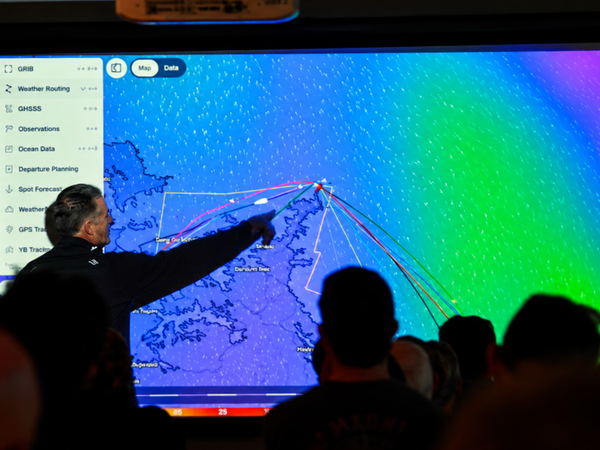
Olson urged crews to set up the observation stations along the coast before Friday. Watching their trend graphs shows whether the breeze is filling along the shore. He called the race “reasonably tricky,” but expected beautiful sailing.
He also demonstrated PredictWind’s new AI routing summary, which reads a routing and explains it in plain language. It runs inside the software and is still mostly geared toward offshore passages, and Olson presented it as a safety tool. Across the routings he had run, finish times varied by around 12 hours.
Before Friday
Simon Hull of the NZ Multihull Yacht Club closed the night. Crews not yet using PredictWind routing can take a free trial and spend the week modelling the race with their own polars. PredictWind has also launched a Man Overboard app, which links crew phones and watches and sounds an alarm if someone goes over the side.
The race tracker has been updated with average speeds and boat-following, and needs a fresh download. The PIC Coastal Classic app carries the sailing instructions, race updates and the tracker link.
In Russell, water taxi tickets must be bought in advance, either online, at the briefing or through the QR codes. Hull asked crews to allow plenty of time getting ashore for prizegiving, to remember where they’ve anchored, and to wear a life jacket if the skipper says so. He also asked for photos and video through the race WhatsApp, since sponsor exposure is what keeps the event running.
PIC Insurance Brokers is in roughly its 17th year as naming sponsor. Doyle Sails is shouting the first 100 people at Thursday’s briefing a burger and a beer from 5.30pm. B&G, marking its 70th anniversary, is funding recycling in Russell and the event’s dolphin permit, and an official rubbish bag comes with the race merchandise. Mount Gay is buying the first round at prizegiving from 6pm Saturday, and Burnsco Westhaven opens at 7am on race day for anything left behind.
Hull’s parting hope was that Thursday’s briefing would bring better news on the weather. The fleet starts on Friday 23 October.